
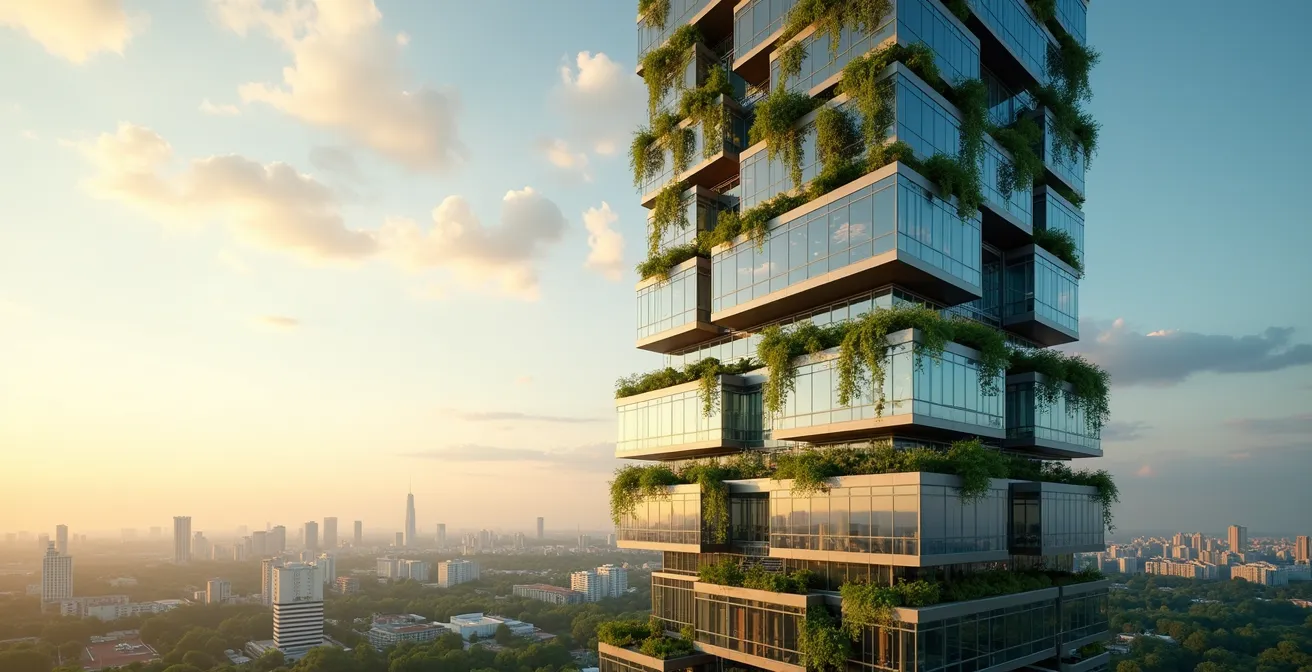
LEED Platinum certification is not an expense but a strategic investment that directly translates to higher net operating income (NOI) and increased asset valuation.
- Certified buildings attract and retain premium corporate tenants who require sustainable workspaces to meet their own ESG goals.
- Advanced energy, water, and ventilation systems significantly lower operational expenditures (OpEx) while de-risking the asset against future utility price volatility.
Recommendation: Integrate certification goals into the earliest stages of a project’s lifecycle to maximize ROI and avoid costly retrofits, positioning your property as a future-proof, high-performance asset.
For any commercial landlord, the central question regarding green building certification is one of pure economics: is the significant upfront capital expenditure (CapEx) justified by the long-term return? The market is filled with anecdotal claims about the benefits of “going green,” often focusing on marketing appeal or environmental stewardship. While these aspects have merit, they don’t provide the data-driven certainty required for a major investment decision. The conversation often circles around vague ideas that tenants “prefer” sustainable spaces, without dissecting the powerful financial mechanics at play.
This analysis moves beyond the platitudes. The decision to pursue a high-level certification like LEED Platinum is not merely about installing solar panels or using recycled materials. It is a fundamental asset management strategy. The real key to understanding the rent premium isn’t found in the environmental benefits themselves, but in how those benefits create a cascade of financial advantages. It’s about risk mitigation, operational efficiency, and attracting a specific, high-value class of tenant that views a building’s performance as an extension of its own corporate identity.
This article will deconstruct the value proposition of LEED certification from a strategist’s perspective. We will examine how local and global standards function, quantify the impact of health and wellness on tenant demand, and analyze the direct reduction in facilities management costs. Ultimately, we will demonstrate that achieving a top-tier certification is one of the most effective ways to future-proof a commercial real estate asset against market and regulatory shifts, ensuring its value and profitability for decades to come.
To provide a clear, analytical framework for this decision, we will explore the critical questions every landlord should ask. The following sections break down the core components of value creation, from regional standard comparisons to the impact of global net-zero initiatives.
Summary: Unpacking the Financial Case for LEED Certification
- Estidama Pearl vs. LEED: Which Certification Matters More in Abu Dhabi?
- The Hidden Health Risk in Buildings Without Proper Ventilation Certification
- How Green Certification Reduces Facilities Management Costs by 20%
- The “Eco-Friendly” Claims That Have No Legal Basis in Construction
- When to Apply for Certification to Avoid Expensive Retrofits
- The “Eco-City” Marketing Trap: What Makes a District Truly Sustainable?
- Why Your AC Is Wasting 30% of Energy and How Smart Thermostats Fix It
- What Is the “Net Zero 2050” Strategic Initiative and How Does It Affect You?
Estidama Pearl vs. LEED: Which Certification Matters More in Abu Dhabi?
While LEED (Leadership in Energy and Environmental Design) is a globally recognized benchmark, a savvy landlord must also master regional standards that can carry significant weight in specific markets. In Abu Dhabi, for instance, the Estidama Pearl Rating System is not just an alternative but a mandatory framework for all new developments. Understanding the nuances between these systems is critical for optimizing an asset’s value. While LEED offers international prestige, Estidama is deeply integrated with local regulations and environmental priorities, focusing on aspects like water conservation, which is paramount in the region.
From an investment perspective, the question isn’t “which is better?” but “which combination creates the most value?” For a building in Abu Dhabi, achieving a high Estidama rating is a baseline for compliance and local relevance. For example, The Sustainable City – Yas Island recently secured the highest possible 5-Pearl rating, signaling top-tier alignment with the emirate’s vision. This local credibility is powerful. Layering a LEED certification on top of this can then broaden the building’s appeal to multinational corporations who use LEED as a global standard for their real estate portfolios. This dual-certification strategy signals both local compliance and international excellence, maximizing the potential tenant pool.
The tangible results of these local standards are compelling. Data from Abu Dhabi shows that buildings designed to Estidama standards demonstrate a 31% reduction in designed energy use and 37% reduction in designed water use compared to conventional buildings. This isn’t just an environmental win; it’s a direct reduction in operational costs that boosts net operating income (NOI) and, consequently, the building’s overall valuation. For a landlord, this demonstrates that aligning with local sustainability mandates is a direct path to improved financial performance.
The Hidden Health Risk in Buildings Without Proper Ventilation Certification
The post-pandemic corporate world has fundamentally shifted its focus toward employee well-being, making a building’s indoor environment a critical factor in leasing decisions. Proper ventilation is no longer a background utility; it is a headline feature that directly impacts a tenant’s ability to attract and retain top talent. Buildings without certified, high-performance ventilation systems now carry a significant hidden risk: they are perceived as less safe, less productive, and ultimately, less desirable. This perception is a direct drag on rental income and asset value.
This paragraph introduces the critical concept of Indoor Air Quality (IAQ) and its impact on tenant perception. To better visualize a space that meets modern expectations, the illustration below showcases an office designed for health and productivity.

As the image suggests, elements like natural light, high-efficiency air circulation, and biophilic design are no longer just aesthetic choices but tangible indicators of a premium, healthy workspace. Certifications like LEED and WELL place a heavy emphasis on these elements, providing a verifiable, third-party endorsement of a building’s superior indoor environment. For a corporate tenant, leasing space in a LEED-certified building is a form of risk management. It helps them assure their employees of a safe return to the office, reducing absenteeism and boosting productivity. This tenant-level benefit is precisely what landlords can monetize.
The financial data confirms this shift. Landlords of certified buildings are not just charging more; they are being rewarded for providing a higher-quality, lower-risk product. In fact, research from CBRE reveals that LEED-certified buildings have commanded a 3% rent premium since the COVID-19 pandemic. This premium is a direct reflection of the increased demand for spaces that prioritize occupant health, demonstrating that investing in superior ventilation and air quality offers a clear and measurable return.
How Does Green Certification Reduce Facilities Management Costs by 20%?
While the prospect of higher rents is a compelling driver for green certification, it only represents one side of the ROI equation. The other, equally powerful, component is the significant and sustained reduction in operational expenditures (OpEx). LEED-certified buildings are engineered from the ground up for efficiency. This isn’t about minor tweaks; it’s a systemic approach to resource management that translates into substantial savings for both tenants (through lower utility bills) and landlords (through reduced common area costs and more predictable facilities management budgets).
The core of these savings comes from optimized energy and water systems. Studies consistently show that certified buildings outperform their conventional counterparts, with documented figures pointing to 25% less energy and 11% less water consumption on average. These efficiencies are achieved through a combination of high-performance insulation, energy-efficient windows, smart HVAC systems, low-flow water fixtures, and often, on-site renewable energy generation. For a landlord, this means lower common area maintenance (CAM) charges and a more resilient asset that is less vulnerable to spikes in utility prices—a key element of asset de-risking.
The level of savings and the corresponding rent premium potential are directly tied to the level of certification pursued. The LEED framework is tiered to allow landlords to match their investment level to their strategic goals, from a basic commitment to market leadership. The following table breaks down how each level corresponds to different benefits, clarifying the strategic choice a landlord faces.
| Certification Level | Points Required | Key Benefits |
|---|---|---|
| Certified | 40-49 | Basic sustainability commitment, foundational energy efficiency |
| Silver | 50-59 | Enhanced performance, moderate cost savings |
| Gold | 60-79 | Comprehensive sustainability, significant operational savings |
| Platinum | 80+ | Leadership in sustainability, maximum efficiency, highest rent premiums |
As this breakdown of the LEED rating system illustrates, achieving Gold or Platinum status signifies a commitment to comprehensive sustainability that delivers the most significant operational savings and, in turn, commands the highest rent premiums. The initial investment in these higher tiers is greater, but the long-term impact on NOI is proportionally larger, making it a calculated decision for long-hold investors.
The “Eco-Friendly” Claims That Have No Legal Basis in Construction
In a market eager to capitalize on the demand for sustainability, the term “eco-friendly” has become ubiquitous—and often meaningless. Many developers engage in “greenwashing,” making vague claims about sustainability that lack the rigor and verification of a formal certification process. For a commercial landlord, it is crucial to understand that these marketing claims have no legal or standardized basis. They do not provide the same level of assurance, risk mitigation, or financial benefit as a credential like LEED. A tenant with a sophisticated ESG (Environmental, Social, and Governance) policy will not be satisfied with a marketing brochure; they require verifiable, third-party data.
This is where the strategic value of a system like LEED becomes clear. It acts as a universal, transparent, and defensible standard. As legal expert Stuart Kaplow notes in the Green Building Law Update, the system’s power comes from its market-driven nature. He points out that LEED was conceived as and thrives as a ‘voluntary’ system not mandated by governments. This voluntary adoption by market leaders is what gives it authority. It is a signal that a building owner has chosen to go above and beyond the minimum legal requirements to deliver a verifiably superior product.
For landlords, this distinction is paramount. Presenting a LEED certificate is not just making a claim; it’s presenting evidence. This evidence protects against accusations of greenwashing and provides the data-rich documentation that corporate tenants need for their own sustainability reporting. In a competitive leasing environment, the ability to provide this proof is a significant advantage. It builds trust and justifies a premium rent in a way that generic “eco-friendly” promises simply cannot.
Action Plan: How to Verify a Building’s Green Credentials
- Third-Party Certification: Demand proof of certification from recognized bodies like LEED, BREEAM, or Estidama and verify its status in their public databases.
- Material Declarations: Request Environmental Product Declarations (EPDs), which provide standardized data on a material’s environmental impact.
- Health Data: Verify Health Product Declarations (HPDs) for interior materials to ensure they are free from harmful chemicals, supporting IAQ claims.
- Performance vs. Projection: Ask for at least one year of actual operational data on energy and water use, not just the initial design projections.
- Certification Details: Confirm the specific certification level (e.g., Gold, Platinum) and the date of issuance to ensure it is current and relevant.
When to Apply for Certification to Avoid Expensive Retrofits
One of the most significant misconceptions about LEED certification is that it’s a plaque you can add to a building after it’s finished. This approach is the single most common cause of budget overruns and diminished ROI. The most critical decision a landlord can make is to integrate certification goals from day one—ideally, before the first architectural sketch is even drawn. Pursuing certification as an afterthought inevitably leads to expensive, inefficient, and sometimes structurally impossible retrofits. It means tearing open walls to improve insulation, redesigning entire HVAC systems, or discovering that the building’s orientation makes passive solar strategies unfeasible.
The concept of the Integrated Design Process (IDP) is central to a successful and cost-effective certification strategy. This collaborative approach brings all stakeholders—architects, engineers, landscape designers, and future building operators—together at the project’s inception. This allows sustainability features to be woven into the very fabric of the building’s design, creating synergies that reduce costs and enhance performance. For example, planning for a green roof early on allows for the necessary structural support to be included in the initial plans, a far cheaper alternative to reinforcing a completed roof.
The image below of a construction site at a foundational stage perfectly symbolizes this principle of early integration, where sustainable infrastructure is part of the building’s core DNA, not a later addition.
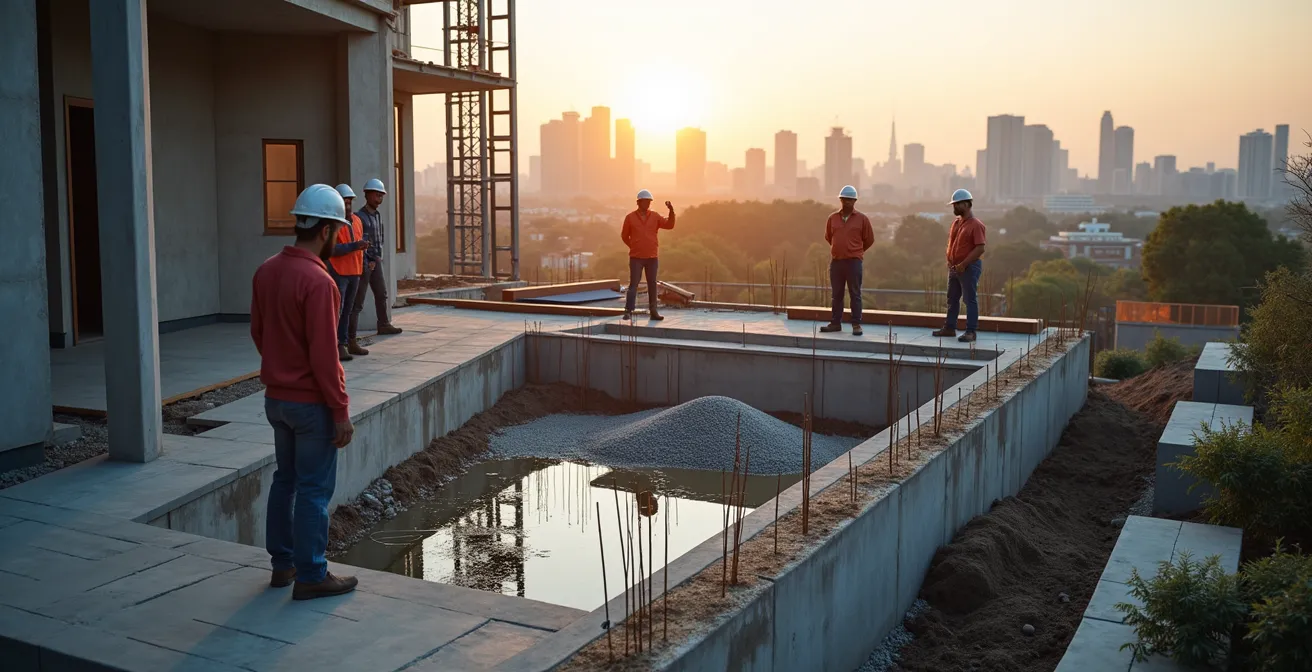
By making the certification a non-negotiable goal from the start, the entire project team can make coordinated decisions that maximize points on the LEED scorecard while minimizing incremental costs. Choosing a site with access to public transportation, orienting the building to maximize natural light, and designing water collection systems are all low-cost, high-impact decisions when made early. Attempting to address these factors later is exponentially more expensive. Ultimately, the cost of certification is not a fixed number; it is a direct function of how early it is incorporated into the project’s lifecycle. An early commitment is the key to unlocking the highest return on investment.
The “Eco-City” Marketing Trap: What Makes a District Truly Sustainable?
A landlord’s asset doesn’t exist in a vacuum. The value and appeal of a LEED-certified building are significantly amplified when it is located within a genuinely sustainable urban district. However, just as individual buildings can be “greenwashed,” entire districts are often marketed as “eco-cities” based on a few token features rather than a holistic, integrated system. A truly sustainable district goes far beyond planting more trees or adding bike lanes. It involves a fundamental rethinking of energy, waste, water, and transportation infrastructure at a macro level.
A prime example of a district-level commitment is Masdar City in Abu Dhabi. This development was conceived from the ground up as a sustainable urban environment. It’s not just a collection of green buildings, but a cohesive ecosystem. For instance, the entire city is powered by renewable resources, including large-scale solar farms. This provides tenants with 100% renewable energy, a powerful selling point for corporations with ambitious carbon reduction targets. Furthermore, the city’s design prioritizes walkability and public transport, reducing reliance on cars and enhancing the quality of life for its inhabitants. These are features an individual building cannot provide on its own.
From a landlord’s perspective, owning an asset within such a district creates a powerful symbiotic relationship. Your LEED Platinum building benefits from the district’s clean energy grid, its advanced waste management systems, and its high-quality public realm. In turn, your building contributes to the district’s overall sustainability profile. For example, Estidama-certified projects within these zones have been shown to achieve a 65% diversion of construction waste from landfills, a metric that contributes to both the building’s and the city’s goals. This synergy creates a compounding value proposition that makes the location itself a premium amenity, justifying higher rents and ensuring long-term asset resilience.
Why Your AC Is Wasting 30% of Energy and How Smart Thermostats Fix It?
For any commercial building, the Heating, Ventilation, and Air Conditioning (HVAC) system is the single largest consumer of energy and, therefore, a primary driver of operational costs. In conventional buildings, these systems often operate inefficiently, running at full capacity even in unoccupied spaces or during periods of low demand. This wastage is a constant drain on the building’s NOI. Modern green certifications, however, mandate the use of smart, responsive HVAC technologies that transform this cost center into a source of operational intelligence and savings.
The core innovation is the shift from a static to a dynamic system. Instead of being programmed on a simple timer, a smart HVAC system uses a network of sensors and data feeds to make real-time decisions. Occupancy sensors detect which rooms are in use, allowing the system to cool or heat only the required zones. Automated window shades are linked to the system, retracting to allow passive heating in the morning and closing to block solar heat gain in the afternoon. The system can even pull in real-time weather data to pre-cool the building before a heatwave, reducing peak load on the grid.
This level of granular control is what unlocks dramatic efficiency gains. A smart thermostat is not just a digital interface; it’s the brain of an integrated system that can reduce a building’s HVAC energy consumption by up to 30%. This directly lowers utility bills, a saving that can be passed on to tenants or used to increase the landlord’s profit margin. Moreover, these systems generate a wealth of data on building usage patterns, which facilities managers can use to further optimize performance and plan for preventative maintenance, reducing long-term capital replacement costs.
Key Takeaways
- Rent premiums are driven by tenant demand for healthy, productive, and ESG-compliant workspaces—all of which are verified by LEED.
- Operational savings from certified energy, water, and HVAC systems directly increase Net Operating Income (NOI) and overall asset valuation.
- Integrating certification goals from the project’s inception is the most critical factor in maximizing ROI and minimizing costs.
What Is the “Net Zero 2050” Strategic Initiative and How Does It Affect You?
The decision to invest in a LEED Platinum building today is not just about capturing current market premiums; it’s about future-proofing your asset against the most significant regulatory and economic shift of our time: the global transition to a net-zero economy. Initiatives like the “UAE Net Zero by 2050” strategy or the European Green Deal are not abstract political goals. They are creating a concrete roadmap that will increasingly penalize inefficient, high-carbon buildings and reward high-performance, sustainable ones.
As governments implement stricter building codes, carbon taxes, and mandatory energy-use disclosures, buildings that are merely “up to code” today will be obsolete and non-compliant tomorrow. This creates a massive financial risk for owners of conventional real estate. These buildings will face the prospect of either costly mandatory retrofits or significant “brown discounts” in valuation as the market prices in their environmental liability. As of 2024, there are already over 195,000 LEED-certified buildings across 186 countries, establishing a clear global benchmark for what a high-performance asset looks like.
A LEED Platinum certification acts as a powerful hedge against this future risk. By already meeting or exceeding the energy performance targets that will likely become mandatory in the coming decades, your asset is insulated from this regulatory obsolescence. It will remain a premium, desirable product in a market where less-efficient buildings become financially and legally burdensome. This long-term risk mitigation is perhaps the most profound, albeit least discussed, component of the certification’s ROI. It ensures the asset’s liquidity and value retention over a multi-decade investment horizon, transforming the building from a passive structure into a resilient and forward-looking financial instrument.
The evidence is clear: the rent premium for LEED Platinum buildings is not an arbitrary market trend but the logical outcome of a superior product that offers quantifiable benefits. It reduces operational costs, mitigates tenant health and safety risks, and future-proofs the asset against a rapidly evolving regulatory landscape. For a commercial landlord, the next logical step is to analyze your own portfolio and development pipeline through this strategic lens. Evaluating your assets against these performance benchmarks is the first step toward unlocking their full financial potential.