
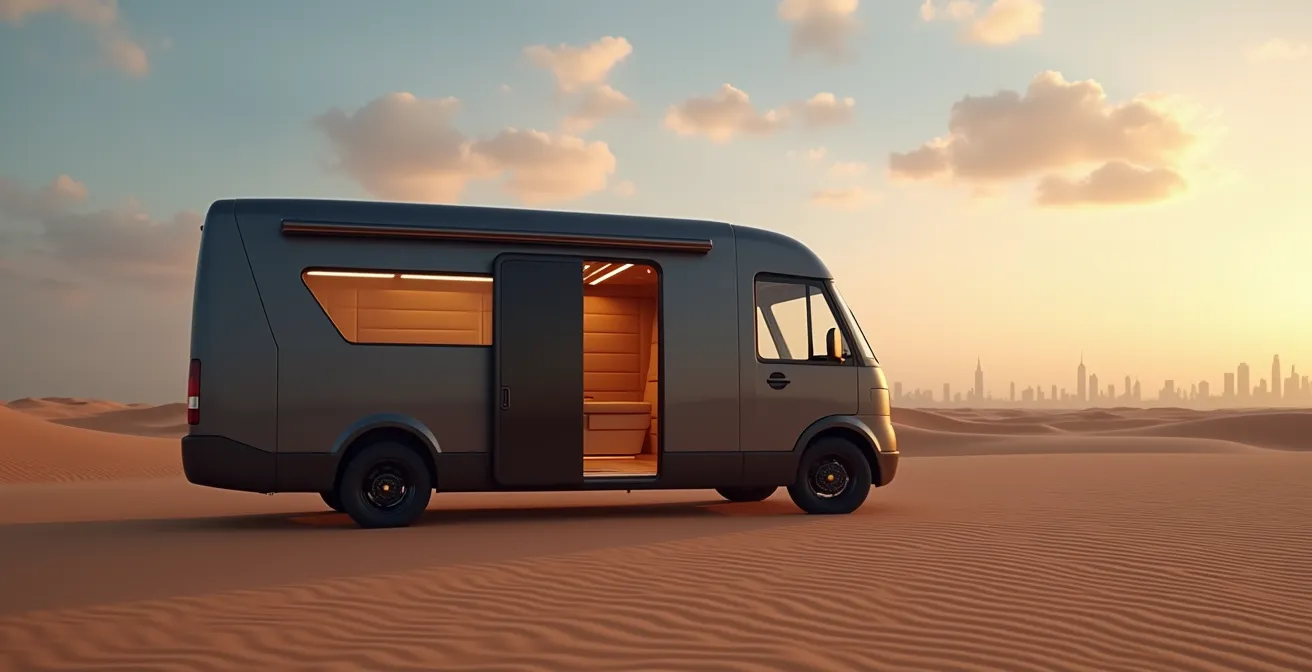
The ultimate status symbol in the UAE is no longer a roaring supercar, but the silent, personalized sanctuary of a custom wellness van.
- Conspicuous consumption is being replaced by “conspicuous self-care,” where control over one’s personal environment is the new currency.
- This shift prioritizes experiences, sustainability, and personal legacy over loud branding and fleeting trends.
Recommendation: Observe how luxury consumption is evolving from owning objects to curating personal ecosystems of well-being.
The familiar image of the UAE’s elite is one intrinsically linked to the gleam of a supercar parked in front of a skyscraper. For decades, the measure of success was loud, fast, and highly visible. But a subtle yet profound shift is underway. The roar of a V12 engine is being replaced by the quiet hum of a bespoke air filtration system. The new frontier of luxury isn’t about public display; it’s about private control. We’re witnessing a pivot from conspicuous consumption to conspicuous self-care.
While the world still associates Dubai with ostentation, the most forward-thinking members of its elite are redefining wealth. They are trading horsepower for headspace, and visibility for vitality. The ultimate luxury is no longer about owning the fastest car, but about possessing a state of perfect personal equilibrium. This has given rise to an unexpected status symbol: the custom wellness van. These are not just vehicles; they are mobile sanctuaries, meticulously designed environments that offer a refuge from the hyper-connected, high-intensity world outside.
This article analyzes this fundamental transformation. Instead of merely listing trends, we will decode the underlying values driving this change. We will explore how this new philosophy of “silent luxury” manifests not only on the road but in boardrooms, in private residences, and in investment choices. The question is no longer “what do you own?” but “how well do you live?”—and the answer is increasingly found in curated, controlled, and deeply personal spaces.
This analysis will guide you through the key facets of this evolution. By examining the tangible shifts in fashion, real estate, technology, and sustainability, we will build a comprehensive picture of what luxury means in the UAE today and where it is headed tomorrow.
Summary: The New Playbook of Elite Status in the Emirates
- Logo-Mania vs Silent Luxury: What to Wear to a Board Meeting in 2025?
- How to secure a “Digital Detox” Vacation in the Most Connected City on Earth?
- Old Dubai vs New Dubai: Which District Defines Modern Sophistication?
- The “Influencer” Aesthetic Error That Devalues Your Personal Brand
- How to Transform Your Villa into a Private Art Gallery Without Overspending?
- Why Buying Vintage Luxury is the Most Sustainable Choice You Can Make?
- Why Your AC is Wasting 30% of Energy and How Smart Thermostats Fix It?
- How to Identify Truly Sustainable Luxury Brands in a Market of Greenwashing?
Logo-Mania vs Silent Luxury: What to Wear to a Board Meeting in 2025?
The first and most visible signal of this luxury evolution is sartorial. The era of “logo-mania,” where value was measured by the visibility of a brand name, is rapidly declining. For the discerning elite, wearing an oversized logo is now seen as a sign of insecurity, not status. The new code is “silent luxury,” a philosophy built on impeccable craftsmanship, superior materials, and timeless design. It’s a language of confidence spoken through the perfect cut of a jacket or the subtle texture of a rare fabric, not the shout of a monogram.
This shift reflects a deeper appreciation for substance over surface. The focus moves from the trend of the season to the story behind the garment. As the Who What Wear editorial team notes in a recent report, “Quality, longevity, and craft matter more than trends.” Brands are responding by highlighting their artisans and heritage. For example, Chanel’s celebration of its 50-year partnership with silk specialist Mantero, or Matthieu Blazy’s collaboration with the 200-year-old tailoring house Charvet for Bottega Veneta, underscores this point. The value is in the heritage craftsmanship, not the logo.
For a 2025 board meeting, the uniform is not about broadcasting wealth, but embodying it. This means unbranded, perfectly tailored pieces from houses known for their materials, like Loro Piana cashmere or Kiton suits. The true status symbol is the knowledge that what you wear is of the highest possible quality, a fact that needs no external validation from a visible brand. It’s a quiet statement of power, understood only by those who share the same values.
How to Secure a “Digital Detox” Vacation in the Most Connected City on Earth?
In a city as relentlessly connected as Dubai, the ultimate luxury is the ability to disconnect. The paradox is that achieving true digital detox requires a highly engineered environment. The elite are no longer just booking trips to remote islands; they are investing in creating pockets of tranquility within their daily lives. This is where the custom wellness van becomes a powerful symbol of the new luxury: a private, mobile space designed for mental and physical restoration.
This paragraph introduces the concept of the custom wellness van. To better understand this, the image below shows a bespoke interior designed as a meditation sanctuary with a view of the city skyline.
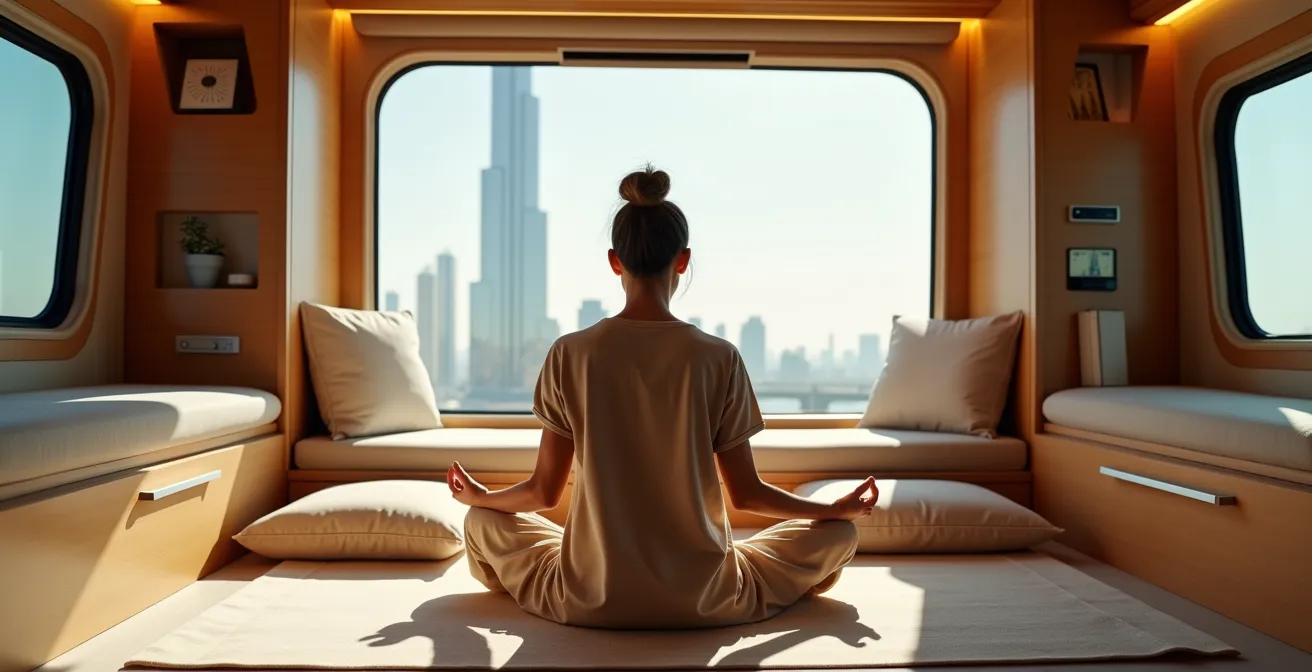
As this visualization demonstrates, these are not campers; they are mobile sanctuaries. They feature meditation spaces, air and water purification systems, soundproofing, and biometric sensors, all without a single distracting screen. It’s an environment engineered for disconnection. This trend scales up to permanent residences, with a growing demand for wellness-focused real estate. It’s no surprise that The Longevity Hub at One&Only One Za’abeel is a massive three-storey wellness sanctuary, indicating the scale of investment in this sector. The goal is to achieve a state of “off-grid” peace, even in the heart of the metropolis.
Securing a digital detox is therefore less about geography and more about technology and design. It’s about curating an environment that actively shields you from digital noise, whether it’s a room in your villa or a custom-built vehicle. This pursuit of personal peace and mental clarity is a core tenet of the new luxury, representing a direct investment in one’s well-being, which is far more valuable than any material possession.
Old Dubai vs New Dubai: Which District Defines Modern Sophistication?
The dichotomy between Old and New Dubai has always defined the city’s narrative. For a long time, “luxury” was exclusively associated with the gleaming towers of New Dubai—the DIFC, the Marina, and Downtown. However, modern sophistication is no longer about choosing one over the other. Instead, it lies in the artful curation of experiences from both, blending the authenticity of heritage with the polish of modernity. The truly sophisticated individual doesn’t live in a bubble of glass and steel; they draw from the city’s full spectrum.
This fusion creates a richer, more textured definition of luxury. It’s about hosting a private dinner on a traditional abra in the Creek, but with a menu curated by a Michelin-starred chef from DIFC. It’s about living in a heritage villa in Jumeirah that has been respectfully extended with a minimalist, modern wing. As the following table illustrates, the most compelling luxury lifestyle now cherry-picks the best attributes from Dubai’s diverse districts, as detailed in a recent comparative analysis.
| Aspect | Old Dubai (Deira, Creek) | New Dubai (DIFC, Marina) | Emerging Creative Hubs |
|---|---|---|---|
| Architecture | Traditional wind towers, souks | Glass skyscrapers, modern towers | Adaptive reuse, industrial-chic |
| Luxury Experience | Heritage hotels, traditional spas | International brands, rooftop lounges | Art galleries, design studios |
| Cultural Authenticity | High – original trading heritage | Low – international aesthetic | Medium – fusion of both |
| Wellness Offerings | Traditional hammams, Arabic treatments | High-tech longevity labs, medical spas | Holistic centers, yoga studios |
The new sophistication is about creating these personalized ‘experiential neighborhoods’. It involves understanding that the most authentic spices for a custom wellness treatment come from the Deira souks, while the most advanced bio-hacking technology is found in a New Dubai clinic. To truly master this, one must:
- Host private dinners on traditional abras with Michelin-starred chefs from DIFC.
- Commission architects to create modern extensions for heritage villas.
- Source spices from Deira markets for custom wellness treatments.
- Book suites in Al Maha Desert Resort for authentic Bedouin heritage wellness.
This curated approach demonstrates a deep, nuanced understanding of the city—a level of connoisseurship that is, in itself, the ultimate status symbol.
The “Influencer” Aesthetic Error That Devalues Your Personal Brand
As silent luxury and authenticity rise, the generic, trend-driven “influencer aesthetic” is facing a sharp devaluation. The curated-yet-impersonal look, once a sign of being on-trend, is now perceived as a liability for a serious personal brand. It signals a lack of original thought and a reliance on fleeting, mass-market validation. This is particularly relevant as the luxury market’s demographics shift. According to an analysis by Simon-Kucher & Partners, consumers under 40 now comprise 40% of the luxury market, and this younger, digitally native cohort is highly adept at spotting inauthenticity.
The core error of the influencer aesthetic is its interchangeability. A perfectly arranged flat lay of branded goods or a photo in a globally recognized “Instagrammable” spot no longer conveys status; it conveys conformity. In a world saturated with identical images, true influence comes from a unique and authentic point of view. It’s the difference between posting from a generic beach club and sharing an experience from a private, undiscovered cove. The former is replicable and therefore holds little value, while the latter suggests access and originality.
For high-net-worth individuals and brands, this means that aligning with the generic influencer look can actively harm their credibility. It creates an aesthetic devaluation. The focus must shift from broad appeal to deep resonance with a specific audience that values substance. As experts from Simon-Kucher advise, the strategy for modern luxury requires a more discerning approach.
The focus should be on fewer bets and better targeting
– Simon-Kucher Partners, Luxury Barometer 2025
This means cultivating a personal brand that is rooted in genuine interests, unique experiences, and a consistent, personal narrative, rather than chasing the algorithm with replicable trends.
How to Transform Your Villa into a Private Art Gallery Without Overspending?
The concept of “silent luxury” extends deeply into the private sphere of the home. For the modern UAE elite, a villa is not just a showcase of wealth but a canvas for personal expression. The old model of simply buying big-name art as a financial asset is being replaced by a more nuanced approach: transforming living spaces into private galleries that reflect a personal journey and aesthetic. This isn’t about overspending on trophies, but about the thoughtful curation of art and design that tells a story.
This paragraph introduces the idea of integrating art into living spaces. The image below provides a visual example of a dining room where a sculptural table serves as a functional art piece, embodying this principle.
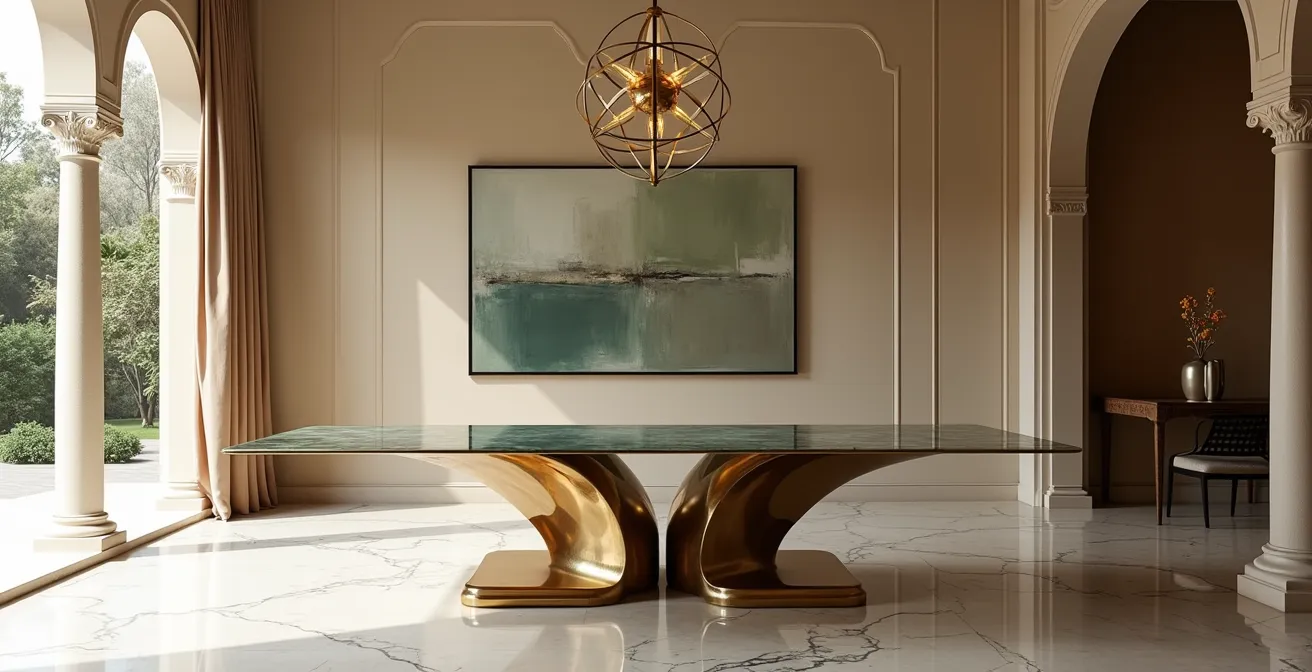
As shown, the key is integration, not just decoration. The most sophisticated interiors now feature functional art, where everyday objects like tables, lighting, or even staircases are commissioned as unique sculptural pieces. This approach blurs the line between art and design, creating a space that is both livable and a work of art in itself. It’s about commissioning a local sculptor to create a dining table rather than buying one from a global luxury brand, or curating a collection of emerging artists from the Alserkal Avenue galleries.
This method prioritizes personal narrative over market value. It’s about building a curated legacy. The collection becomes a reflection of the owner’s taste, travels, and intellectual curiosity. This strategy is also inherently more discreet and personal. It fosters a deeper connection with the objects in one’s home and supports a creative ecosystem of artisans and designers. Ultimately, it transforms the villa from a static display of assets into a dynamic, evolving gallery that is deeply personal and impossible to replicate.
Why Buying Vintage Luxury is the Most Sustainable Choice You Can Make?
In the new luxury paradigm, sustainability is not a marketing buzzword but a core value. However, discerning consumers are wary of “greenwashing” and are seeking tangible ways to make responsible choices. The most powerful and authentic sustainable action in luxury is not buying “new” sustainable products, but investing in vintage. Pre-owned luxury items, from watches to handbags to furniture, represent the pinnacle of circularity and conscious consumption.
The fundamental advantage is clear: vintage pieces carry a story, not a carbon footprint. A vintage Hermès scarf or a pre-owned Patek Philippe watch has zero new embodied carbon, a fact highlighted by recent sustainability analyses. An article on Patra.com’s blog points out that vintage luxury items have zero new embodied carbon, making them an inherently sustainable choice compared to any newly manufactured item, no matter how “green” its production process claims to be. This choice moves beyond corporate promises and becomes a direct, personal contribution to reducing consumption.
Furthermore, investing in vintage champions the very essence of luxury: longevity and craftsmanship. As detailed in a Fashion Times report on the circular economy, leading brands are now establishing buy-back and repair programs, acknowledging that their products are assets designed to last for generations. This model supports the skilled artisans—watchmakers, restorers, and leatherworkers—whose crafts are vital to maintaining the value of these pieces. Buying vintage is a vote for quality over quantity and for enduring style over fleeting trends. It is a choice that is both environmentally responsible and a testament to an appreciation for true, lasting quality.
Key Takeaways
- True luxury status has shifted from material ownership (supercars) to experiential control (wellness).
- “Silent luxury” values craftsmanship, longevity, and personal narrative over visible logos and fleeting trends.
- Sustainability is demonstrated through tangible actions like investing in vintage, not just by trusting brand marketing.
Why Your AC is Wasting 30% of Energy and How Smart Thermostats Fix It?
The ultimate expression of personal sovereignty is the complete control of one’s immediate environment, and in the UAE, this begins with climate. Traditional air conditioning is a brute-force tool, often leading to significant energy waste. The new luxury is about intelligent, responsive climate control—a form of environmental bio-hacking that optimizes for comfort, health, and efficiency. Smart home systems are no longer a novelty; they are an essential tool for curating the perfect personal atmosphere.
The inefficiency of standard AC systems lies in their lack of responsiveness. They cool empty rooms and fail to adapt to changing external conditions or personal needs. Smart thermostats and integrated climate systems solve this by using AI and a network of sensors to create a truly personalized environment. These systems learn your routines, respond to weather forecasts, and can even link to biometric wearables to optimize sleep cycles by adjusting the temperature throughout the night. The responsiveness is key, with advanced service providers like Wayout UAE promising that their smart climate systems can reach any location in Dubai within 30-45 minutes for installation or service.
This level of control goes beyond simple comfort. It’s about creating personalized climate zones within a villa—a cool 21°C for a focused home office, a warmer 24°C for a yoga room, and an optimized temperature profile for the bedroom. Integrating this with circadian lighting systems that mimic natural daylight further enhances well-being. This intelligent environmental control is a discreet but profound form of luxury. It’s an investment in personal performance and health, turning a home from a simple shelter into a high-performance ecosystem.
Action Plan: Smart Climate Optimization for Your Villa
- Link smart thermostats to biometric wearables for sleep cycle optimization.
- Implement AI-powered predictive cooling based on weather forecasts.
- Create personalized climate zones (e.g., 21°C office, 24°C yoga room).
- Install energy dashboards as sophisticated status displays to monitor efficiency.
- Integrate circadian lighting with temperature controls for holistic well-being.
- Set up geofencing for automatic pre-cooling of your home before you arrive.
How to Identify Truly Sustainable Luxury Brands in a Market of Greenwashing?
As sustainability becomes a central pillar of modern luxury, the challenge for the discerning consumer is to navigate a market rife with greenwashing. Many brands use vague environmental claims as a marketing tool without making substantive changes. Identifying truly sustainable luxury requires a shift in perspective: from trusting a brand’s narrative to scrutinizing its actions and business model. It is about looking for evidence of a genuine, long-term commitment to circularity and ethics.
A truly sustainable brand is transparent about its entire supply chain and, crucially, its end-of-life plan for its products. As an editorial in Fashion Times notes, “Consumers increasingly demand transparency, ethical sourcing, and durability from luxury brands.” This means looking for brands that offer robust repair services, buy-back programs, or clear recycling initiatives. A brand committed to sustainability takes responsibility for its products long after the initial sale. It’s also critical to investigate a brand’s policy on unsold goods; the practice of destroying inventory to maintain exclusivity is the antithesis of sustainability.
The materials themselves are another key indicator. Genuine sustainable luxury prioritizes high-quality, natural materials known for their longevity, such as organic cotton, traceable cashmere, and vegetable-tanned leather. The focus is on durability and the potential for the item to have a second or third life. By prioritizing brands that build products to last and take responsibility for their lifecycle, consumers can confidently invest in a luxury that is both ethical and enduring. This informed approach is the only effective antidote to greenwashing.
The evolution from supercars to wellness vans is more than a trend; it’s a declaration of new values. It signifies that for the UAE’s elite, the greatest luxury is no longer what can be shown to the world, but what can be cultivated within. To participate in this new era of luxury is to become a curator of your own well-being, environment, and legacy.
Frequently Asked Questions About Sustainable Luxury
How can I identify greenwashing in luxury brands?
Check if the brand has a clear end-of-life program for products, including buy-back, repair, or recycling. True sustainability addresses the entire lifecycle. Also look for public policies against destroying unsold goods – a common but hidden practice in luxury.
What materials indicate genuine sustainable luxury?
Premium natural fabrics like cashmere, silk, wool, and linen that offer longevity. These materials saw search increases of 614% year-over-year as consumers seek quality over quantity in their luxury purchases.