
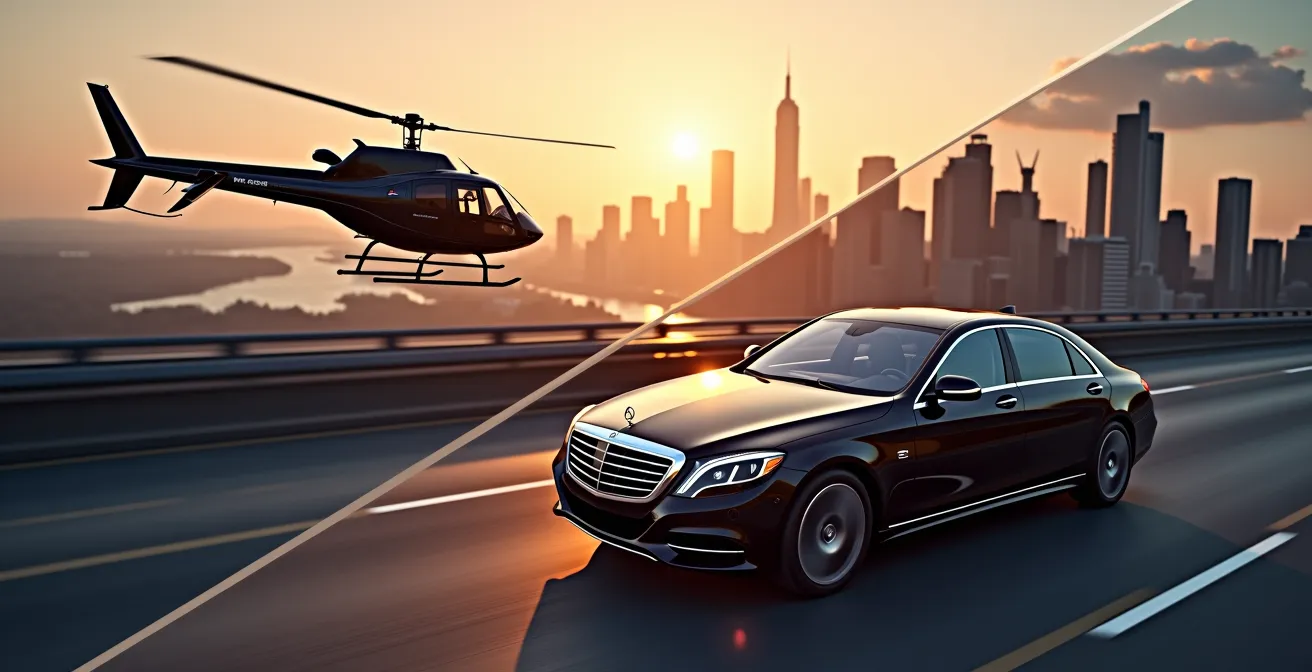
From a pure time-efficiency standpoint, the helicopter’s impressive flight speed is an illusion; the ‘ground friction’ involved in reaching helipads makes a dedicated private transfer superior for most point-to-point urban journeys.
- The total journey time for a helicopter transfer is often dominated by car rides to and from helipads, erasing the aerial speed advantage.
- Helicopter travel introduces significant variables, including a higher statistical risk profile and a greater susceptibility to weather-related cancellations, reducing its predictability.
Recommendation: For executives prioritizing predictable, door-to-door efficiency, a professional chauffeur service is the optimal tool. Reserve helicopter charters for specific scenarios where extreme ground congestion and dense helipad infrastructure invert the time-value calculation.
For the busy executive, time is not just money; it is the fundamental currency of operation. Every decision is weighed against a ticking clock, and transportation is a critical variable in the efficiency equation. The allure of aerial transport, like an Uber Chopper, presents a compelling proposition: soaring above gridlocked traffic to slash travel time. It promises a victory over the city’s most common logistical bottleneck. This promise is often framed as a simple dichotomy between a fast, expensive helicopter and a slow, affordable car.
However, this perspective overlooks the most critical metric for any executive: Total Transit Time (TTT). This is not the 8-minute flight time advertised, but the full duration from the office door to the airport terminal door. Standard analyses often fail to account for the significant ‘ground friction’ inherent in helicopter travel—the car ride to the helipad, the security and check-in procedures, and the final transfer from the landing zone to the actual destination. These hidden time sinks can quickly erode, and even reverse, the perceived time savings of the flight itself.
The central thesis of this analysis is that the helicopter’s speed is a seductive but often misleading data point. When we shift the focus from ‘airborne time’ to a rigorous, door-to-door TTT calculation, the value proposition changes dramatically. This guide will deconstruct the entire journey, comparing the real-world efficiency, predictability, risk, and cost of a helicopter transfer against a dedicated private car service, empowering you to make a decision based on logistical reality, not marketing glamour.
To fully grasp the nuances of this decision, this article breaks down the key factors an executive must consider. From safety protocols and time-saving realities to cost structures and operational limits, each section provides a data-driven look at whether a helicopter or a private car best serves your strategic needs.
Summary: The Executive’s Transport Efficiency Matrix
- Do You Talk to a Limousine Driver in Dubai: Protocol for VIPs?
- The Airport Transfer Mistake That Leaves You Stranded at 3 AM
- The Insurance Clause That Makes Supercar Rentals Risky
- Lease vs Buy: What Makes Sense for Executive Company Cars?
- When to Book Your Chauffeur for New Year’s Eve to Guarantee Availability?
- Taxi or Rental Car: Which is Best for Traveling Between Abu Dhabi and Dubai?
- Buy vs Charter: At What Usage Level Does Owning a Yacht Become Logical?
- How to Charter a Superyacht for the Formula 1 Weekend Without Overpaying?
Do You Talk to a Limousine Driver in Dubai: Protocol for VIPs?
While the title question hints at etiquette, the underlying strategic point for an executive is the value of the human component in their transport logistics. A professional chauffeur is more than a driver; they are a logistical asset. Their role is to provide a seamless, secure, and productive environment. This includes managing luggage, navigating discreetly, adapting to real-time schedule changes, and ensuring the vehicle is a confidential space for calls and work. This level of service provides an unbroken chain of productivity from door to door, a concept we can call point-to-point integrity.
In contrast, a helicopter journey involves multiple, less-integrated service points: a car driver, helipad staff, and a pilot. The pilot’s sole focus is the safe operation of the aircraft, not the passenger’s broader logistical needs. While pilots of commercial services are highly trained professionals, their role is functionally different from a dedicated chauffeur. The safety advantage of this professionalism is clear. As one analysis in a Slate Transportation Safety Study points out, the risk is significantly lower with professionals at the controls:
The governor has a professional pilot, which makes him far safer. Personal helicopters, often operated by inexperienced pilots, crash 18 times as often as commercial helicopter taxis
– Safety Analysis Report, Slate Transportation Safety Study
This confirms that using a commercial service like Uber Chopper is far safer than private operation. However, the service itself remains transactional and segmented, lacking the holistic, personalized management an executive receives from a dedicated chauffeur, whose entire purpose is to facilitate the passenger’s mission. The value isn’t just in the driving; it’s in the seamless ground support that protects an executive’s time and focus.
The Airport Transfer Mistake That Leaves You Stranded at 3 AM
The single biggest mistake in executive transport planning is optimizing for the best-case scenario while ignoring the predictability quotient. A transport solution is only as valuable as its reliability. An airport transfer scheduled for 3 AM must be ironclad, as any failure has cascading consequences. While ground transport faces the risk of traffic or mechanical issues, aerial transport introduces a far more abrupt and non-negotiable point of failure: weather. Fog, high winds, or heavy rain can ground a helicopter fleet with little notice, leaving a passenger stranded without a viable, immediate alternative.
This operational vulnerability is compounded by the illusion of time saved. The advertised flight time is only a fraction of the Total Transit Time. An illuminating case study from a CNN test run of Uber’s helicopter service highlights this ‘ground friction’ perfectly. The reporter’s door-to-door journey from Manhattan to JFK took a total of 55 minutes. The helicopter flight itself? A mere 8 minutes. The other 47 minutes were consumed by ground transfers to and from the helipads and waiting time. This demonstrates that the primary time cost of the journey lies on the ground, a domain where a private car excels with door-to-door service.
Case Study: The Uber Copter Last-Mile Challenge
During a test run reported by CNN, the complete Uber Copter journey from a building in Manhattan to the JFK terminal took 55 minutes. The helicopter flight itself was only 8 minutes long. The vast majority of the time was spent in cars traveling to and from the respective helipads, a clear illustration of the last-mile logistics challenge that erodes the time savings of aerial transport. This “ground friction” is a hidden time cost not present in door-to-door private car services, as confirmed in the detailed review of the service.
General airport operations already face significant disruption; recent airport statistics show a delay rate of 27.63% at a major US airport even before adding helicopter-specific weather constraints. For an executive, the minimal potential time saved by a helicopter is a poor trade-off for such a high degree of uncertainty.
The Insurance Clause That Makes Supercar Rentals Risky
While the context of this title is supercar rentals, the core principle for our analysis is the objective evaluation of risk. For a time-conscious executive, risk is not just about safety; it’s another variable that can disrupt a schedule. From a purely statistical standpoint, the safety profile of helicopter travel is fundamentally different from that of ground transport. While commercial helicopter services are professionally operated and regulated, they operate in a physically less forgiving environment.
The most direct way to assess this is by comparing fatality rates per hour of travel. This data-driven approach removes emotion and focuses on quantifiable risk, a language any executive understands. A private car, especially with a professional chauffeur trained in defensive driving, represents the baseline for low-risk, predictable travel. Helicopter travel, even in a commercial capacity, introduces a statistically higher risk factor. This is a non-negotiable data point in the efficiency equation.

The following table, based on comprehensive safety data, starkly illustrates the difference in risk profiles between transport modes. It quantifies the abstract feeling of risk into a concrete factor that must be included in any time-value calculation.
| Transport Mode | Fatality Rate per 100,000 Hours | Risk Factor |
|---|---|---|
| Professional Helicopter Service | 1.44 | 27x more dangerous than driving |
| Private Car with Professional Driver | 0.054 | Baseline comparison |
| Personal Helicopter (Owner-operated) | 26 | 18x more dangerous than commercial helicopter |
This data, from a detailed analysis of transportation fatality rates, shows that a professional helicopter service is approximately 27 times more dangerous than driving in a car. For an executive and their organization, this increased risk liability, however small in absolute terms, is a significant factor to weigh against the often-illusory time savings.
Lease vs Buy: What Makes Sense for Executive Company Cars?
Pivoting from the “lease vs. buy” framework to our comparison, the core question becomes: does it make more sense to retain a dedicated car service (akin to leasing) or use on-demand helicopters (akin to buying one-off trips)? The answer lies in a cost-benefit analysis that goes beyond the sticker price. The cost of an on-demand helicopter service is not just the fare but also includes the potential for surge pricing and the lack of volume-based discounts available with a retained chauffeur service.
On-demand helicopter services are priced for single, high-value trips. For instance, according to pricing data from The Points Guy, an Uber Copter trip from Manhattan to JFK typically costs between $200 and $225 per person. While this may seem justifiable for a single urgent transfer, the cost quickly becomes prohibitive for an executive requiring frequent, reliable transport. In contrast, a retained chauffeur service offers a fixed, predictable cost structure, allowing for precise budgeting and often a lower per-trip cost for high-volume users.
Furthermore, the logistical limitations of helicopters must be factored into the cost-benefit equation. The service is not a flexible, on-demand tool but is restricted to specific routes between pre-determined helipads. For an executive whose schedule is fluid, this rigidity is a major operational cost. To make an informed decision, a systematic evaluation is necessary.
Your Action Plan: Helicopter vs. Chauffeur Decision Framework
- Calculate True TTT: Map your entire journey door-to-door, including ground travel to/from helipads and buffer time. Compare this with the door-to-door time of a private car.
- Evaluate Frequency vs. Cost: For frequent travel, compare the total monthly cost of on-demand helicopter trips (including potential surge pricing) against the fixed retainer for a dedicated chauffeur service.
- Assess Flexibility & Route Needs: Confirm if your start and end points are efficiently served by the fixed helipad network. If your destinations vary, the point-to-point integrity of a car is superior.
- Factor in the Predictability Quotient: Assign a cost to potential disruption. What is the financial impact of a weather-related cancellation or a significant delay due to ground friction?
- Verify Practical Constraints: Check luggage capacity. Most helicopter services are highly restrictive, often allowing only one personal item and one small suitcase, a critical limitation for business travel.
When to Book Your Chauffeur for New Year’s Eve to Guarantee Availability?
This question highlights a critical advantage of a pre-arranged private transfer: guaranteed availability at a predictable cost. High-demand periods, like New Year’s Eve or major sporting events, expose the volatility of on-demand transport models. Surge pricing, driven by algorithms, can cause costs to skyrocket, making budgeting impossible and service unreliable. An executive cannot afford to be at the mercy of a fluctuating market when a critical meeting or flight is on the line.
While helicopter services may sometimes offer a flat rate—for example, a review noted that Blade’s flat rate to JFK is $195 one way—these can be subject to their own demand-based premiums or simply become unavailable. The volatility can even lead to paradoxical situations, as one case study revealed during a peak holiday travel period.
Case Study: December Holiday Surge Pricing Reality
During the intense travel period of December 23rd, a traveler heading to JFK airport discovered a surprising inversion of costs. As reported by The Outline, at 2:45 p.m., the Uber helicopter option was priced slightly *cheaper* than a standard Uber carpool ride. This anomaly wasn’t due to the helicopter being cheap, but because the ground transport surge pricing had become so extreme that it surpassed the aerial option’s high base price. This case perfectly demonstrates the unpredictable nature of on-demand pricing during peak events, making it an unreliable tool for strategic planning.

Booking a professional chauffeur service in advance decouples the executive from this market volatility. It secures a high-quality vehicle and a professional driver for a pre-agreed price, ensuring logistical certainty. For a busy executive, this predictability is not a luxury; it is an operational necessity. The peace of mind that comes from knowing your transport is confirmed and insulated from demand spikes is a significant, if unquantifiable, benefit.
Taxi or Rental Car: Which is Best for Traveling Between Abu Dhabi and Dubai?
In any transport comparison, speed is an undeniable factor. It is the primary selling point of helicopter travel. From a raw physics perspective, the advantage is clear. Helicopters are not bound by speed limits or road networks, allowing for a much higher average cruise speed. A direct comparison shows that helicopter speed comparisons show they are typically two to three times faster than cars in terms of pure velocity. A helicopter might cruise at 230 km/h while a car on a highway is legally limited to 110-120 km/h, and much less in city traffic.
However, as our analysis has consistently shown, this ‘airborne speed’ is only one component of the Total Transit Time. An executive’s journey does not begin and end at a helipad. The critical error is to mistake cruise speed for journey efficiency. Let’s imagine a 50km cross-city trip. A helicopter might cover the distance in 15 minutes, while a car takes 45 minutes in moderate traffic. On the surface, the helicopter saves 30 minutes.
But this is before we add the ‘ground friction’: * 15-minute car ride to the departure helipad. * 10-minute buffer for check-in and boarding. * 15-minute car ride from the arrival helipad to the final destination.
Suddenly, 40 minutes of ground-based time have been added to the 15-minute flight, bringing the TTT to 55 minutes. The 45-minute car journey is now 10 minutes faster, more comfortable, and involves a single, seamless leg. The helicopter’s raw speed advantage has been completely negated. This simple calculation reveals that for many urban and suburban routes, the point-to-point integrity of a car provides a superior TTT.
Buy vs Charter: At What Usage Level Does Owning a Yacht Become Logical?
Expanding the cost analysis to the broader world of private aviation helps to properly position the helicopter in the executive’s toolkit. It is a specialized short-haul tool, and its charter cost reflects this. While per-seat services like Uber Copter offer one price point, chartering an entire aircraft for privacy and flexibility operates on a different scale. The costs are significant and place it in a category closer to light jet travel than ground transport.
According to industry data, the cost of chartering a private helicopter is substantial and varies by aircraft size and flight duration. As a detailed guide from Simple Flying explains, “A one-hour flight on a helicopter may cost between $1,500 and $5,000 or a half day $7,000 to $15,000, depending on type.” This positions it as a premium service for very specific use cases where its unique capabilities are non-negotiable.
To put this into perspective, we can compare it to the cost of chartering a private jet. A comprehensive charter cost analysis reveals that a private jet can cost from $4,000 to $15,000 per hour. While the helicopter may be cheaper at the low end, its limited range and speed make it suitable only for short hops. The private jet offers far greater range and capability for its price. This comparison shows that a helicopter is not a replacement for a car or a jet, but a niche tool. It is a ‘last-mile’ solution for bypassing specific, extreme chokepoints, not a comprehensive transport strategy.
For an executive, this means the helicopter charter is a high-cost, special-purpose expenditure. It cannot logically replace the daily utility, cost-effectiveness, and flexibility of a retained chauffeur service, which remains the workhorse of executive ground logistics. The helicopter is a scalpel for a specific surgical intervention, not a versatile multi-tool.
Key Takeaways
- The most important metric is ‘Total Transit Time’ (TTT), not flight speed; ground travel to/from helipads often negates any time saved in the air.
- Helicopter travel has a lower ‘Predictability Quotient’ due to high susceptibility to weather cancellations and operational delays.
- From a data-driven perspective, commercial helicopter travel carries a statistically higher risk factor compared to being driven by a professional chauffeur.
How to Charter a Superyacht for the Formula 1 Weekend Without Overpaying?
Having established the limitations of helicopter travel, it is crucial for a balanced analysis to define when it *does* become a logical choice. The answer lies in context. In environments of extreme, predictable ground congestion combined with high-density helipad infrastructure, the time-value calculation can indeed tip in the helicopter’s favor. Major events like the Formula 1 weekend in Monaco or the daily reality of mega-cities with purpose-built aerial networks are prime examples.
In these specific scenarios, the ‘ground friction’ of a car journey becomes so immense that it outweighs the helicopter’s own logistical hurdles. The time saved by flying over hours-long standstills becomes real and significant. A powerful example of this dynamic is the city of São Paulo, Brazil, which boasts one of the world’s most extensive helicopter networks.
Case Study: São Paulo’s Helicopter Network Efficiency
In São Paulo, a city notorious for its traffic, the helicopter is an established and efficient mode of transport for executives. A car trip from the main business aviation airport (FBO) to Guarulhos International Airport can easily take two hours. By helicopter, the same journey takes only a matter of minutes. This efficiency is made possible by a dense network of over 260 helipads across the city, where, as reported by Simple Flying, a helicopter lands every 45 seconds during peak times. This infrastructure is what makes helicopter transport viable, turning a theoretical time-saver into a practical, everyday tool.
This demonstrates the core principle: the viability of helicopter transport is directly proportional to the dysfunction of the ground network and the maturity of the aerial one. For the discerning executive, the helicopter is not an ‘always better’ or ‘never better’ option. It is a specialized tool to be deployed surgically when the data supports it. The default solution for reliable, productive, and safe transport remains the professional chauffeur service. The helicopter is the high-impact alternative for bypassing exceptional and predictable gridlock.
Therefore, the most efficient executive transport strategy involves using a dedicated private transfer as the reliable default, while identifying and reserving helicopter services for those rare, well-defined situations where the unique environmental factors make it the superior logistical choice.