
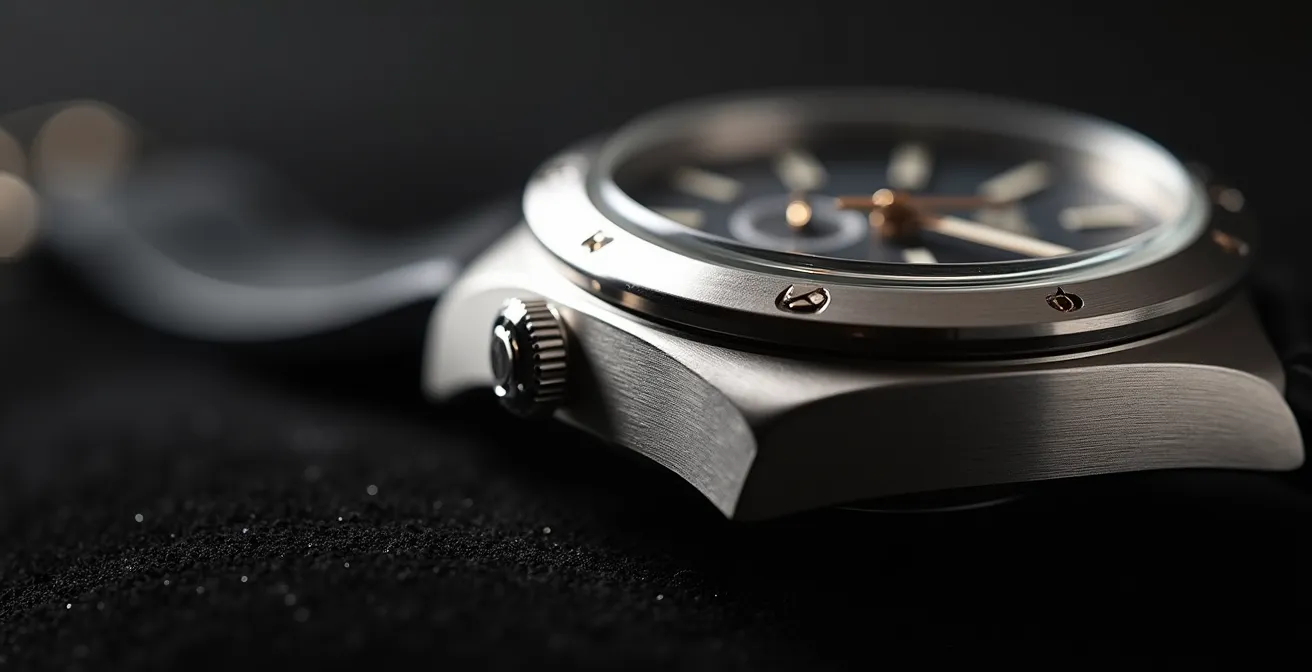
A luxury handbag can outperform gold as an investment, but only when managed with the discipline of a serious financial asset, not as a simple consumer purchase.
- Asset performance is driven by rarity and pristine condition; environmental factors like humidity can completely destroy value.
- Standard home insurance policies are dangerously inadequate for high-value collections, exposing investors to significant financial loss.
- Net returns are heavily impacted by structural costs; sales commissions, insurance premiums, and VAT refund fees must be strategically managed.
Recommendation: Shift from a passive collector’s mindset to an active investor’s framework by rigorously analyzing preservation risks and all associated costs to protect your capital and maximize returns.
For decades, the conventional wisdom for alternative investments centered on assets like gold, art, or real estate. Luxury goods were often seen as frivolous expenditures, not serious financial instruments. Yet, the data reveals a startling trend: certain luxury items have not only held their value but have generated returns that eclipse traditional markets. For instance, between 1980 and 2015, select Hermès bags delivered average annual returns far superior to that of the S&P 500 or gold, transforming them into a legitimate, albeit complex, asset class.
Many collectors are drawn to the allure and status of these items, but they often neglect the critical backend management that defines a successful investment. They might focus on acquiring a hyped piece while overlooking the silent value-killers: improper storage, inadequate insurance, and inefficient sales channels. This oversight is the single greatest risk in treating luxury goods as an investment. A collector buys an item; an investor manages a tangible asset through its entire lifecycle.
The key to success is not simply spotting the next “it” bag or watch. The true advantage lies in adopting a professional framework—what we can term an Asset-Grade Luxury approach. This strategy moves beyond the excitement of the purchase to the disciplined management of the asset. It requires a cautious, analytical mindset focused on preservation, risk mitigation, and maximizing net return. This guide is built to provide that framework, equipping you with the critical knowledge to protect and grow your investments in tangible luxury.
To navigate this complex market, it is essential to understand each component of a professional investment strategy. This article breaks down the key pillars, from analyzing historical performance to mastering the logistics of insurance and sales.
Summary: A Strategic Guide to Luxury Asset Investment
- Handbags vs Gold: Which Asset Has Performed Better Over the Last Decade?
- The Humidity Mistake That Ruins Hermès Bags in Storage
- Why Home Insurance Won’t Cover Your Watch Collection Fully?
- How to Sell Your Luxury Asset at the Peak of the Hype Cycle?
- Auction House vs Private Dealer: Who Takes the Lower Commission?
- How to Ensure Your Custom Piece Retains Value on the Secondary Market?
- Why Buying Electronics Tax-Free Might Void Your Warranty in Europe?
- How to Save 15% on Luxury Watches via the VAT Refund System?
Handbags vs Gold: Which Asset Has Performed Better Over the Last Decade?
When evaluating alternative assets, empirical data must supersede market chatter. While gold is traditionally seen as a safe haven, its performance can be surprisingly volatile and, in some periods, disappointing. In contrast, specific categories of ultra-luxury handbags have emerged as a formidable asset class. A comprehensive study reveals a stark difference in returns: one analysis found that between 1980 and 2015, Hermès Birkin bags averaged 14.2% annual returns, significantly outperforming both the S&P 500’s 8.7% and gold’s inflation-adjusted -1.5% over the same period. This demonstrates that certain tangible goods are not just status symbols but potent investment vehicles.
This performance is not theoretical; it is proven in the auction market. The most coveted pieces achieve staggering prices, cementing their status as “investment-grade” assets. For example, the most expensive handbag sold at auction in 2024 was a Hermès Kelly 25 Himalaya with diamond hardware, which fetched $330,000 at Sotheby’s. Such sales are fueled by extreme rarity, exceptional craftsmanship, and sustained demand from a global collector base. However, it is crucial to note that these stellar returns are concentrated in a very small subset of items; not every luxury bag is a Birkin.
A disciplined investor must analyze these assets with the same rigor they would apply to stocks or bonds. This involves comparing not just potential returns but also volatility and associated costs. The following table provides a clear overview of how top-tier handbags stack up against traditional investment classes, highlighting their unique combination of high returns and relatively low maintenance.
| Asset Class | Annual Return (35-year avg) | Volatility | Maintenance Costs |
|---|---|---|---|
| Hermès Birkin | 14.2% | Low (2.1%-25%) | Minimal (storage only) |
| S&P 500 | 8.7% | High (-36.6% to +37.2%) | Brokerage fees |
| Gold | -1.5% (after inflation) | Moderate | Storage/insurance |
| Chanel Classic Flap | 16% (last decade) | Low (2.5%-5%) | Minimal |
The Humidity Mistake That Ruins Hermès Bags in Storage
The remarkable financial performance of luxury assets is entirely contingent on one non-negotiable factor: pristine condition. Unlike digital stocks, the value of a tangible asset like a Hermès bag can be irrevocably destroyed by environmental negligence. The most common and devastating mistake an owner can make is improper storage, specifically ignoring ambient humidity. For most exotic leathers and materials, a stable environment is paramount. Experts agree that most bag materials are best stored in 30-40% relative humidity. Exceeding this range, especially in a sealed space, creates a perfect breeding ground for mildew and mold, which can cause permanent staining, odor, and structural damage to the leather.
Achieving this “Condition Alpha”—the value premium derived from perfect preservation—requires a deliberate and proactive storage strategy. It is not a passive activity. Stacking bags, using plastic containers that trap moisture, or failing to properly clean the interior before storage can all lead to degradation. The goal is to create a stable micro-climate that protects the asset from light, dust, pressure, and, most importantly, humidity fluctuations.
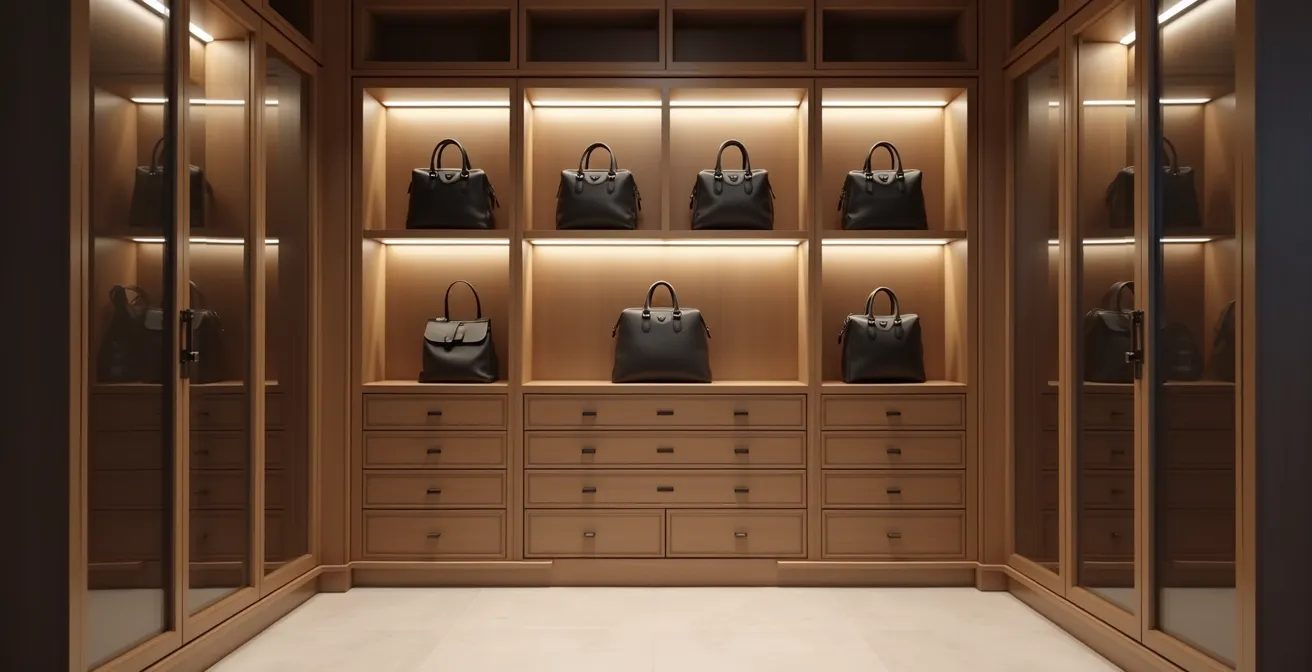
As the image above suggests, professional storage involves more than just putting a bag in its dust cover. It is about creating an environment that actively preserves the asset. This includes ensuring proper air circulation between items and using breathable materials for protection. For serious collectors, investing in a climate-controlled cabinet or storage room with a digital hygrometer is not an extravagance; it is a fundamental part of risk management.
Action Plan: Professional Handbag Storage Checklist
- Ensure a clean start: Before storing, confirm the bag’s surface and interior are completely clean and dry. Even minor residue from lotions or crumbs can cause discoloration or attract moisture.
- Provide adequate space: Use adjustable shelving to allow air to circulate freely between bags. Never stack them, as pressure can leave permanent impressions on delicate leathers.
- Avoid improper stuffing and covers: Never use plastic for stuffing as it traps humidity. Every bag should be in its original breathable dust bag or a cotton cover; avoid plastic containers which cause condensation.
- Monitor the environment: In overly dry climates, a small bowl of water placed nearby (never inside the bag) can help maintain gentle humidity. In humid climates, a dehumidifier is essential.
- Document conditions: Keep a log of your storage environment’s humidity and temperature to demonstrate a history of proper care, adding to the item’s provenance.
Why Home Insurance Won’t Cover Your Watch Collection Fully?
One of the most dangerous assumptions a new investor in luxury goods can make is that their collection is adequately protected by a standard homeowner’s or renter’s insurance policy. This is a critical and potentially catastrophic misunderstanding of how these policies work. For high-value, portable items like jewelry and watches, standard policies have strict sub-limits on coverage. An analysis of typical policies shows that most provide minimal coverage for luxury watches, typically capping at $1,000-$5,000 per item. This means if your $50,000 timepiece is stolen or lost, your policy might only reimburse you for a tiny fraction of its actual worth.
Furthermore, the scope of coverage is often narrow. Standard policies may cover theft from your home but will likely not cover “mysterious disappearance”—for instance, if a watch simply goes missing while you are traveling. As the insurance experts at Jewelers Mutual point out, the protection you think you have is often an illusion:
Likely not to the extent you need it to. Homeowners policies typically don’t provide comprehensive coverage for watches—and many standard homeowners policies don’t even cover common risks for watches, including loss and damage. So if your watch flies off your wrist while you’re bungee jumping, a standard homeowners policy may not fully reimburse you for the loss.
– Jewelers Mutual Insurance, Watch Insurance Coverage Guidelines
A prudent investor must view specialized insurance not as a cost, but as a vital mechanism for capital preservation. These dedicated policies are designed to cover the full appraised value of your items against a much broader range of risks, including accidental damage, loss, and worldwide travel. The premium, typically 1-2% of the collection’s value annually, is a non-negotiable structural cost of managing an Asset-Grade Luxury portfolio.
| Coverage Aspect | Standard Home Insurance | Specialized Watch Insurance |
|---|---|---|
| Coverage Limit | $1,000-$5,000 per item | Full appraised value |
| Deductible | $500-$1,000 typical | Often $0 |
| Mysterious Disappearance | Not covered | Covered |
| Travel Coverage | Limited/None | Worldwide |
| Appraisal Required | Usually not accepted | Required for items >$20,000 |
| Premium Cost | Included in home policy | 1-2% of watch value annually |
How to Sell Your Luxury Asset at the Peak of the Hype Cycle?
In the world of luxury investments, timing is paramount. While long-term holds on classic pieces can yield steady returns, significant profits can be realized through what can be termed Lifecycle Arbitrage—the strategic sale of an asset at the zenith of its hype cycle. This phenomenon occurs when a specific item experiences a sudden, exponential surge in demand and cultural relevance, driving its secondary market value far above its retail price. A savvy investor is one who can identify the indicators of a peak and execute a sale before the market inevitably cools.
These hype cycles are fueled by a confluence of factors: celebrity endorsements, social media trends, and perceived scarcity. The key is to monitor leading indicators like search volume, mentions in high-fashion media, and a rapid increase in resale asking prices. Waiting too long can mean missing the window of maximum profitability. The goal is to sell into the frenzy, not after it has subsided.
Case Study: The Row’s Margaux Bag Hype Surge
A quintessential example of a hype cycle is the recent surge in value for The Row’s Margaux bag. Initially appreciated for its quiet luxury and craftsmanship, the bag’s profile exploded in 2024 and 2025, earning it the moniker of “the next Birkin.” This was not accidental; it was driven by a focused brand strategy and strong media attention. According to Fashionphile, this surge resulted in a staggering 126 percent increase in resale value, a clear indicator of a market peak. Investors who recognized these early signs and sold during this period were able to capitalize on the peak of the hype, realizing returns that may not be sustainable in the long term.

Identifying the peak is part art, part science. It requires constant market monitoring and a degree of emotional detachment. The temptation to hold on, believing the value will climb indefinitely, is a common pitfall. A cautious appraiser would advise that once an item moves from being a niche collector’s piece to a mainstream trend, the peak is often near. At this point, the risk of a market correction begins to outweigh the potential for further gains.
Auction House vs Private Dealer: Who Takes the Lower Commission?
When the time comes to liquidate a luxury asset, the choice of sales channel is a critical decision that directly impacts your net return. The two primary avenues for high-value items are major auction houses (like Sotheby’s, Christie’s, or Heritage Auctions) and specialized private dealers. Each has a distinct structure for fees and commissions, and the “cheaper” option is not always the most profitable one. Understanding these structural costs is essential for any serious investor.
Auction houses offer unparalleled marketing reach and the potential for record-breaking prices. Events like Heritage Auctions’ Autumn 2024 Luxury Accessories sale, which generated over $2.4 million, attract a global base of competitive bidders. However, this exposure comes at a high cost. Auction houses typically charge a “seller’s commission” and a “buyer’s premium,” which, when combined, can total 20-30% or more of the final hammer price. Furthermore, the sales process is long, often taking 3-6 months from consignment to payment.
Private dealers, on the other hand, offer speed and discretion. They operate on a simpler commission model, typically charging a negotiable 10-20% fee. A sale can be completed in a matter of days, with immediate payment. While a private dealer is unlikely to achieve a world-record price, they provide a guaranteed sale at a fair market rate, free from the uncertainty of a public auction. The transaction is also confidential, which is a significant benefit for many collectors.
The decision depends on the seller’s priorities. The table below, based on industry data, outlines the key trade-offs between these two channels. For a seller prioritizing maximum price potential and willing to accept higher fees and a longer timeline, an auction house may be ideal. For those who value speed, certainty, and lower commissions, a private dealer is often the superior choice.
| Factor | Auction House | Private Dealer |
|---|---|---|
| Commission Rate | 20-30% (seller + buyer premium) | 10-20% negotiable |
| Sale Timeline | 3-6 months (scheduled auctions) | Immediate to 30 days |
| Price Potential | Record-breaking possible | Market rate |
| Privacy | Public sale records | Confidential transaction |
| Payment Terms | 35-45 days post-sale | Immediate or consignment |
| Marketing Reach | Global collector base | Targeted buyer network |
How to Ensure Your Custom Piece Retains Value on the Secondary Market?
Commissioning a custom or bespoke luxury item, whether it’s a unique timepiece or a one-of-a-kind handbag, is the ultimate expression of a collector’s passion. However, from an investment perspective, personalization is a double-edged sword. While it creates a unique piece, it can also drastically reduce its appeal on the secondary market if not executed with extreme care. The key to retaining value lies in balancing personal taste with the brand’s established design language and heritage.
Wildly experimental designs or personalizations that are too specific (such as prominent initials) can make a piece virtually unsellable to a wider audience. As one industry expert noted in the Investment Watch Collectors Guide, a successful custom piece enhances, rather than overwrites, the brand’s identity:
The strongest custom pieces respect the brand’s design DNA while adding personal touches. A custom Patek Philippe that maintains the brand’s aesthetic language will outperform wildly experimental designs.
– Industry Expert Analysis, Investment Watch Collectors Guide
To protect the investment value of a custom piece, a strategy of provenance diligence is crucial from the very beginning. This means not only choosing the right maker but also meticulously documenting the entire creation process. This documentation—from original sketches and correspondence to certificates of authenticity—becomes an integral part of the asset’s value, proving its origin and unique story. The focus should always be on the quality of execution over the quantity of embellishments.
Here are several key strategies to maximize the future resale value of a custom luxury asset:
- Commission from established makers: Work with independent artisans or brands with a strong, proven reputation and secondary market presence, such as F.P. Journe or Philippe Dufour in the watch world.
- Document the creation process: Keep a complete file of original sketches, photos of the work in progress, and all correspondence with the artisan. This narrative adds immense value.
- Obtain direct certification: A certificate of authenticity issued directly by the maker is non-negotiable.
- Prioritize quality over flash: The value lies in the superlative quality of the craftsmanship and materials, not necessarily in the number of diamonds added.
- Retain all original components: If any part of the item is modified, always keep the original parts. A future buyer will almost always want the option to restore it to its factory state.
Why Buying Electronics Tax-Free Might Void Your Warranty in Europe?
Investors often look for arbitrage opportunities, such as buying luxury goods in jurisdictions with lower taxes or favorable exchange rates. While this can be a valid strategy, it introduces significant risks, particularly with items like luxury watches, which are complex electronic or mechanical devices. A common pitfall is purchasing from the “grey market”—a network of unauthorized dealers who sell authentic goods acquired from other regions. While the price may be attractive, these items often come with a critical flaw: a voided manufacturer’s warranty.
Manufacturers, especially in Europe, structure their warranties by region. A warranty is typically only valid in the region where the product was originally intended to be sold by an authorized dealer. When you buy a watch from a grey market dealer, it may have been imported from Asia or the Middle East. If a problem arises, an authorized service center in Europe may refuse to honor the warranty, leaving you with a very expensive repair bill. This risk completely negates any initial savings from the tax-free or discounted purchase.
This is a perfect example of a hidden structural cost. The perceived “discount” is an illusion if it exposes the buyer to unlimited downside risk in the form of uncovered repairs. True provenance diligence involves verifying not just the authenticity of the item, but also the validity of its accompanying paperwork and warranty in your home region. For a high-value mechanical watch, a valid manufacturer’s warranty is an essential component of the asset’s worth, and its absence should be a major red flag for any cautious investor.
Key takeaways
- Select luxury assets, particularly specific models of handbags and watches, have historically outperformed traditional investments like gold, but this performance is not universal across all luxury goods.
- The value of a tangible luxury asset is inextricably linked to its condition. Active preservation, including controlling storage humidity and securing specialized insurance, is a non-negotiable part of an investment strategy.
- Net return is what remains after all costs are paid. A successful investor must strategically manage structural costs, including sales commissions, insurance premiums, and VAT refund fees, as they can significantly erode profits.
How to Save 15% on Luxury Watches via the VAT Refund System?
For the global investor, leveraging the Value-Added Tax (VAT) refund system is a well-known strategy to reduce the net cost of a luxury purchase. When buying a high-value item like a watch in a foreign country, non-resident travelers are often eligible to reclaim the VAT, which can range from 15% to 25% depending on the country. However, maximizing this refund is not as simple as it appears. The process is fraught with hidden fees that can dramatically reduce the amount you actually receive.
The primary issue lies with third-party VAT refund processors. While they offer convenience, their business model relies on taking a significant cut of your refund. These companies charge high commission rates and often use unfavorable currency exchange rates, a combination that can result in fees that consume up to 30% or more of your eligible refund. An investor who expects a 20% VAT return might be dismayed to find they only receive 14% back in their pocket. This erosion of savings is another critical structural cost that must be actively managed.
To truly maximize your savings, a more hands-on approach is required. The goal is to minimize the involvement of intermediaries and be strategic about where and how you purchase and process your refund. For a serious investor, a 6% difference on a $20,000 watch is over a thousand dollars—capital that is better off in your portfolio. The following strategies can help you secure a much higher portion of your entitled VAT refund:
- Compare net prices: Research and compare the final price after the estimated VAT refund across different luxury shopping hubs like Dubai, Geneva, and London.
- Use airport-direct refund desks: Whenever possible, process your refund directly at airport customs desks rather than using third-party agencies in the city.
- Seek in-house systems: Some large luxury retailers or department stores have their own, more efficient refund systems with lower fees.
- Pay with a no-fee card: Use a credit card that does not charge foreign transaction fees to avoid another layer of hidden costs.
- Time purchases with exchange rates: If possible, make large purchases when the exchange rate is favorable to your home currency.
To apply this framework effectively, your next step should be a thorough audit of your existing collection’s insurance coverage and storage conditions. Verifying that your assets are protected against physical and financial risk is the cornerstone of transitioning from a collector to a serious investor.
Frequently Asked Questions about Luxury Asset Investing
What is the grey market for electronics?
The grey market consists of authentic products that are sold through distribution channels not authorized by the original manufacturer. These items are often imported from other regions to take advantage of price differences, but they are not illegal fakes.
How does grey market affect warranty?
Manufacturers typically structure their warranties on a regional basis. They often void the warranty for grey market products because they were not sold through an authorized dealer in the intended country. This means a service center in your home country may refuse to perform a free repair.
Can credit card purchase protection help?
Potentially, yes. Some premium credit cards, like the Amex Platinum, offer their own extended warranty or purchase protection benefits that operate independently of the manufacturer’s warranty. This can be a valuable safety net, as these policies often provide global coverage that can bypass regional restrictions imposed by the brand.