

Forget everything you know about standard networking; in Dubai, access isn’t won with business cards, it’s earned through strategic social infiltration.
- High-level connections are forged in closed, high-trust ecosystems, not at open networking events.
- Cultural fluency, particularly the art of patient, indirect communication, is your primary currency.
Recommendation: Shift your mindset from “attending events” to executing a targeted 90-day campaign focused on providing value and hacking access to specific social and cultural circles.
You’ve relocated to Dubai, a global nexus of ambition and capital. Your objective is clear: connect with the decision-makers, the financiers, the family offices that shape the future of this region. The common advice is to attend industry events, join business councils, and perfect your elevator pitch. This is the playbook for the masses, and it will keep you firmly in the outer circle. It is a fundamental misunderstanding of how power and trust operate here.
The real game is played in layers, in private Majlis gatherings, on yachts during the Grand Prix, and within the discreet walls of members-only clubs. Access to these circles isn’t for sale; it is earned. Building a high-level network in Dubai is not a social activity; it is a strategic campaign of social infiltration. It requires you to become a student of culture, a provider of unique value, and a master of discretion long before you ever mention a business deal.
This is not a guide about collecting contacts. This is your 90-day operational playbook to bypass the gatekeepers and earn a seat at the table. We will deconstruct the city’s power dynamics, map its social ecosystems, and provide the tactical tools to navigate them. Your mission begins now: to transform from an outsider into a trusted member of Dubai’s most exclusive circles.
For those who prefer a visual summary, the following video offers a glimpse into the fast-paced world of structured business networking in the UAE, a key component of the broader strategy discussed in this guide.
This guide provides a structured approach to your networking campaign. Each section below is a critical mission, designed to equip you with the intelligence and tactics needed to navigate a specific facet of Dubai’s elite social landscape.
Summary: Your 90-Day Dubai Networking Campaign
- DIFC vs Palm Jumeirah: Where Do the Real Deals Happen After Hours?
- The Conversation Mistake That Will Get You Excluded from Majlis Gatherings
- Why Missing the Abu Dhabi Grand Prix is a Business Strategy Error?
- How to Optimize Your LinkedIn Profile to Attract UAE Royal Family Offices?
- When is the “Golden Month” for Networking Before the Summer Exodus?
- Business Club vs Beach Club: Which Membership ROI is Higher for Networking?
- How to Get into the After-Race Concerts Without a Race Ticket?
- How to Get Approved for a Members-Only Arts Club Without a Proposer?
DIFC vs Palm Jumeirah: Where Do the Real Deals Happen After Hours?
Your first strategic decision is choosing your battleground. Dubai’s power networks are geographically concentrated, and where you spend your time dictates the opportunities you encounter. The two primary poles of influence are the Dubai International Financial Centre (DIFC) and Palm Jumeirah, each with its own distinct culture, industry focus, and networking rhythm. Understanding this dichotomy is fundamental to deploying your time effectively.
DIFC is the heart of institutional capital. It’s a high-density zone of finance, banking, and law, home to a staggering number of global players. According to DIFC’s 2024 anniversary report, it houses 6,920 active companies with a workforce of 46,078, including the world’s most systemically important banks. Networking here is structured, formal, and agenda-driven. The real connections aren’t made in boardrooms but in the exclusive restaurants and lounges within this “city within a city” during power lunches and post-work drinks.
Palm Jumeirah, in contrast, is the hub for new money: tech, crypto, and creative ventures. The atmosphere is relaxed, the dress code is smart casual, and the networking happens at beach clubs, weekend brunches, and private villa parties. Deals here are often more innovative and startup-focused. Choosing between them isn’t about which is “better,” but which aligns with your strategic objectives.
This table breaks down the core differences to help you allocate your resources effectively. Use it to map your targets to the correct environment.
| Aspect | DIFC | Palm Jumeirah |
|---|---|---|
| Primary Industries | Finance, Banking, Insurance | Tech, Crypto, Creative Ventures |
| Networking Style | Formal, Structured | Casual, Relaxed |
| Key Venues | Zuma, LPM, Capital Club | Beach Clubs, Private Villas |
| Deal Type | Corporate, Institutional | Startup, Innovation-focused |
| Best Time | Business Lunches, After-work | Weekend Brunches, Evening Events |
Your strategy should be a portfolio approach: focus 70% of your efforts on the ecosystem that houses your primary targets and 30% on the other to diversify your connections and gather cross-industry intelligence.
The Conversation Mistake That Will Get You Excluded from Majlis Gatherings
Once you are in the right room, your behavior determines if you are invited back. In the context of high-level Emirati circles, particularly in a Majlis setting, the single most critical error a Western executive can make is mistaking silence for awkwardness and patience for weakness. Rushing to fill a conversational gap or pushing directly for a business outcome is a sign of disrespect that will get you silently blacklisted.
This cultural nuance is highlighted by experts in regional business. As the DMCC’s guide to networking notes, patience is a highly valued trait. The guide explicitly advises against rushing discussions. This isn’t just polite advice; it’s a strategic imperative.
Emirati culture highly values patience, so don’t rush business discussions or negotiations.
– DMCC Business Guide, The Guide to Networking for Business in Dubai
The core principle to master is “receptive listening.” Unlike Western “active listening,” which encourages interjections and affirmations, receptive listening means giving the speaker your full, uninterrupted attention. A comfortable silence after someone has spoken is a sign of contemplation and respect, not a cue for you to jump in. It signals that you are weighing their words carefully.
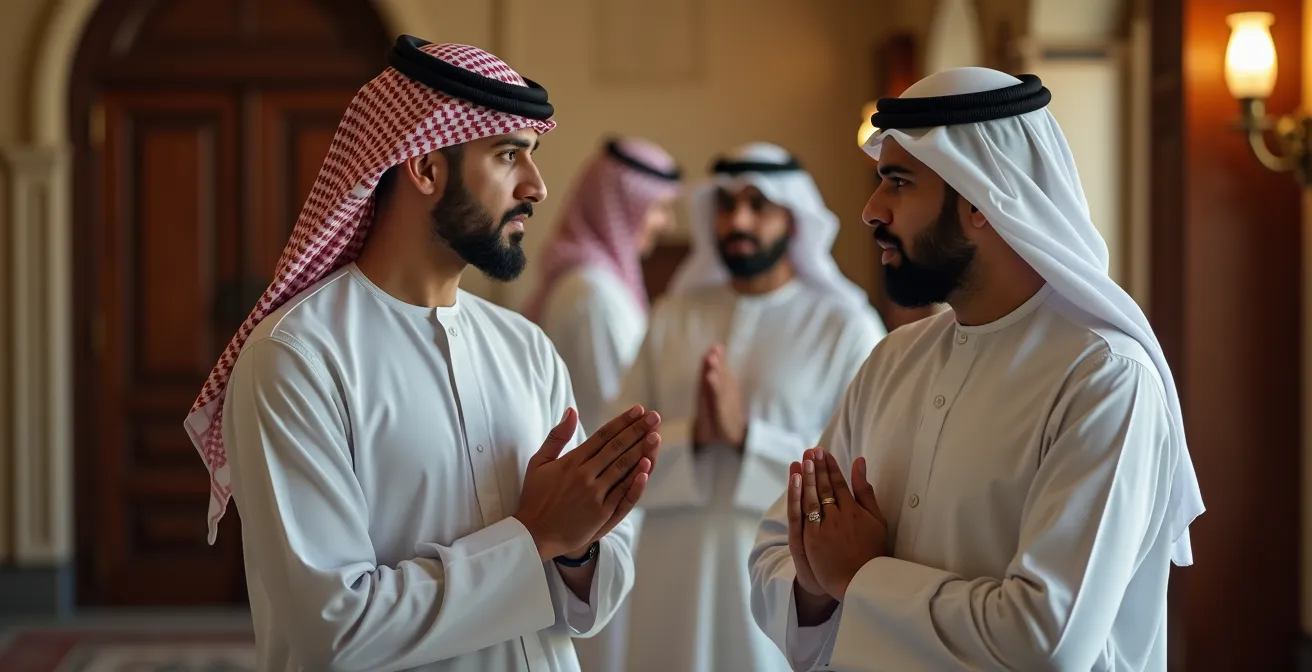
As the visual above suggests, the posture is one of calm and attentiveness. This approach is vital in a city that hosts over 200 nationalities. The most successful networkers understand that their primary job in these settings is to absorb information, show respect, and build trust. Business is a byproduct of a strong relationship, and relationships in this part of the world are built on a foundation of patience and mutual understanding.
Case Study: The Power of Receptive Listening
Dubai hosts over 200 nationalities with varying business customs. Successful networkers practice ‘receptive listening’—giving speakers full, uninterrupted attention rather than ‘active listening’ with frequent interjections. Learning a few Arabic phrases like “Shukran” (Thank you) or “Ahlan wa sahlan” (Welcome) acts as a powerful bridge. Most importantly, understanding that comfortable silence signals respect and contemplation, not awkwardness, is key to being perceived as a thoughtful and trustworthy potential partner.
Your objective in any initial high-level gathering is not to close a deal or even to pitch. It is simply to be invited back. Master the art of silence, and you will be heard loud and clear.
Why Missing the Abu Dhabi Grand Prix is a Business Strategy Error?
You might see the Abu Dhabi Grand Prix as a sporting event. This is a strategic miscalculation. In the UAE, marquee international events are not just entertainment; they are a critical concentration of global power and capital. For one weekend, the highest echelons of regional and international business, from C-suite executives to UHNWIs and family office principals, converge in a single, highly-charged environment. Missing it is not missing a race; it’s missing your single greatest opportunity for high-velocity networking.
The density of influential figures is unparalleled. With the UAE being a central node for global commerce, these events act as powerful magnets for the decision-makers you want to reach. The presence of so many influential figures in a relaxed, high-energy setting breaks down formal barriers and creates unique opportunities for serendipitous encounters that would take months of cold-calling to secure. This is where relationships are accelerated and informal agreements are born.
However, mere attendance is not a strategy. The Grand Prix ecosystem is stratified into distinct access tiers, each offering a different level of networking ROI. Your mission is to understand this hierarchy and execute a plan to ascend it. A general admission ticket places you in the outer circle, while a Paddock Club pass puts you shoulder-to-shoulder with the C-suite. The real game, however, is played on the private yachts in the marina and within the exclusive team hospitality suites.
Your goal is not just to be there, but to be in the right part of “there.” The following hierarchy maps out the different access levels. Your 90-day campaign should include a plan to gain access to at least one tier above general admission.
- General Admission: Basic access. Good for soaking in the atmosphere and connecting with the local business community.
- Paddock Club: The first real step up. Direct access to corporate C-suite executives, sponsors, and major decision-makers.
- Private Yacht Marina: An ultra-exclusive ecosystem. This is where you find UHNWIs, private investors, and family office representatives in a highly relaxed setting.
- Team Hospitality Suites: The highest level of access, typically reserved for major sponsors, global investors, and their personal guests.
Your strategy should focus on the “off-track” events: pre-race dinners, private concerts, and investor brunches hosted by sponsors. Build relationships with managers at sponsoring companies (airlines, banks, telecoms) months in advance. This is how you hack your way into the inner circle.
How to Optimize Your LinkedIn Profile to Attract UAE Royal Family Offices?
While much of Dubai’s high-level networking happens face-to-face, your digital presence is the silent ambassador working for you 24/7. For targeting the discreet and powerful world of UAE family offices, LinkedIn is not a resume site; it is a strategic positioning tool. These entities, which manage vast private wealth, operate on trust and discretion. Your profile must reflect these values to even be considered.
The scale of opportunity is immense. The MENA region is home to a rapidly growing number of billionaires, and their family offices are sophisticated investment machines. A recent Forbes Middle East report highlighted there are 38 billionaires across MENA with a combined net worth of $128.4 billion. These groups are actively seeking unique opportunities but are notoriously difficult to access directly. Your LinkedIn profile must be optimized to be found by their advisors and chiefs of staff, not the principals themselves.
This requires a complete shift in language and positioning. Scrap the “hustle” and “disruption” buzzwords. Family offices prioritize stability, legacy, and long-term value creation. Your profile’s headline and summary should be filled with keywords like “governance,” “risk management,” “sustainable value,” and “legacy planning.” This signals that you understand their world and speak their language. Furthermore, your location should be specific—DIFC or ADGM—to show you are physically present in their ecosystem.

Your strategy should be about “connecting sideways.” Identify and build relationships with the Tier-2 professionals who serve family offices: lawyers, wealth managers, and specialist consultants. Engaging with their content and joining the same professional groups (like UAE family office associations) makes you a known entity within their trusted circle. Your objective is to become a familiar, credible name that appears in their orbit, backed by a profile that exudes competence and discretion.
Checklist: Optimizing Your LinkedIn for Family Office Attraction
- Keyword Shift: Replace words like ‘hustle’ or ‘disruption’ with ‘governance’, ‘legacy’, and ‘sustainable value’.
- Targeting Strategy: Focus connection requests on Chiefs of Staff, investment advisors, and legal counsel, not the family principals.
- Location Specificity: Update your location to a specific, relevant free zone like DIFC or ADGM, not just “Dubai”.
- Sideways Connections: Actively build your network with Tier-2 professionals (lawyers, consultants) who already serve family offices.
- Expertise Highlighting: Emphasize your experience in risk management, due diligence, and sourcing off-market opportunities.
Ultimately, your LinkedIn profile should act as a silent verification of the expertise and gravitas you project in person. It must be immaculate, professional, and aligned with the values of the entities you wish to attract.
When is the “Golden Month” for Networking Before the Summer Exodus?
Timing is a strategic weapon in Dubai. The city operates on a distinct seasonal rhythm, and failing to understand it means wasting critical opportunities. While the cooler months from October to March are seen as the main business season, the most crucial period for solidifying relationships and closing deals is the “Golden Month”—the four-week window from mid-April to mid-May, right after Ramadan and just before the summer exodus.
During this period, there is a palpable sense of urgency. Decision-makers are in town and focused on finalizing agreements before they depart for the cooler climates of Europe for July and August. This is not the time for initial introductions; it is the time for decisive action. Data from the DIFC confirms this surge in activity. Recent annual results showed a significant peak in business registrations in the second quarter, immediately following Ramadan, with 1,823 new registrations in a single year and Q2 showing the highest activity.
Your 90-day campaign must be structured around this calendar. Ramadan itself is a powerful period for relationship-building through private Iftars and Suhoors, which are more personal than standard business meetings. This sets the stage for the Golden Month, where you can convert that social capital into tangible progress. Conversely, the September/October “opening season” is better suited for making new, initial connections.
To maximize this critical window, you need a clear, week-by-week plan of attack. This is not the time for casual coffees; it is the time for scheduled, high-stakes meetings with a clear objective. Demand for venues and C-suite time is at its peak, so advance planning is essential.
- Week 1 (Mid-April): Begin immediately post-Ramadan. Re-engage your key contacts with Eid greetings and propose meetings for the coming weeks.
- Week 2: Focus on attending key industry wrap-up events and conferences. The mood is forward-looking and decisive.
- Week 3: This is your prime window for critical one-on-one meetings. Schedule them well in advance. Your objective is to get firm commitments.
- Week 4 (Mid-May): Use this final week to solidify agreements, sign paperwork, and clearly define the next steps for post-summer follow-ups.
Treat Dubai’s business calendar like a stock market. The Golden Month is the peak trading session before the market closes for the summer. Be prepared, be decisive, and you will reap the rewards while your competitors are just starting to book their flights.
Business Club vs Beach Club: Which Membership ROI is Higher for Networking?
Investing in a private membership club is a classic networking strategy in Dubai, but choosing the right one is a critical investment decision. The choice between a formal business club, like the Capital Club in DIFC, and a high-end beach club, like Nuska or Twiggy, is not a matter of preference but of strategic alignment. Each offers a different networking environment, attracts a different demographic, and yields a different type of ROI.
Business clubs are the traditional bastions of corporate power. They offer a high density of target profiles (DTP) from finance, law, and established industries. The environment is formal, conversations are professional and focused, and the primary activities are structured lunches and private meetings. The ROI here is in the quality of conversation and direct access to the corporate C-suite.
Beach clubs represent the new nexus of influence. They have a high DTP for the tech, crypto, and creative sectors. The atmosphere is relaxed, which leads to a higher frequency of serendipitous encounters (FSE). While conversations may be more casual, these informal settings are where innovative ideas are born and partnerships in the new economy are forged. The ROI here is in the volume of connections and access to fast-moving, entrepreneurial circles.
The following table provides a quantitative framework for evaluating your membership investment based on your specific networking objectives.
| Metric | Business Club (e.g., Capital Club) | Beach Club (e.g., Nuska, Twiggy) |
|---|---|---|
| Annual Membership | AED 15,000-25,000 | AED 8,000-15,000 |
| Density of Target Profiles (DTP) | High for finance/corporate | High for tech/crypto/creative |
| Frequency of Serendipitous Encounters (FSE) | Low (formal setting) | High (relaxed atmosphere) |
| Quality of Conversation (QC) | High (focused, professional) | Medium (casual, exploratory) |
Case Study: The Hybrid Model of V Club Dubai
V Club Dubai demonstrates the power of a hybrid approach. Their model combines formal business meetups with relaxed social gatherings, attracting a diverse mix of entrepreneurs, investors, and professionals. By hosting curated events with expert speakers, they provide a structured environment for traditional sectors while also facilitating informal networking for creative and tech profiles. This “portfolio diversification” strategy allows members to maximize their ROI by accessing multiple ecosystems through a single membership, proving that the highest return may come from not choosing one over the other, but finding a club that offers both.
The ultimate strategy is to build a “portfolio of access.” If your budget allows, a membership in both a business club and a beach club provides comprehensive coverage of Dubai’s dual power centers. If you must choose one, let your primary target demographic be your guide.
How to Get into the After-Race Concerts Without a Race Ticket?
The after-race concerts at the Abu Dhabi Grand Prix are one of the most exclusive networking environments of the year. This is where the real C-suite, UHNWIs, and investors unwind after a day in the Paddock Club. The mistake most people make is assuming a concert ticket is the only way in. This is false. The concerts are a closed ecosystem, and access is controlled not by ticket sales, but by social capital and strategic relationships.
Thinking you can buy your way in on the day is a tactical failure. Hacking access requires a long-term strategy that begins months before the race cars hit the track. The key is to understand who controls the access points: the event sponsors, the high-end hotel concierges, and the premium service providers who cater to the elite. Your mission is to build relationships within these adjacent ecosystems.
Sponsor companies (major telecoms, airlines, and banks) receive large allocations of VIP passes for their top clients and partners. Identify these sponsors and begin networking with their mid-to-senior level marketing and partnership managers early in the year. Attending their other, smaller events builds familiarity and puts you on their radar for a coveted Grand Prix invitation. Similarly, the concierges at top hotels like the W Abu Dhabi or Emirates Palace have discretionary access to a small number of passes for their most valued guests. A strong relationship there can be invaluable.
Here is a list of alternative access routes. Your objective is to pursue at least two of these channels as part of your 90-day campaign.
- Sponsor Networking: Connect with managers at sponsor companies months in advance.
- Concierge Relationships: Build strong relationships with concierges at 5-star hotels adjacent to the event.
- Premium Credit Cards: Leverage concierge services from cards like Amex Centurion or Visa Infinite, which often have special access packages.
- VIP Programs: Join the VIP or premium client programs of major sponsor banks or airlines.
– Yacht Charters: Connect with yacht owners or charter companies in the marina, as their wristbands often grant concert access.
Remember the golden rule of high-stakes networking: the most valuable rooms are never accessed through the front door. By focusing on these alternative routes, you demonstrate a level of strategic thinking that is, in itself, highly attractive to the people you want to meet.
Key Takeaways
- Networking in Dubai is a strategic campaign of social infiltration, not a series of social events.
- Access is stratified. Your goal is to understand and ascend the “Access Tiers” at every opportunity.
- Cultural fluency, especially patience and indirect communication, is your most valuable asset for building trust.
How to Get Approved for a Members-Only Arts Club Without a Proposer?
Gaining entry to a top-tier, members-only arts club in Dubai without a proposer is the ultimate networking challenge. It seems impossible by design, as these clubs are built on the very principle of social proof and trusted referrals. However, it can be done. The key is to reframe the problem: you must make yourself so valuable and visible to the club’s ecosystem that the membership committee seeks you out, or your application becomes self-evident.
This is a campaign of demonstrating value and aligning with the club’s identity. These clubs are cultural institutions, not just social venues. They are looking for members who will contribute to their community’s prestige and intellectual vibrancy. Your strategy, therefore, is to become a recognized and respected patron of the local arts and culture scene—the very ecosystem from which the club draws its members and its identity.
Start by becoming a regular, visible presence at key cultural hubs like the galleries in Alserkal Avenue. Attend exhibition openings, participate in panel discussions, and engage with artists and gallery owners. This is not passive attendance; it is active participation. Your goal is to be seen and known as someone who genuinely supports and understands the arts in Dubai. This organic involvement naturally leads to connections with current club members and even members of the committee.
Case Study: The Arts & Business Convergence Strategy
Organizations like CEO Clubs UAE, supported by Dubai’s leadership, exemplify how deep cultural involvement opens networking doors. They attract C-level executives by hosting events at prestigious art venues like DIFC Art Nights. Members report that by becoming highly visible in Dubai’s art scene—attending gallery openings at Alserkal Avenue, supporting local artists, and participating in Art Dubai—they naturally form organic connections with the very people who sit on the membership committees of exclusive clubs, making a formal proposer a secondary concern.
The following roadmap outlines the concrete steps to building the social proof required for a successful proposer-free application. This is your path to becoming an insider.
Your Proposer-Free Approval Roadmap
- Become a Patron: Commit to regular, engaged attendance at Alserkal Avenue galleries and Art Dubai events. Go beyond just looking.
- Build Public Profile: Seek opportunities to be featured or quoted in local art and culture publications, positioning yourself as an expert or passionate collector.
- Research the Committee: Identify the membership committee members. Attend their public speaking engagements or support the charities and causes they are publicly involved with.
- Leverage Reciprocity: If you hold membership in a prestigious club elsewhere in the world, use its reciprocal benefits for temporary access to build familiarity.
- Craft a Compelling Letter: Write an application letter that goes beyond your CV. Highlight your unique contributions to the club’s community and your passion for fields Dubai is investing in (e.g., AI, sustainability, arts).
By executing this strategy, you are not just asking for entry; you are demonstrating your worthiness. You transform from an unknown applicant into a desirable candidate who will enrich the club’s community, making your approval a logical conclusion for the committee.