
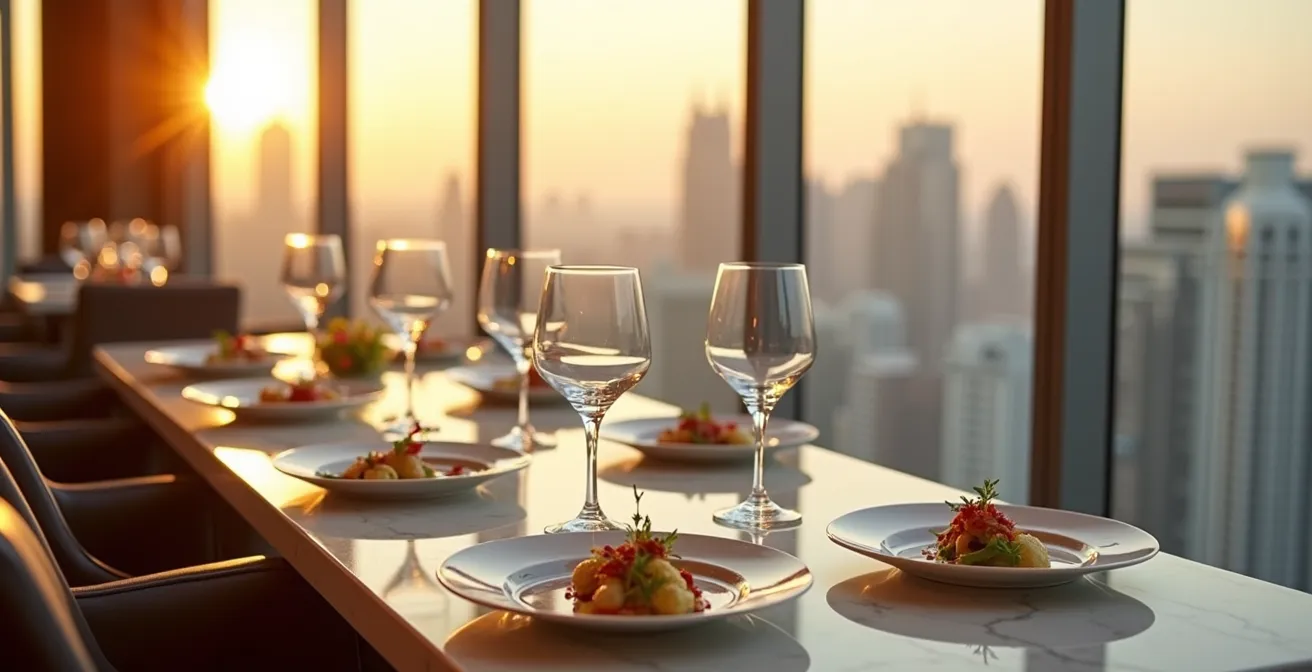
The best value in elite dining lies not in the menu’s price, but in aligning your choice—tasting menu or à la carte—with your desired culinary experience.
- A tasting menu is the chef’s curated narrative, offering a journey through their peak creativity and rarest ingredients.
- An à la carte selection is a dialogue, allowing you to compose a personal experience focused on specific signature dishes.
Recommendation: Choose the tasting menu to experience the kitchen’s full artistic statement; opt for à la carte to create your own highlight reel of a restaurant’s best work.
Navigating Dubai’s exhilarating fine-dining landscape presents a sophisticated paradox of choice. The scene is electric, with the number of recognized venues skyrocketing; the official Dubai Michelin Guide has expanded to 106 restaurants, a massive jump since its inception. For a discerning diner, the central question at any two-star establishment remains: tasting menu or à la carte? The common wisdom frames this as a simple trade-off between variety and cost, or decisiveness and control. This view, however, is a disservice to both the diner and the chef.
The true measure of value is not found on the bill, but in understanding the culinary narrative behind each format. A tasting menu is not merely a collection of smaller dishes; it is a meticulously plotted performance, a showcase of a chef’s peak expression and the kitchen’s operational harmony. Conversely, ordering à la carte is not a lesser choice, but an opportunity to become the curator of your own meal, composing an experience around specific cravings or celebrated signature plates. The decision isn’t about spending more or less, but about what kind of story you want to be told.
This guide moves beyond surface-level advice. It’s a strategic manual for the value-aware diner, decoding the unspoken rules of reservations, dress codes, and communication. By understanding the intricate mechanics of a high-end restaurant, from the sommelier’s language to the kitchen’s pressure points, you can ensure that every dirham spent translates into an unforgettable culinary return on investment.
To help you master Dubai’s elite dining scene, this article breaks down every crucial element, from securing the reservation to deciphering the menu’s true value. Explore the sections below to become a more strategic and satisfied diner.
Summary: A Strategic Guide to Dubai’s Elite Dining
- How Far in Advance Must You Book for a Friday Night at Top Tier Venues?
- Shorts and Sandals: Will a Michelin Restaurant Actually Turn You Away?
- How to Talk to a Sommelier When You Don’t Know Wine Terms?
- The 500 AED No-Show Fee: Is It Legal to Charge Your Card?
- When is the Kitchen Most Stressed: 8 PM or 10 PM?
- How to Secure a Table at the Resort’s Michelin Star Venue Last Minute?
- When to Request Hard-to-Get Reservations to Ensure Success?
- Restaurant Week: How to Spot the “Filler” Menus vs Real Deals?
How Far in Advance Must You Book for a Friday Night at Top Tier Venues?
Securing a prime-time Friday night table at a top-tier Dubai restaurant is a competitive sport, driven by a culture where residents dine out frequently. In fact, a recent study on dining habits revealed that Dubai residents dine out an average of 2.5 times per week, creating immense pressure on weekend availability, especially during the peak tourist season from October to April. For two and three-star venues, the booking window isn’t a matter of days, but weeks.
The golden rule is to plan four to six weeks in advance. This timeline is not arbitrary; it aligns with when most high-end restaurants release their reservation slots. Many establishments give priority to their own websites before making tables available on third-party platforms like OpenTable or Resy. The most strategic diners set calendar alerts for the 30-day mark and are ready to book the moment tables go live, which is often at a specific time like 9 AM or midnight.
For those staying at luxury properties, the hotel concierge remains a powerful ally. They often have access to ‘house tables’—a small number of seats held back specifically for VIP guests. If your initial attempts fail, don’t underestimate the power of the waitlist. Many cancellations occur 24 to 48 hours beforehand as confirmation deadlines pass, opening up last-minute opportunities for those who have registered their interest.
Shorts and Sandals: Will a Michelin Restaurant Actually Turn You Away?
The question of dress code in Dubai’s fine dining establishments is less about fashion and more about respect for the environment the restaurant has painstakingly created. While the city’s vibe is often relaxed, a two-Michelin-star venue is a stage for a culinary performance. The short answer is yes, a restaurant not only can but absolutely will turn you away if your attire—such as shorts, sandals, or athletic wear—breaches their stated policy. It is not personal; it is a measure to protect the experience for all guests.
The universally accepted dress code for these venues is ‘smart elegant’ or ‘business casual’. For gentlemen, this typically means tailored trousers or smart chinos, a collared shirt, and closed-toe shoes. A blazer is often recommended but not always mandatory. For ladies, the code allows for more flexibility but generally points toward cocktail dresses, elegant separates, or stylish jumpsuits. The goal is to complement the sophisticated atmosphere, not to distract from it. The image below captures the intended ambiance.
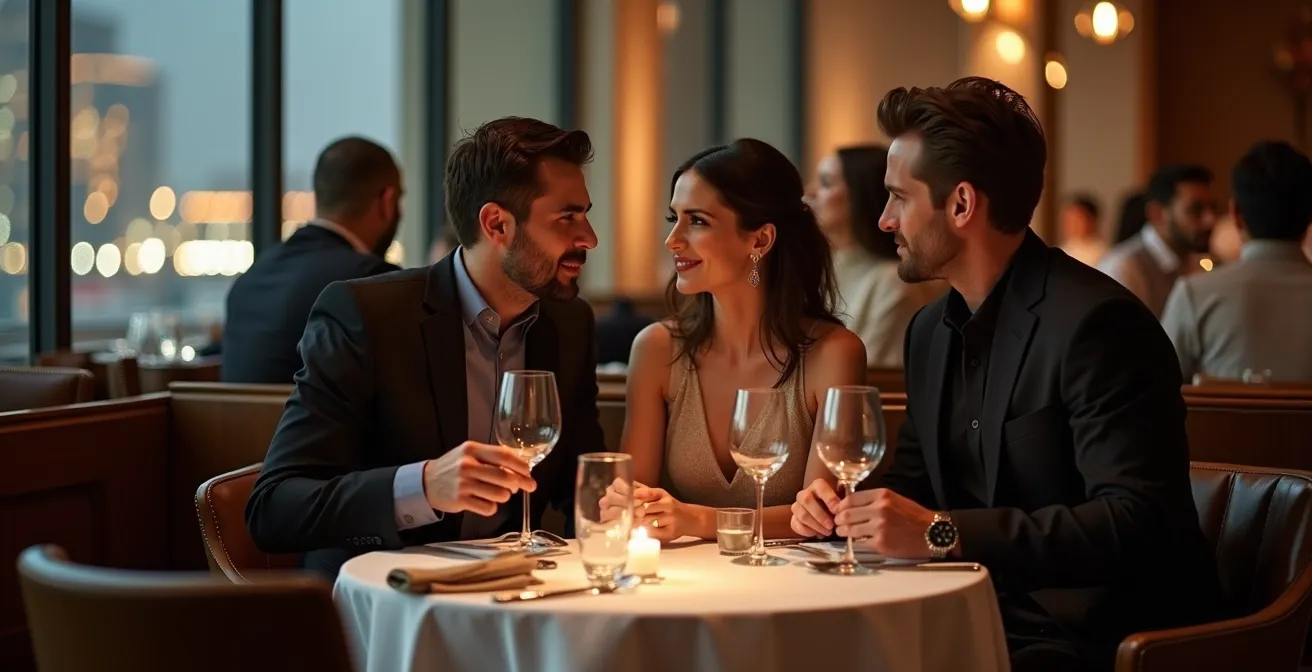
Adhering to the dress code is the first signal you send to the staff that you understand and appreciate the occasion. As one Dubai-based expert notes, this simple act of conformity can set the tone for the entire evening. A prominent guide reinforces this sentiment perfectly:
Showing respect for the establishment’s rules is the first step in a good dining experience and positively influences how the staff will interact with you all evening.
– Dubai Fine Dining Expert, Time Out Dubai Restaurant Guide
Ultimately, dressing the part isn’t a chore; it’s part of the ritual of fine dining. It enhances your own experience and contributes to the collective elegance that makes the evening special for everyone.
How to Talk to a Sommelier When You Don’t Know Wine Terms?
The presence of a sommelier can be intimidating for those not versed in the complex language of wine. However, their purpose is not to test your knowledge but to be your guide. The key to a successful interaction is to communicate your preferences and budget clearly, using descriptive language rather than technical jargon. Forget terms like ‘tannic’ or ‘malolactic’; instead, think about what you enjoy in other foods and drinks.
Do you like the crispness of a green apple or the richness of baked fruit? Do you prefer a light, zesty salad dressing or a creamy, buttery sauce? These analogies provide a sommelier with a wealth of information. Another effective strategy is to state your price range. You can do this discreetly by pointing to a wine on the list that is within your budget and saying, “I’m thinking of something in this region,” or more directly, “I’d like to stay around X AED.” A professional sommelier will respect your budget and find the best possible value within it. The experience at a venue like STAY by Yannick Alléno, a two-Michelin-starred restaurant, is often praised for sommeliers who are ‘attentive, professional, and warm’ in their approach, making guests feel comfortable regardless of their expertise.
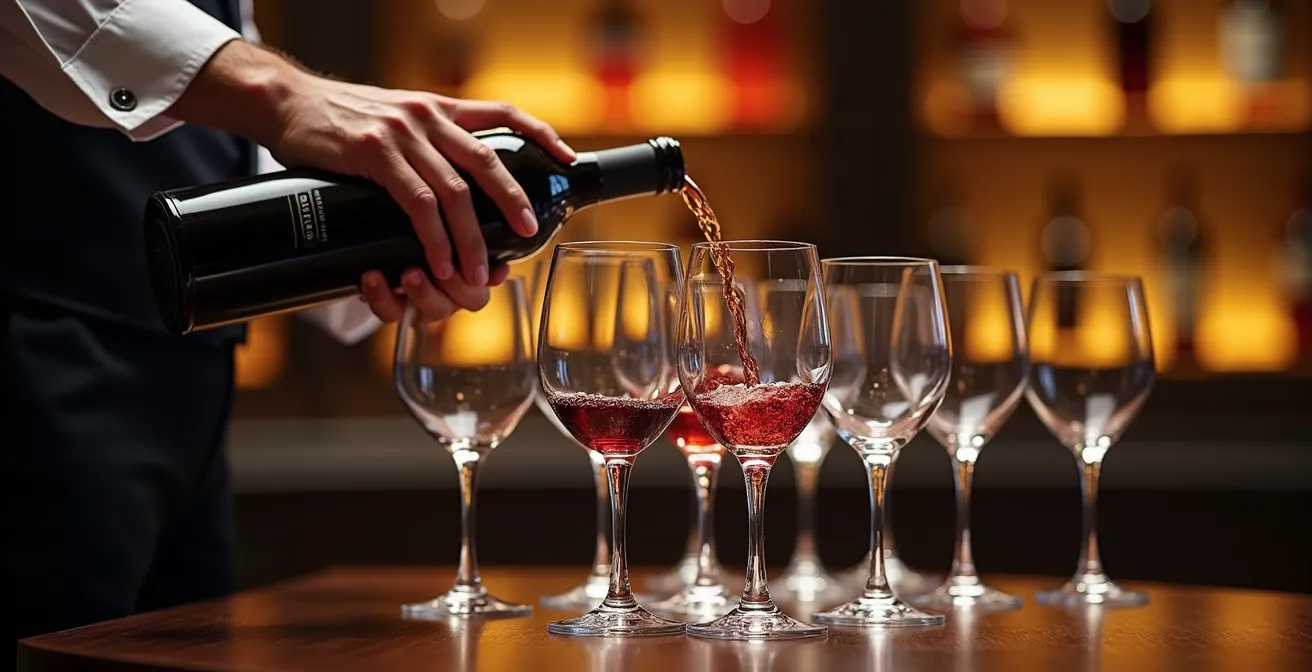
To facilitate the conversation, here are three “magic questions” that signal you are a savvy, curious diner, not an uninformed one:
- “What on your list offers exceptional value for its quality?” This shows you are value-conscious, not simply cheap.
- “What would the chef choose to drink with this dish?” This connects the wine choice directly to the food, showing respect for the kitchen’s vision.
- “Is there a local or lesser-known grape/region you’d recommend?” This demonstrates an open mind and a desire for discovery.
These questions open a dialogue, transforming the selection process from a transaction into a shared exploration. The sommelier becomes your partner in enhancing the meal, not just a salesperson.
The 500 AED No-Show Fee: Is It Legal to Charge Your Card?
The dreaded no-show fee, often a hefty sum of 500 AED or more per person, is an increasingly common policy in Dubai’s high-demand restaurants. While it can feel punitive, it is a legal and necessary business practice. As long as the policy is clearly stated and explicitly agreed to during the booking process—typically via a checkbox or disclaimer—it is generally enforceable under UAE consumer protection laws. You are entering into a contract when you provide your credit card details to secure a reservation.
The justification for these fees becomes clear when you consider the scale of the industry. The scale of Dubai’s restaurant industry, which saw food service value increase by 13% to $9.4 billion in 2023, operates on tight margins. An empty table, especially one reserved for a multi-course tasting menu, represents significant lost revenue. It’s not just about the potential income from another party; it’s about the cost of ingredients purchased and prepared in advance, and the staff scheduled specifically for that service. For tasting menus, much of the prep work is done hours before the guest arrives, making a no-show a direct financial loss.
However, this doesn’t mean you are without recourse in a genuine emergency. Most reasonable establishments will be accommodating if you communicate with them. If you have a valid reason and provide as much notice as possible, even if it’s inside the cancellation window, it’s worth a polite phone call. Furthermore, if the restaurant manages to fill your table, you have a strong case to contest the fee. The policy is designed to deter casual no-shows and protect against lost business, not to penalize patrons facing unavoidable circumstances.
When is the Kitchen Most Stressed: 8 PM or 10 PM?
For diners seeking the pinnacle of execution and attention, timing their meal to avoid the kitchen’s peak stress period can be a savvy move. Conventional wisdom points to the 8 PM to 9 PM slot as “prime time,” but from the kitchen’s perspective, this is also “pressure time.” The initial wave of orders floods the system, creating a synchronized surge of activity. However, the most complex period often occurs slightly later.
According to analysis of service flow, the period around 9:00 PM to 9:30 PM often presents the greatest operational challenge. At this point, the kitchen is firing entrées for the 8 PM tables while simultaneously plating appetizers for the 9 PM arrivals. This overlap of different stages of the meal for multiple tables creates a complex, multi-layered service that requires immense concentration and coordination. This is where the difference between a tasting menu and à la carte becomes most apparent from a kitchen standpoint. Restaurants with a tasting menu focus report a smoother service flow, as the predetermined sequence allows for better pacing and more predictable preparation, a core part of its inherent value proposition.
As a Dubai-based restaurant operations expert noted in a dining guide, there’s a strategic advantage to dining on the fringes of the peak rush:
The 8-9 PM slot is ‘prime time’ but also ‘pressure time’ – dining earlier at 7 PM or later at 9:45 PM often results in a more relaxed kitchen and potentially more attention to detail.
– Dubai Restaurant Operations Expert, Time Out Dubai Dining Guide
Choosing an earlier seating (around 7 PM) or a later one (after 9:45 PM) means your order is handled when the kitchen brigade has more bandwidth. This can translate to an even higher level of precision in plating and potentially more flexibility for off-menu requests. It’s a subtle but powerful way to optimize your experience by understanding the restaurant’s internal rhythm.
How to Secure a Table at the Resort’s Michelin Star Venue Last Minute?
Finding yourself in a luxury Dubai resort without a dinner reservation for its flagship Michelin-starred restaurant can feel like a missed opportunity. With Dubai’s hotels hosting record numbers of up to 18.72 million international visitors annually, walk-in success seems impossible. However, with the right strategy, securing a last-minute table is more achievable than you might think. It requires a combination of politeness, flexibility, and knowing who to ask.
Forget the online booking portal; your best asset is the human element within the resort. The Head Concierge or Guest Relations Manager holds significant sway and often has access to “house tables” or a priority waitlist for in-house guests. A polite, in-person visit to their desk early in the day can work wonders. Another powerful strategy is to go directly to the restaurant around 6 PM, dressed for dinner, and speak with the maître d’. Politely explain your situation and ask if you can wait at the bar for any potential no-shows or last-minute cancellations. This demonstrates genuine interest and puts a face to the name.
Flexibility is your currency. Be willing to accept the first available slot, whether it’s a very early seating at 6:30 PM or a late one at 10 PM. Also, inquire about alternative seating options. Many top restaurants have a chef’s table, counter seating overlooking the kitchen, or a lounge area with a full menu that operates on a first-come, first-served basis. These can offer a unique and often more dynamic dining experience. To maximize your chances, a clear plan is essential.
Your Action Plan: Last-Minute Reservation Strategies
- Direct Contact: Personally visit the resort’s Head Concierge or Guest Relations Manager. They are your most powerful internal advocates.
- Early Arrival: Go to the restaurant around 6 PM, dress appropriately, and ask the maître d’ if you can wait at the bar for a no-show.
- Show Flexibility: Clearly state your willingness to take any time slot, whether very early or late, to make it easier for them to fit you in.
- Explore Seating: Inquire specifically about non-standard seating like the chef’s counter or bar, which may not be part of the main reservation system.
- Leverage Status: Politely mention any hotel loyalty status or if you are celebrating a special occasion to help your request stand out.
By approaching the situation with strategy and grace, you can often turn a moment of disappointment into an evening of unexpected culinary delight.
When to Request Hard-to-Get Reservations to Ensure Success?
For the world’s most coveted restaurants, booking a table isn’t a casual act; it’s a precisely timed operation. While the last-minute strategies have their place, the surest path to success is proactive planning that borders on obsession. The most critical factor is knowing the exact moment reservations are released and being prepared to act instantly. This “drop time” varies but is typically 30, 60, or even 90 days in advance, often at a specific time like 9:00 AM local time or midnight.
Success requires preparation. You should have accounts pre-created on all relevant booking platforms (the restaurant’s own site, OpenTable, Resy) with your payment details saved. On the day of release, it’s wise to have multiple devices—a laptop and a phone—ready and synchronized to a world clock to ensure you hit ‘refresh’ at the exact second. Following the restaurant and its head chef on social media can also provide a critical edge, as they sometimes announce surprise table openings or changes to the booking schedule.
If dinner reservations remain elusive, consider a strategic pivot to lunch. Many Michelin-starred restaurants offer a lunch service that showcases the same culinary philosophy, and often includes signature dishes, but with significantly better availability. It’s an excellent way to experience the restaurant’s quality without the intense competition of a weekend dinner slot. The ultimate strategy combines timing, technology, and foresight.
- Set calendar alerts for the exact release date and time (e.g., “Book ‘Restaurant X’ – 60 days out”).
- Have multiple devices open and ready to book a few minutes before the release time.
- Ensure your account details and credit card information are pre-filled on the booking site.
- Follow the restaurant’s social media channels for any surprise announcements.
- If dinner fails, immediately check for lunch availability as a high-value alternative.
This disciplined approach transforms the booking process from a game of chance into a matter of strategic execution.
Key Takeaways
- True dining value is matching the menu type (tasting vs. à la carte) to your personal goal—be it culinary discovery or curated enjoyment.
- Mastering the logistics is part of the experience: book 4-6 weeks in advance, respect the dress code, and communicate clearly with staff.
- Strategic timing is key, from knowing when reservations drop to dining outside the 9 PM peak stress hour for a more relaxed service.
Restaurant Week: How to Spot the “Filler” Menus vs Real Deals?
Dubai Restaurant Week is a fantastic opportunity for diners to experience high-end venues at a fraction of the usual cost. During the event, Dubai Restaurant Week featured over 50 restaurants offering fixed-price menus, often around AED 125 for lunch and AED 250 for dinner. As Ahmad Al Khaja, CEO of Dubai Festivals and Retail Establishment, puts it, the event is a “celebration of the city’s booming dining scene.” However, for the value-aware critic, it’s crucial to distinguish between a genuine showcase and a “filler” menu designed to minimize cost.
A real deal menu is a condensed version of the restaurant’s soul; a filler menu is a generic, uninspired offering that could be served anywhere. The first thing to check is whether the set menu includes at least one or two of the restaurant’s renowned signature dishes. If the menu is populated entirely with unfamiliar and generic items like “grilled chicken breast” or “pan-seared salmon,” it’s a red flag. A top chef will use the opportunity to entice you back by giving you a taste of their best work. Also, calculate the potential savings. A true value offering should represent at least a 25-30% discount compared to ordering similar items à la carte.
Pay close attention to supplementary charges. A menu littered with extra fees for the most appealing dishes is a sign that the headline price is misleading. The best Restaurant Week menus are creative, use premium ingredients, and offer full portion sizes, reflecting the restaurant’s true style. They are an invitation, not a compromise.
This comparative table helps a discerning diner quickly identify where the true value lies.
| Real Deal Indicators | Filler Menu Red Flags |
|---|---|
| Includes 1-2 signature dishes from regular menu | All unfamiliar, generic items (chicken breast, salmon) |
| 25-30% discount vs regular à la carte prices | Less than 20% savings when calculated |
| Minimal or no supplementary charges | Multiple dishes require additional fees |
| Creative expression of restaurant’s style | Simplified, dumbed-down versions |
| Premium ingredients at set price | Basic proteins and sides only |
| Full portion sizes | Noticeably smaller portions than regular menu |
Armed with this critical framework, your next culinary adventure can be both exquisite and exceptionally smart. The ultimate luxury is not just eating well, but choosing wisely, ensuring every meal is a deliberate and valuable experience.
Frequently Asked Questions about Fine Dining in Dubai
Is it legal for Dubai restaurants to charge no-show fees?
Yes, as long as the policy is clearly stated and agreed to during booking, it is generally enforceable under UAE consumer protection laws.
What are valid reasons to contest a no-show fee?
Genuine emergencies, providing ample notice even if inside the cancellation window, or if the restaurant manages to fill the table.
Why do high-end restaurants implement these fees?
To cover lost revenue, wasted food (especially for pre-prepared tasting menus), and staff scheduling costs when tables remain empty.