
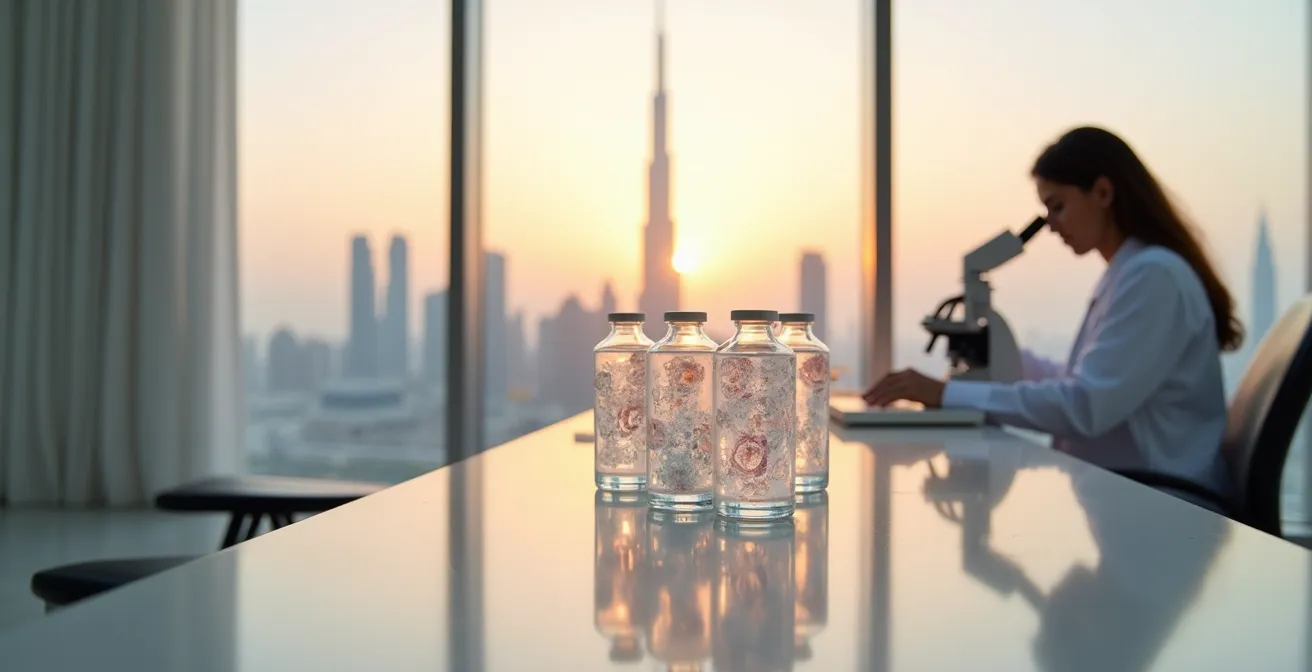
Stem cell therapy in Dubai is not just a cosmetic treatment; it’s a strategic investment in your biological assets, where the value is determined by regulatory compliance and cellular expertise, not just luxury.
- True value lies in verifiable credentials (DHA licenses, GMP-certified labs), not just the clinic’s address or price tag.
- Realistic outcomes mean systemic cellular repair and stimulated collagen production, not a magical “filter effect” or age reversal.
Recommendation: Your first step isn’t booking a treatment, but conducting a thorough due diligence audit of the clinic’s and physician’s credentials to ensure safety and efficacy.
The promise of turning back the clock is the bedrock of the aesthetic industry, and Dubai stands at its glittering epicenter. For patients seeking potent, non-surgical rejuvenation, the conversation has rapidly shifted towards stem cell therapy. This advanced branch of regenerative medicine is often presented as the ultimate solution, a near-magical key to unlocking youthful vitality. The narrative is compelling: harness your body’s own repair mechanisms to rebuild and restore skin, energy, and overall wellness from the inside out. This has led to a surge in clinics offering everything from stem cell facials to full-body intravenous (IV) infusions, each promising unparalleled results.
However, the conventional discourse often gets lost in marketing gloss, focusing on luxurious clinic interiors and vague promises of “rejuvenation.” It rarely delves into the critical scientific and regulatory distinctions that separate a genuine therapeutic intervention from an expensive, ineffective, or even risky procedure. While traditional options like lasers and chemical peels have well-defined parameters, the world of stem cells is a new frontier. The real challenge for a discerning patient is not simply to find a clinic, but to understand what they are actually buying. Is it a superficial enhancement or a profound investment in their long-term cellular health?
But what if the key to navigating this landscape wasn’t about chasing the most futuristic-sounding treatment, but about adopting the mindset of a biotech investor? This guide abandons the hype to provide a strategic framework. We will decode the science, dissect the cost structures, and establish the non-negotiable credential checks required. This is not about finding the cheapest or most luxurious option; it’s about making an informed, strategic decision to protect and enhance your most valuable biological asset: your own body. We will analyze the technology through a lens of scientific validity, regulatory compliance, and realistic outcomes, empowering you to differentiate true regenerative medicine from mere cosmetic marketing.
This article provides a detailed framework for evaluating the advanced aesthetic treatments available in Dubai. We will dissect the recovery times of various procedures, establish a critical checklist for verifying clinic credentials, and demystify the complex pricing structures. The following summary outlines the key areas we will explore.
Summary : A Strategic Guide to Dubai’s Regenerative Aesthetics
- Laser vs Chemical Peel: Which Gets You Back to Work the Next Day?
- The Credential Check You Must Do Before Any Injectable Procedure
- Why Does the Same Laser Treatment Cost 3x More in Jumeirah?
- The “Filter Effect” Error: What Aesthetic Tech Can and Cannot Do
- When to Schedule Fillers Before Your Wedding to Avoid Bruising?
- The Infection Risk of Boutique IV Drips You Should Know About
- Thailand vs UAE: Which Offers Better Post-Surgery Recovery Luxury?
- Is a Full-Body MRI Scan Worth the Cost for Asymptomatic Executives?
Laser vs Chemical Peel: Which Gets You Back to Work the Next Day?
The first decision in aesthetic rejuvenation often involves choosing between superficial resurfacing and deeper regenerative treatments. Traditional methods like lasers and chemical peels work by creating a controlled injury to the skin’s surface, prompting a healing response that generates new collagen and smoother skin. However, their primary limitation is downtime. For instance, aggressive CO2 lasers, while effective, come with a significant recovery period. In fact, Dubai aesthetic clinics report that patients often need 7-10 days of healing before feeling comfortable in public. This makes them a poor choice for anyone with a demanding professional or social schedule.
This is where the distinction between superficial and systemic treatments becomes critical. While lasers target the surface, regenerative therapies like stem cell facials work at a cellular level to repair and stimulate, resulting in minimal visible downtime. Understanding this trade-off between immediate but aggressive action and a gentler, more profound regenerative process is key. The following table provides a clear comparison of recovery timelines for common procedures, highlighting why stem cell-based treatments are increasingly favored for their “next day” return to normal activities.
| Treatment Type | Visible Recovery | Full Recovery | Return to Work |
|---|---|---|---|
| CO2 Fractional Laser | 7-10 days | 3-4 weeks | 7-10 days |
| Light Fractional Laser | 2-5 days | 1-3 weeks | 2-3 days |
| Chemical Peel (Deep) | 7-14 days | 2-3 weeks | 7-10 days |
| Stem Cell Facial | 24-48 hours | 2-4 weeks | Next day |
As the data from a comparative analysis of treatments shows, the difference is stark. A stem cell facial allows a return to work the very next day, with only minor redness that typically subsides within 48 hours. This positions it as a powerful tool for rejuvenation without the social or professional interruption associated with more invasive methods. The choice is no longer just about the desired result, but also about the opportunity cost of downtime.
The Credential Check You Must Do Before Any Injectable Procedure
In the high-stakes field of regenerative medicine, a clinic’s credentials are not a mere formality; they are the fundamental guarantee of safety and efficacy. The Dubai Health Authority (DHA) has established a stringent regulatory framework precisely because of the potent nature of these therapies. As confirmed by leading practitioners, the Dubai Health Authority approved the use of mesenchymal stem cells for IV infusion and localized cutaneous injection, opening the door for advanced anti-aging protocols. However, this approval is tied to strict licensing and accreditation requirements that a patient must personally verify.
Treating this verification process as a “due diligence” exercise is the most critical step you can take. Before considering any injectable procedure, especially those involving stem cells, you must move beyond the marketing materials and scrutinize the clinic’s and lab’s foundational qualifications. This includes ensuring the facility is licensed specifically for stem cell services, that the laboratory processing the cells adheres to international manufacturing standards, and that the physician has certified expertise in regenerative medicine. An unaccredited provider not only risks delivering an ineffective treatment but also poses a serious health risk, including infection or adverse immune reactions. The following checklist provides a concrete, non-negotiable action plan for vetting any potential provider in Dubai.
Your DHA Verification Action Plan: Vetting a Stem Cell Clinic
- Facility License: Verify the clinic possesses a DHA facility license specifically for providing stem cell services. Request to see the physical document.
- Laboratory Standards: Confirm the laboratory that processes the cells has Good Manufacturing Practice (GMP) certification and ISO 15189 accreditation, ensuring quality and safety.
- International Accreditation: Check if the clinic or its lab holds, or is in the process of obtaining, FACT-JACIE or AABB international accreditation, the gold standard in cellular therapy.
- Treatment Approval: Request written proof of DHA approval for the specific type of stem cell treatment you are considering (e.g., autologous adipose-derived vs. allogeneic umbilical cord).
- Physician Certification: Use the DHA portal to verify that your treating doctor holds a specific certification or license in regenerative medicine.
Completing this checklist is the difference between making a sound biological investment and taking a dangerous gamble. A reputable clinic will be transparent and readily provide this documentation. Any hesitation or refusal to do so should be considered an immediate red flag.
Why Does the Same Laser Treatment Cost 3x More in Jumeirah?
The significant price variation for aesthetic treatments in Dubai can be perplexing. A procedure using the exact same branded technology can vary dramatically in cost depending on the clinic’s location. This isn’t arbitrary; it’s a reflection of the “Premium Equation,” where price is an aggregate of multiple value factors beyond the machine itself. For stem cell therapies, this is even more pronounced, with stem cell therapy prices in Dubai range from AED 30,000 to AED 170,000, a spread that demands explanation.
The primary drivers of this premium are expertise, environment, and protocol. A clinic in a prime location like Jumeirah or DIFC has higher overheads, but it also typically invests in internationally-trained specialists with decades of experience, state-of-the-art facilities that exceed basic requirements, and comprehensive, bespoke service protocols. This “premium” is not just for the view; it’s for a higher standard of care, risk mitigation, and a more holistic patient experience. The visual appeal of a luxury clinic is merely the surface of a deeper investment in quality.

This concept is best understood through a real-world example of how premium positioning correlates with recognized excellence and a more comprehensive service model.
Case Study: The Premium Equation at Skin111 (DIFC & Palm Jumeirah)
Skin111 operates clinics in prime Dubai locations, including DIFC and Palm Jumeirah. The clinic justifies its premium pricing through a combination of factors: it employs internationally-trained staff with over 20 years of expertise, maintains state-of-the-art facilities, and offers exclusive services like at-home treatments. This commitment to a higher standard of care has been recognized externally; the clinic won “Best Aesthetics Clinic in Dubai” at the MEA Business Awards for both 2022 and 2023. This demonstrates a clear correlation where a higher price point directly reflects investment in superior expertise and service delivery, which in turn leads to validated, award-winning outcomes.
Therefore, when evaluating cost, the question shouldn’t be “Why is this so expensive?” but rather “What am I getting for this price?” A higher cost should correspond to verifiable expertise, superior protocols, and a better overall standard of care, transforming the expense from a simple cost into a comprehensive investment in your well-being.
The “Filter Effect” Error: What Aesthetic Tech Can and Cannot Do
A significant pitfall in pursuing aesthetic technology is the “Filter Effect” error—expecting real-world science to replicate the flawless, instantaneous results of a social media filter. Stem cell therapy, despite its power, is not magic. It is a biological process, and understanding its mechanisms is key to setting realistic expectations. The goal of this technology is not to numerically reverse your age but to fundamentally improve your body’s cellular health and function.
The primary mechanism of anti-aging stem cell therapy is paracrine signaling: the cells release a cocktail of growth factors, cytokines, and exosomes that instruct your own resident cells to behave more youthfully. This process has several tangible outcomes:
- Stimulated Collagen Production: The signals encourage fibroblasts to produce more collagen and elastin, improving skin density and firmness over weeks and months.
- Reduced Inflammation: Stem cells have powerful anti-inflammatory properties, which can calm chronic low-grade inflammation that accelerates aging (inflammaging).
- Cellular Repair: They can help repair and replace damaged cells, improving tissue quality and function.
As leading medical experts in Dubai explain, the focus should be on biological improvement rather than chronological reversal.
Stem cell therapy doesn’t reverse age numerically, but it can reduce visible and physical signs of aging by stimulating collagen production, reducing inflammation, and repairing cellular damage.
– Shookra Medical Center, Anti-Aging Stem Cell Reality
While the results are profound, they are gradual and natural. The therapy enhances your body’s own potential, leading to healthier, more resilient skin and improved vitality. It will not erase every line or give you the poreless, texture-free look of a digital filter. Globally, this approach has proven highly effective within its intended scope. Evidence shows that, when administered correctly for appropriate indications, stem cell treatments demonstrate an 85-95% worldwide success rate in achieving measurable improvements in tissue regeneration and function. This high success rate is based on achieving realistic biological goals, not chasing an impossible digital ideal.
When to Schedule Fillers Before Your Wedding to Avoid Bruising?
Event-based aesthetic planning, such as preparing for a wedding, requires a strategic, long-term approach, especially when incorporating regenerative treatments. The biggest mistake is scheduling procedures too close to the event date, leaving no buffer for healing, settling, or addressing potential side effects like bruising. A successful “regenerative timeline” is not about a last-minute fix but about a carefully orchestrated sequence of treatments that build upon each other for an optimal, natural-looking result.
This timeline should begin up to a year in advance, starting with foundational steps and progressing towards final refinements. The most invasive procedures with the longest recovery, such as deep laser resurfacing, should be done at least six months out. Regenerative treatments like stem cell facials are best initiated around the three-month mark to give your body ample time to build new collagen. Injectables like Botox and dermal fillers have their own specific windows. Botox needs about six weeks to fully settle for a natural expression, while dermal fillers, especially when administered with a micro-cannula technique to minimize bruising, should be done no later than four weeks before the event. This provides time for any swelling to resolve and for the product to integrate smoothly with your tissue.

A well-structured plan ensures you arrive at your special day looking radiant and refreshed, not like you’ve just left a clinic. The final touch, such as a stem cell exosome therapy session, can be done a week prior to provide a final boost of glow and hydration without any downtime. Here is a model timeline for strategic pre-wedding aesthetic planning:
- 12 Months Before: The journey begins with an initial consultation. This is also the time for stem cell banking if you’re considering autologous (your own cells) treatments for maximum compatibility.
- 6 Months Before: Schedule any major resurfacing procedures that require significant healing time, like deep chemical peels or aggressive laser treatments.
- 3 Months Before: Initiate your first stem cell facial or regenerative treatment to kickstart the collagen production cycle.
- 6 Weeks Before: Administer Botox or other neuromodulators. This allows the effect to settle completely, avoiding a “frozen” look.
- 4 Weeks Before: Perform dermal filler treatments, ideally using a micro-cannula to dramatically reduce the risk of bruising and swelling.
- 1 Week Before: A final, non-invasive treatment like a stem cell exosome or hydrating facial for that perfect “day of” glow.
Adhering to such a timeline is the professional’s secret to achieving a flawless, camera-ready look that appears entirely natural.
The Infection Risk of Boutique IV Drips You Should Know About
The rise of “boutique” IV therapy, often marketed for wellness and vitality, has created a grey market where the risk of infection and complications is significantly heightened. While DHA-approved clinics operate under strict medical protocols, many pop-up or mobile IV services do not. These services, sometimes administered in hotel rooms or non-clinical settings, bypass the essential safety measures required for any intravenous procedure. The primary risk is not just an ineffective treatment but a serious systemic infection (sepsis) or contamination from improperly handled materials.
An IV drip, whether for vitamins or stem cells, is a medical procedure. It requires a sterile environment, preparation of the solution in a controlled manner (not pre-mixed in an unknown location), and the direct supervision of a licensed medical professional. The use of pre-mixed IV bags is a major red flag, as you have no way of verifying the contents, their sterility, or the preparation date. Furthermore, any provider who promises to “cure” diseases rather than support regeneration is operating outside ethical and regulatory guidelines. The lack of a prior doctor consultation is another critical warning sign, as a patient’s medical history must be reviewed to avoid contraindications.
Recognizing the warning signs of an unsafe provider is crucial for protecting your health. A legitimate medical procedure should never be treated with the casualness of a cosmetic service. You must be vigilant and prioritize safety above convenience or cost. Here are the key red flags to watch for when considering any IV therapy:
- No Displayed DHA License: The provider cannot or will not show you a valid DHA facility license upon request.
- Pre-Mixed IV Bags: The IV solution is not prepared in a sterile environment in front of you.
- Absence of Doctor Consultation: No qualified doctor assesses your medical history and suitability before the treatment.
- Non-Clinical Setting: The service is offered in a hotel room, spa, or home without a proper mobile medical setup.
- Promises of Cures: The provider makes unrealistic claims about curing chronic diseases instead of supporting wellness and regeneration.
- No Risk Disclosure: There is no discussion of potential risks, side effects, or what to do in case of an adverse reaction.
Avoiding providers who exhibit these characteristics is non-negotiable for safeguarding your health. True regenerative medicine is performed with the rigor of a surgical procedure, not the informality of a beauty treatment.
Thailand vs UAE: Which Offers Better Post-Surgery Recovery Luxury?
For international patients, the choice of a medical tourism destination often comes down to a comparison between established hubs like Thailand and emerging leaders like the UAE. While both offer high-quality medical care, the UAE, and Dubai in particular, has carved out a unique niche by creating an integrated medical-luxury ecosystem that is unparalleled. This model goes beyond simply having a good hospital; it seamlessly blends cutting-edge regenerative medicine with five-star hospitality and holistic wellness programs, creating a comprehensive recovery experience.
Thailand has a long-standing reputation for affordable and skilled cosmetic surgery. However, its model often separates the medical procedure from the recovery and wellness aspects. In contrast, Dubai’s approach is to consolidate them. Top-tier clinics are often located within or partnered with luxury resorts, offering a continuum of care that starts before the procedure and extends long after. This integrated model is designed to optimize the body for the best possible outcome. This is especially true in the regenerative medicine space, where the UAE’s serious investment is clear. In fact, projections show that the UAE stem cell therapy industry is projected to reach a valuation of USD 138.0 million by 2030, a testament to its commitment to becoming a global leader.
Case Study: AEON Clinic’s Integrated Luxury Model at Atlantis The Royal
AEON Clinic, located within the ultra-luxury Atlantis The Royal resort in Dubai, perfectly exemplifies the UAE’s integrated recovery model. The clinic’s approach is not just to administer a treatment but to create a complete wellness journey. Their pre-treatment phase includes a suite of preparatory therapies such as IV drips, ozone therapy, peptide therapy, and photobiomodulation. This comprehensive protocol is designed to prepare the body at a cellular level, ensuring it is in the optimal state to receive and integrate stem cells. By combining this advanced medical preparation with the amenities and services of a world-class 5-star hotel, AEON creates a seamless, high-end medical and luxury experience that is difficult to replicate in other destinations.
This integrated approach is the UAE’s key differentiator. It redefines “recovery” not as a passive waiting period, but as an active, luxurious, and medically supervised phase of the rejuvenation journey. For the patient seeking the absolute pinnacle of care and comfort, Dubai’s model offers a superior value proposition that goes far beyond the procedure itself.
Key Takeaways
- Downtime is a critical factor; stem cell facials offer rejuvenation with a next-day return to work, unlike lasers or deep peels.
- Verifying a clinic’s DHA license and lab accreditations (GMP, ISO) is a non-negotiable step for ensuring safety and efficacy.
- Higher costs in premium locations like Jumeirah are often justified by superior expertise, advanced protocols, and better overall standards of care.
Is a Full-Body MRI Scan Worth the Cost for Asymptomatic Executives?
In the proactive pursuit of longevity and peak performance, the conversation is shifting from treatment to strategy. For asymptomatic executives and high-performers, the ultimate tool in this strategic arsenal is not a therapy, but a diagnostic: the full-body MRI scan. While traditionally used to investigate symptoms, its application as a preventative screening tool provides an unprecedented, in-depth look at your current biological state. It offers a comprehensive baseline of your internal health, detecting potential issues long before they manifest as symptoms.
From a regenerative medicine perspective, this is invaluable. An MRI scan can identify areas of inflammation, early-stage degenerative changes in joints, or other subtle markers of aging. This data allows for a highly targeted and personalized anti-aging program. Instead of a generic approach, therapies can be directed precisely where they are needed most. This positions the MRI not as an expense, but as the foundational diagnostic step for any serious, long-term anti-aging or “bio-hacking” strategy. It answers the question: “Where should I invest my resources for the greatest return on my health?”
Top specialists in the field advocate for this diagnostic-first approach, reframing the MRI as the ultimate tool for personal biological management.
Frame this as the ultimate ‘bio-hacking’ tool, positioning it as the diagnostic foundation before embarking on an expensive anti-aging program, including stem cell therapy.
– Dr. Ebenezer Abel Paul, Regenerative Medicine Specialist
Therefore, for an executive accustomed to making data-driven decisions in business, applying the same logic to their health is the next logical step. The cost of a full-body MRI becomes a strategic investment, providing the critical intelligence needed to design a truly effective and personalized longevity plan. It transforms health management from a reactive process to a proactive, highly optimized strategy, ensuring that significant investments in therapies like stem cells are made with maximum precision and impact.
Ultimately, navigating the world of advanced aesthetics in Dubai requires a shift in mindset—from that of a patient to that of a strategic investor in your own biology. By prioritizing verifiable credentials, understanding the science behind the results, and starting with a comprehensive diagnostic baseline, you can ensure your choices lead to genuine, lasting regeneration. To begin this journey with confidence, the first step is to apply the rigorous vetting process to a potential provider.