
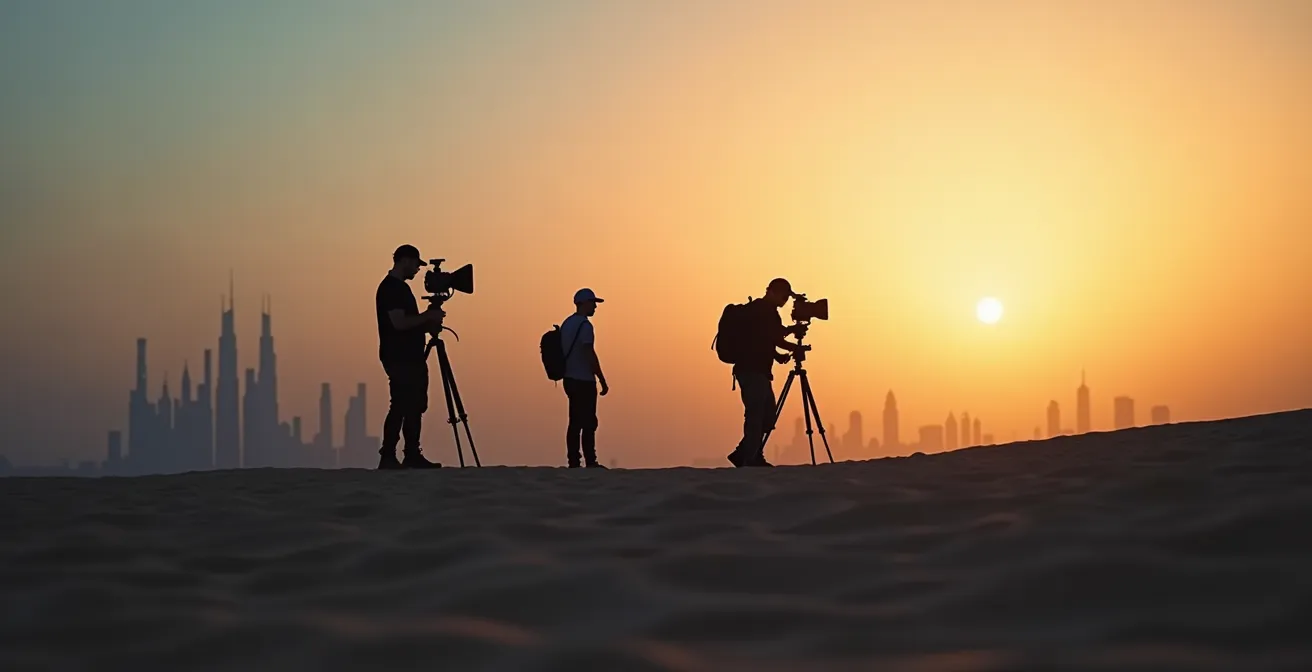
Securing Abu Dhabi’s 30% film rebate requires mastering the Emirate’s full operational and legal ecosystem, not just submitting an application.
- Hidden costs arising from permitting, licensing, and compliance can significantly erode the net financial value of the incentive.
- Strategic choices in local partnerships, technology use (like drones), and creative direction have a direct and material impact on budgetary integrity.
Recommendation: Treat the rebate not as a simple discount, but as the financial outcome of a meticulously planned and locally-compliant production strategy.
For any production manager, the headline offer of a 30% cashback rebate for filming in Abu Dhabi is a compelling financial incentive. The initial focus naturally falls on the creative possibilities and the significant budget reduction. Most guides will highlight the world-class infrastructure and diverse locations, from futuristic cityscapes to the vast desert landscapes that famously stood in for Arrakis in major Hollywood productions. This establishes the “what” and the “where,” but it critically omits the “how” from a procedural and financial standpoint.
The true success of leveraging this rebate, however, is determined not by the initial application but by the mastery of the complex operational ecosystem that underpins it. The real net benefit is what remains after navigating a gauntlet of permits, licenses, and specific local regulations. Failure to account for this compliance overhead can quickly erode the very savings you sought to gain. This is the procedural friction that can turn a profitable shoot into a logistical and financial quagmire, impacting everything from crew scheduling to intellectual property rights.
This guide moves beyond the marketing headlines to provide a procedural deep-dive for the production manager. We will deconstruct the critical, and often overlooked, operational layers that determine your project’s true financial viability. We will examine the specific compliance challenges—from public space filming permits and drone registration to influencer licensing and IP protection—that must be managed to protect your budgetary integrity and maximize the net value of the Abu Dhabi filming rebate.
The following sections break down the key procedural and financial considerations you must master. This detailed overview serves as a roadmap to navigate the Emirate’s creative economy regulations effectively.
Summary: A Production Manager’s Guide to the Abu Dhabi Rebate Ecosystem
- Filming in Public Spaces: When Do You Need a Police Permit?
- The Drone Registration Process for Commercial Photography
- NMC License: Do Micro-Influencers Really Need to Pay 15,000 AED?
- How to Take Down Stolen Content from Local Platforms?
- When is the “Golden Hour” in UAE Winters for Best Lighting?
- The “Influencer” Aesthetic Error That Devalues Your Personal Brand
- How to Patent Your Software Algorithm in the UAE?
- Co-working vs Coffee Shop: Where is the Wi-Fi Reliable Enough for Zoom?
Filming in Public Spaces: When Do You Need a Police Permit?
A common misconception is that a general filming permit from the film commission covers all locations. This is a critical oversight. While the Abu Dhabi Film Commission (ADFC) is your primary point of contact, any filming in public spaces—such as parks, streets, or beaches—requires a separate No Objection Certificate (NOC) from the relevant police authority. This is a non-negotiable procedural step that directly impacts your schedule and budget. Failing to secure this permit can lead to immediate shutdown of a shoot, resulting in costly delays and potential fines.
The key trigger for requiring a permit is not the intent (commercial vs. personal) but the equipment and crew size. The use of any professional gear, including tripods, external lighting, reflectors, or the presence of a multi-person crew, automatically flags the activity as professional and mandates a permit. Furthermore, timelines are a significant factor. While standard applications can be processed, current UAE permit processing guidelines suggest 3-7 working days, shoots in security-sensitive areas or those requiring road closures can take up to 25 days. This procedural friction must be factored into your pre-production schedule to avoid jeopardizing your timeline.
Properly navigating this dual-permit system is fundamental to maintaining your production’s budgetary integrity. The cost of a failed shoot day due to a missing police permit will far outweigh the administrative effort of securing it in advance. It is an essential piece of compliance overhead that protects the overall value of the rebate.
Action Plan: Navigating UAE Film Permit Thresholds
- Assess your equipment: Professional gear (tripods, reflectors, crew) automatically requires permits, even for shoots that might feel personal in nature.
- Identify location authority: The film commission handles the main permit, but police approval is mandatory for public spaces, and you must apply for both.
- Bundle applications strategically: To save time, submit applications to the GCAA (for drones), police, and any private property owners simultaneously where possible.
- Factor in security-sensitive locations: Any shoot near government buildings, airports, or military sites requires a minimum of 15+ days for advance approval.
- Distinguish casual vs. commercial: Simple mobile phone photos without props or crew are generally exempt, but any hint of commercial setup removes this exemption.
The Drone Registration Process for Commercial Photography
The allure of capturing sweeping aerial shots of Abu Dhabi’s landscapes is undeniable, but the procedural hurdles for commercial drone operation are among the strictest in the world. This is a critical area of compliance overhead where foreign productions often face significant challenges. The regulatory environment is governed by the General Civil Aviation Authority (GCAA) and is enforced with zero tolerance due to national security concerns and heavily trafficked airspace. Attempting to operate a drone without the proper licensing and permits is not just a risk of fines; it can lead to equipment confiscation and legal action against the production team.
Every drone used for commercial purposes must be registered with the GCAA, and the operator must hold a valid UAE drone operator license. On top of this, each individual flight requires a location-specific permit from both the GCAA and the relevant emirate’s film commission. This multi-layered approval process makes partnering with a licensed local drone operator not just a convenience, but a strategic necessity for maintaining schedule and budget. A local partner provides pre-approved GCAA status, existing insurance, and invaluable knowledge of no-fly zones, mitigating significant financial and legal risks.
Case Study: UAE Drone Filming Regulatory Framework
Drone videography in the UAE is heavily regulated due to airspace restrictions and national security policies. You must obtain a drone operator license from the General Civil Aviation Authority and a location-specific videography permit from the respective emirate’s film commission. Drone flights are prohibited in many zones like airports, military areas, and residential zones unless explicitly authorised. Unauthorised drone use can lead to arrest or legal fines, representing a severe risk to any production budget and timeline.
The choice between navigating this complex process as a foreign entity versus engaging a local partner has clear financial implications, as detailed in the comparison below. For a production manager focused on efficiency and risk mitigation, the data points towards a clear conclusion.
| Aspect | Foreign Operator | Local Partner |
|---|---|---|
| GCAA License Processing | 15-25 business days | Pre-approved status |
| Insurance Requirements | Must obtain UAE coverage | Existing coverage |
| Permit Application | Via local production company | Direct application |
| No-fly Zone Knowledge | Learning curve required | Established expertise |
| Cost Structure | Equipment import + permits | Service fee only |
NMC License: Do Micro-Influencers Really Need to Pay 15,000 AED?
The topic of influencer licensing in the UAE has been a source of confusion and concern for productions looking to engage with local content creators. The widely cited 15,000 AED National Media Council (NMC) license fee caused many to believe that working with any influencer was a prohibitively expensive endeavor. For a production manager, understanding the nuances of this regulation is key to avoiding unnecessary costs and ensuring legal compliance for all cast and crew, including social media talent.
The reality is more flexible than the headline figure suggests. While the high-cost individual license exists, it is primarily aimed at top-tier, freelance influencers operating as independent businesses. For productions engaging micro-influencers or as part of a broader campaign, there are far more cost-effective routes. The most efficient strategy is for the production company itself to be licensed under a creative free zone authority. These zones, such as twofour54 in Abu Dhabi, offer a regulatory umbrella. Influencers contracted under the production’s free zone license are typically covered, obviating the need for individual licenses. Furthermore, many creative free zones offer more affordable licensing options with media packages starting from as low as 3,500 AED annually, a fraction of the feared cost.
This demonstrates a core principle of operating in the UAE: the official “sticker price” is often just one of several pathways. A strategic approach, leveraging the ecosystem’s structure like free zones, transforms a perceived high cost into a manageable operational expense, thereby protecting the project’s budgetary integrity.

Working within a designated creative free zone provides the necessary legal framework and collaborative environment to integrate influencers into a production seamlessly and cost-effectively. This is a clear example of how understanding the local business ecosystem is vital for financial planning.
How to Take Down Stolen Content from Local Platforms?
Protecting your intellectual property is as crucial as creating it, especially when operating in a new jurisdiction. The risk of content theft or unauthorized use on local or regional platforms is a valid concern for any production. A robust IP protection strategy is an integral part of maximizing the total return on your production investment, which includes the value of the content itself. The UAE has a structured legal framework for this, but it requires specific procedural steps that a production manager must be aware of.
The process begins with meticulous documentation. To file a complaint with the UAE’s Telecommunications and Digital Government Regulatory Authority (TDRA), you must provide definitive proof. This includes screenshots of the infringement with visible timestamps and URLs, along with notarized proof of your original content ownership and its creation date. For maximum effectiveness, all documentation submitted to local authorities should be translated into Arabic. If the infringing platform is slow to respond, a direct approach to the UAE-based Internet Service Provider (ISP) hosting the content can be a faster route to resolution. For significant cases, engaging a local legal representative is advisable.
This entire process reinforces a fundamental requirement of the Abu Dhabi rebate itself. As legal experts analyzing the framework note, eligibility is tightly controlled. As a leading law firm, Bird & Bird, states in their analysis of the rebate guidelines:
Rebate applicants must be a production company or production services company licensed by Abu Dhabi’s Creative Media Authority
– Bird & Bird Law Firm, Legal Analysis of Abu Dhabi Film Rebate Guidelines
This highlights that being a legitimate, licensed entity is the bedrock of everything, from claiming the rebate to defending your IP. Your legal standing is your primary tool, both for securing funds and for protecting your finished product.
When is the “Golden Hour” in UAE Winters for Best Lighting?
While a creative decision, scheduling for optimal lighting conditions has direct and significant budgetary implications. The “golden hour”—the period shortly after sunrise or before sunset—provides the soft, diffused light favored by cinematographers. In the UAE, the characteristics of this period vary drastically between summer and winter, and understanding this is crucial for efficient scheduling of crew, talent, and equipment. Miscalculating these windows can lead to wasted time on set, requiring costly overtime or even additional shoot days.
During the winter months (December to February), the sun angle is lower, creating longer, softer shadows and a warmer color temperature. This provides a more forgiving and extended window for filming compared to the harsh, high-sun conditions of a UAE summer. A production manager must be able to translate these atmospheric conditions into a concrete schedule. For instance, the recent production of ‘Dune: Part Two,’ which spent almost a month shooting in the Liwa Oasis, undoubtedly built its schedule around these precise lighting windows to capture the iconic look of the desert planet Arrakis. This level of planning is not an artistic luxury; it is a financial necessity.
The technical specifications below provide the hard data needed for precise planning. Factoring these details into your call sheets and production schedule is a clear example of how creative requirements must be managed with financial discipline to protect the budget and, by extension, the value of the rebate.
| Season | Morning Golden Hour | Evening Golden Hour | Sun Angle | Shadow Length |
|---|---|---|---|---|
| Winter (Dec-Feb) | 6:45-7:30 AM | 5:30-6:15 PM | 25-30° | 2x subject height |
| Summer (Jun-Aug) | 5:30-6:15 AM | 6:45-7:30 PM | 35-45° | 1.5x subject height |
| Color Temperature | 3200K | 2800K | – | – |
The “Influencer” Aesthetic Error That Devalues Your Personal Brand
While the title references a “personal brand,” the principle applies directly to any commercial production’s brand and financial return. A significant risk in filming in a location known for luxury is falling into aesthetic clichés. The “Dubai Bling” stereotype—an over-reliance on supercars, skyscraper penthouses, and luxury mall imagery—can render content generic and indistinguishable. For a production financed with the expectation of a 30% rebate, creating content that fails to resonate or appears dated is a direct devaluation of the investment. The net value of the rebate is not just the cash received, but the commercial success of the asset produced.
Avoiding this pitfall requires a deliberate creative strategy that seeks authenticity beyond the surface. This involves moving beyond tourist-centric views to explore the genuine cultural narratives and diverse landscapes the Emirates have to offer. This could mean developing location-specific color palettes that reflect the subtle coastal blues of Abu Dhabi or the muted mountain grays of Ras Al Khaimah. It involves a conscious effort to include local small businesses, artisans, and authentic Emirati voices in the content, moving the narrative from one of passive luxury to active culture. This approach not only creates more compelling and unique content but also demonstrates a deeper engagement with the location, which can be beneficial in relationships with local authorities and partners.
This is not about avoiding aspirational content, but about balancing it with scenes that reflect the texture of everyday local life, adding depth and relatability. A production that successfully does this creates a more valuable and enduring asset, ensuring the budget was well-spent.

The visual contrast between sterile luxury and authentic natural beauty, such as Abu Dhabi’s mangrove forests, is a powerful creative tool. Choosing the latter can result in more memorable and emotionally resonant content, ultimately delivering a higher return on the creative investment.
How to Patent Your Software Algorithm in the UAE?
For a growing number of productions, particularly in advertising, gaming, and interactive content, the final product is not just a video file but also includes proprietary software, such as custom VFX algorithms, interactive apps, or data management tools. In these cases, the production manager’s scope of asset protection must extend to intellectual property beyond traditional copyright. Understanding the UAE’s framework for patenting software is crucial for maximizing the total value derived from the production activity in Abu Dhabi.
The UAE Ministry of Economy has a specific requirement for software patents: the algorithm must demonstrate a clear “technical character.” This means the software cannot simply be a business method or automation of a manual process. It must solve a tangible technical problem in a new way, for example, by significantly improving computer processing efficiency, reducing data storage requirements, or enabling new hardware capabilities. A generic business process automation algorithm would likely be rejected. This “technical character” test is the primary hurdle that patent applications must clear.
For companies developing such technology, the choice of legal jurisdiction within the UAE matters. Financial free zones like the Abu Dhabi Global Market (ADGM) operate under a British-based Common Law framework, which can be more familiar to international companies. This can offer significant advantages in the event of a dispute, with ADGM Courts statistics indicating up to 85% faster IP dispute resolution compared to mainland courts. For a production involving significant R&D, factoring in this IP protection strategy from the outset is a key component of a comprehensive financial plan.
Key Takeaways
- The 30% rebate is a gross figure; the net value is determined by your ability to manage local compliance costs effectively.
- Every operational choice, from permit applications and drone usage to creative direction, has a direct financial implication that can erode or protect your budget.
- Local expertise, whether through partnerships or deep procedural research, is a non-negotiable prerequisite for ensuring a production’s financial success in Abu Dhabi.
Co-working vs Coffee Shop: Where is the Wi-Fi Reliable Enough for Zoom?
The logistical backbone of any modern production is reliable digital connectivity. For a production manager overseeing a project in Abu Dhabi, ensuring that the core team, both local and remote, can communicate and transfer large files without interruption is a fundamental operational requirement. The seemingly simple choice of where to work can have a cascading impact on efficiency and, consequently, the budget. A dropped video call with the director or a failed upload of daily rushes is not just an annoyance; it’s a loss of productive time and money.
While hotel lobbies and mall coffee shops offer convenience, they are often a false economy. Their Wi-Fi networks typically offer speeds between 10-50 Mbps, which is often unstable, congested, and may block the use of VPNs essential for secure corporate network access. This creates an environment of high risk for critical communications. In contrast, designated creative free zones and professional co-working spaces like those within twofour54 are built for media professionals. They offer enterprise-grade connectivity with speeds often exceeding 100-200 Mbps, full VPN support, and the necessary infrastructure like ample power outlets and acoustic privacy.
The minor cost of a co-working day pass or short-term membership is an insurance policy against the major costs of lost productivity and communication breakdowns. For a production manager, providing the team with a reliable work environment is a direct investment in the project’s efficiency. It eliminates a key point of procedural friction and ensures that the operational side of the production runs as smoothly as the on-set creative work. This choice supports the overall goal of protecting the budget to maximize the final rebate value.
To effectively leverage these insights, the next logical step for any production manager is to conduct a detailed pre-production audit of your project’s specific needs against these local compliance frameworks and operational realities. Proactive planning is the only way to ensure the 30% rebate translates from a headline number into a tangible net benefit for your production’s bottom line.