
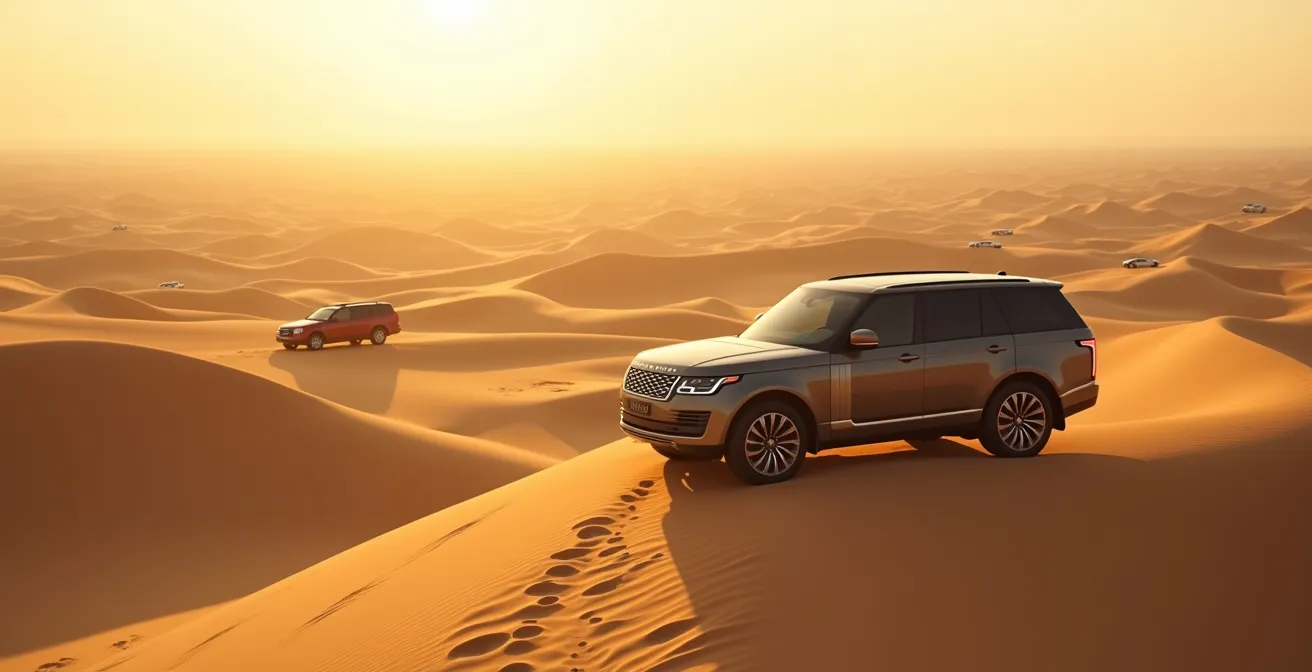
The ~$200 price difference isn’t for an ‘upgrade’; it’s for a completely different, superior product designed for romance and exclusivity.
- A private safari buys you quantifiable time and quality: 60-90 minutes of sunset photo time versus 10, and a dedicated guide focused solely on your experience.
- It eliminates ‘hidden costs’ like long queues for short activities and constant upselling pressure, maximizing your romantic ROI.
Recommendation: For a couple seeking a memorable, romantic, and seamless experience, the private safari isn’t just ‘worth it’—it’s the only option that truly delivers on that promise.
The choice between a shared and a private desert safari often boils down to a single, stark number: a price difference of around $200. For a couple planning a romantic getaway, this poses a real dilemma. Is that extra cost merely a fee for a bit of privacy, or does it unlock a genuinely different level of experience? The internet is filled with generic advice about “flexibility” and “avoiding crowds,” but these platitudes fail to address the core question: what tangible, romantic value are you actually purchasing?
The common mistake is to view the private option as a mere upgrade—like choosing a business class seat on the same plane. But what if that’s the wrong analogy? What if the private safari isn’t the same product with more legroom, but an entirely different mode of transport, like a private jet versus a public bus? The shared tour is an exercise in operational logistics, designed to move large numbers of people efficiently. The private tour is an exercise in crafting a personal narrative, designed to create memories.
This article deconstructs that $200 difference. We will move beyond vague notions of “luxury” and expose the ‘hidden curriculum’ you are paying for: the quantifiable gains in safety, the specific moments of intimacy, the ecological integrity, and the expert knowledge that a mass-market tour, by its very design, cannot provide. This is about understanding the real return on your romantic investment.
Summary: Private vs Shared Safari: Is the $200 Difference Worth It?
- Are Dune Bashing Safaris Safe for Toddlers in Car Seats?
- Sandals or Boots: What to Wear to Avoid Sand Burns and Scorpions?
- The “Free” Camel Ride Trap: How to Avoid Upselling at Camps?
- How to Spot a Safari Company That Respects the Desert Ecosystem?
- When Does the Camp Pick You Up to Guarantee Sunset Photos?
- Private Desert Dinner or Yacht Sunset: Which Offers Better Value for Couples?
- How to Glamp in the Desert Without Leaving a Carbon Footprint?
- How to Deflate Your Tires Correctly for Soft Sand Driving?
Are Dune Bashing Safaris Safe for Toddlers in Car Seats?
While this article is for couples, the question of safety, particularly with children, reveals the most critical difference between the two products. A shared safari operates on a fixed model for the majority. A private safari operates on a bespoke model for you. When it comes to dune bashing, this distinction is paramount. In a shared 4×4, the driver follows a pre-set route and intensity designed to thrill the average adult passenger. There is no room for customization. If your child becomes distressed, an immediate return is operationally impossible; you are locked into a 4-6 hour schedule with strangers.
A private safari, however, puts you in complete control. You can request a “scenic slopes only” drive, skipping the intense dune bashing entirely. Crucially, you can ensure vehicle compatibility with your specific child car seat brand, verifying pre-verified ISOFIX points before booking. This is a level of due diligence that shared operators cannot and do not offer. You are not just buying a private car; you are buying a private security detail where the driver’s sole focus is your family’s comfort and safety.
The cost difference becomes an insurance policy. This table, based on an analysis of safari safety features, highlights the non-negotiable advantages you are paying for.
| Safety Aspect | Private Safari | Shared Safari |
|---|---|---|
| Driver Control | 100% customizable intensity | Fixed route for majority preference |
| Emergency Exit | Immediate return possible | Locked into 4-6 hour schedule |
| Car Seat Compatibility | Pre-verified ISOFIX points | Standard seats only |
| Driver Focus | Dedicated to your family | Split attention (4-6 groups) |
| Cost for Family of 4 | AED 800-1200 per vehicle | AED 600-1000 total (150-250pp) |
Your Pre-Booking Safety Checklist
- Can you confirm the exact 4×4 model and its ISOFIX anchor points for our specific car seat brand?
- Will you send a photo of the installed car seat for verification before pickup?
- Can we dictate the dune bashing intensity, including a ‘scenic drive only’ option?
- What is your exact protocol for an immediate return to the hotel if a passenger feels unwell?
- Do you carry pediatric first-aid supplies and are your guides trained in child-specific emergency procedures?
Sandals or Boots: What to Wear to Avoid Sand Burns and Scorpions?
The question of footwear seems trivial, but it’s a powerful indicator of the underlying quality of your camp experience. In many shared safaris, the “camp” is a large, communal area with basic facilities and sand floors. Here, closed-toed shoes or boots are non-negotiable, not just for comfort, but for safety against hot sand after sunset and the (admittedly rare) possibility of scorpions.
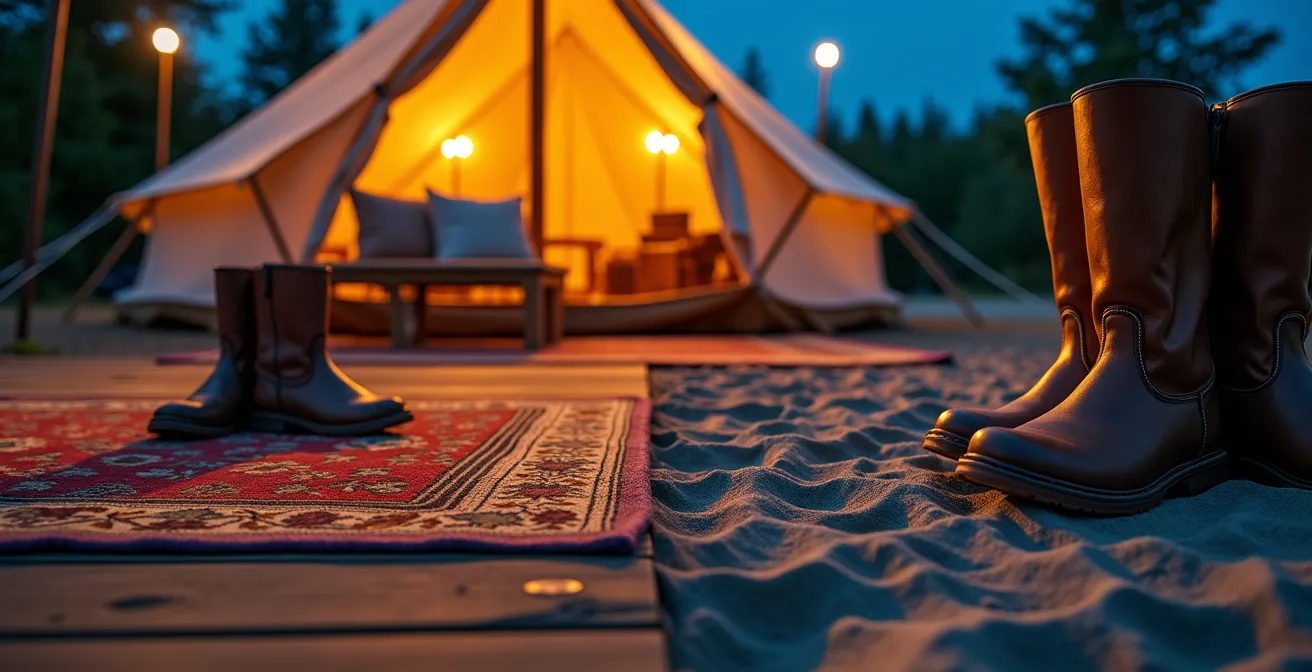
This is where the “product, not upgrade” concept becomes clear. A private safari often includes a truly private or premium camp setup. As one case study on camp quality notes, private desert camps are designed for exclusivity and luxury, often featuring wooden decking, Persian rugs, sofa seating, and fine dining arrangements. This transforms the environment entirely. In this setting, elegant sandals are not only possible but appropriate, allowing for a more comfortable and glamorous evening. You are not paying to “avoid scorpions”; you are paying for an environment where they are not a concern in the first place.
The guide’s role also evolves in a private setting, moving from a simple driver to a true naturalist. As a Dubai Desert Safari Safety Expert highlights in a guide training manual:
A good private guide is a naturalist who can spot scorpion tracks, knows which areas are safe to walk barefoot after sunset, and will proactively guide you away from risks.
– Dubai Desert Safari Safety Expert, Dubai Desert Conservation Reserve Guide Training Manual
This expertise is part of the hidden curriculum you purchase with a private tour—an invisible layer of safety and knowledge that elevates the entire experience from a simple outing to a genuine desert immersion.
The “Free” Camel Ride Trap: How to Avoid Upselling at Camps?
Nothing sours a romantic evening faster than feeling like a mark in a tourist trap. The “free” camel ride included in most shared safaris is a classic example. The reality is often a brief, 2-minute loop on an overworked animal, preceded by a significant wait. An analysis of shared safari camp operations reveals that a 45-minute average queue time is common for this “free” perk. This has a disastrous “Romantic ROI.” You trade nearly an hour of your precious evening for a fleeting, crowded, and ultimately unsatisfying photo op.
This is just the tip of the iceberg. Shared camps are often rife with upselling for everything from better seating and shisha to longer camel rides or photos with falcons. The business model relies on these micro-transactions. A private safari flips this model on its head. The higher upfront cost is an investment in eliminating the entire upselling ecosystem. Activities are integrated seamlessly into your evening because they are exclusively for you.
The camel experience is a perfect illustration. Instead of a centralized queuing station, a private operator can arrange a genuine 30-minute camel trek at sunset, away from any crowds. This is no longer a cheap thrill; it becomes an authentic, peaceful, and deeply romantic moment. To ensure you’re booking a truly private experience and not a “private car, shared camp” hybrid, you must ask pointed questions. Are the animals owned by the company or a third-party vendor? Is the experience at a centralized station or integrated into your private evening? This is not about paying more; it’s about paying for an experience free of queues, crowds, and commercial pressure.
How to Spot a Safari Company That Respects the Desert Ecosystem?
For a discerning couple, true luxury is increasingly tied to sustainability and authenticity. Choosing a safari company becomes an ethical decision as much as a financial one. Mass-market shared tours, by their very nature, have a larger environmental impact. Convoys of ten or more vehicles create more soil compaction and disturbance than a single, carefully driven 4×4. A private tour offers an intrinsically lower environmental footprint, a fact highlighted by a 2024 Environmental Impact Assessment from the Dubai Desert Conservation Reserve.
However, the real differentiator lies in a company’s core philosophy. Many operators use vague terms like “eco-tour” without substantiation. A truly responsible operator will have specific, verifiable credentials. Do they partner with official bodies like the Dubai Desert Conservation Reserve (DDCR)? Do they employ trained naturalist guides who enforce observation-only wildlife policies, or do they promote feeding and handling wild animals for photos? Do their camps use temporary setups and renewable energy, or permanent concrete structures?
The price difference is often a direct reflection of this commitment. Maintaining a fleet of modern, well-serviced vehicles, paying for DDCR access fees, and employing highly-trained, certified naturalist guides is expensive. These costs are absorbed in the premium price of a private safari, making it a direct investment in the conservation of the very desert you’ve come to admire.
This comparative table helps distinguish genuine conservation efforts from “greenwashing.”
| Aspect | Red Flags | Green Flags |
|---|---|---|
| Marketing Terms | Vague ‘eco-tour’ with no proof | Specific conservation partnerships (e.g., Dubai Desert Conservation Reserve) |
| Wildlife Interaction | Promoting feeding wild animals | Observation-only policies with trained naturalist guides |
| Scale of Operation | Convoys of 10+ vehicles | Single vehicle for 2-4 people (lower footprint) |
| Camp Infrastructure | Permanent concrete structures | Temporary setups, solar power, greywater recycling |
| Waste Management | No mention of practices | Detailed zero-waste policies, no single-use plastics |
When Does the Camp Pick You Up to Guarantee Sunset Photos?
For a couple on a romantic trip, the sunset photo is not just a picture; it’s the iconic, frame-worthy moment of the entire desert experience. This is where the operational difference between shared and private tours becomes painfully clear. A shared tour’s itinerary is a compromise, dictated by the need to get a large group from the dunes to the camp for the dinner and show. The sunset stop is often a rushed, crowded affair at a non-exclusive location.
A private tour, in stark contrast, is built *around* the sunset. The entire afternoon’s timing is reverse-engineered from that perfect golden hour moment. This is part of the ‘hidden curriculum’ your private guide executes flawlessly.
The Golden Hour Itinerary Advantage
As detailed in a recent analysis of VIP packages, private tours are built around the sunset. Experienced guides time the dune bashing to conclude at a pre-selected, secluded vantage point approximately 20-30 minutes before the sun dips below the horizon. This allows for relaxed, crowd-free photo opportunities. This flexibility is a godsend for photographers and content creators, but for a couple, it means something more profound: a moment of genuine intimacy, watching the desert change colours in peace. The experience can even be extended to capture the ‘blue hour’ post-sunset or for astrophotography—luxuries of time that are simply non-existent in a rigid shared schedule.
The numbers are telling. A separate time analysis shows that shared tours offer a frantic 10 minutes of photo time on average, compared to a leisurely 60-90 minutes of quality photo time on a private tour. You are not just paying for a private car; you are paying for the time and creative freedom to capture the perfect romantic memory, without a dozen other tourists in your frame.
Private Desert Dinner or Yacht Sunset: Which Offers Better Value for Couples?
When considering a high-end romantic experience in Dubai, the private desert dinner often finds itself in competition with another classic: a private yacht sunset cruise. While both offer luxury and exclusivity, their “Romantic ROI” can be vastly different. A yacht trip, while glamorous, often means being moored near dozens of other boats, with music from neighboring vessels potentially disrupting the peace. The experience is also highly weather-dependent, with choppy seas capable of spoiling the evening.
A truly private desert dinner, however, can offer something increasingly rare: absolute silence and solitude under the stars. This point is often emphasized by luxury travel advisors. In a report for the Dubai Tourism Board, one advisor noted, ” A truly private desert dinner can offer absolute silence and solitude under the stars, while a ‘private’ yacht may still be moored near dozens of others with loud music.” This level of profound privacy is the ultimate luxury.
The service ratio also tends to be higher in the desert. It’s not uncommon for a private dinner setup to involve a dedicated guide, a private chef, and a personal waiter for a single couple—a 3:2 service ratio. This ensures a level of attention and personalization that is difficult to match at sea. While the price point for both can be similar, the desert dinner often provides a more unique, authentic, and deeply intimate backdrop, making it the superior choice for couples prioritizing genuine connection over polished glamour.
To vet a potential operator, one must ask critical questions: Can you show me the exact menu? What is the physical setup? And most importantly: how far are we from any other groups?
How to Glamp in the Desert Without Leaving a Carbon Footprint?
The concept of “glamping” or luxury camping in the desert can seem at odds with environmental responsibility. However, choosing a private, premium operator is often the most sustainable way to experience the desert. Counterintuitively, a smaller, more exclusive operation can have a significantly lower per-person carbon footprint. As environmental impact studies demonstrate, there are up to 40% lower emissions per person in small private groups versus large convoy tours, simply due to the reduced number of vehicles and more efficient logistics.
Beyond vehicle emissions, the most reputable private operators build sustainability into their business model, a cost reflected in their premium pricing. They are pioneers of a “zero-impact” philosophy.
The Zero-Impact Business Model
Operators like Platinum Heritage have built a world-renowned reputation by making conservation their core mission. Their entire operation is a masterclass in sustainability. They use solar panels for all camp power needs, implement advanced greywater recycling systems, source food from local farms to reduce food miles, and even build carbon offset costs directly into their pricing structure. Their success, including numerous TripAdvisor awards, proves that eco-conscious operations can deliver superior, five-star experiences. When you book with such a company, part of your fee is a direct contribution to these sustainable practices.
This is the epitome of “experience arbitrage.” By paying the premium for a top-tier private safari, you are not only buying a better, more exclusive experience for yourself but also actively investing in a model that preserves the desert for future generations. You are trading a cheap, high-impact tour for a premium, low-impact one, where the value gained—both experiential and ethical—far outweighs the monetary cost.
Key takeaways
- The price difference between safaris is not a fee for privacy, but payment for a different, higher-quality product with tangible benefits.
- Private safaris offer quantifiable advantages in time (90 vs. 10 mins for photos), safety (customizable dune bashing), and comfort (premium camps).
- Choosing a premium private operator is often a more sustainable choice, with a lower carbon footprint per person and direct investment in conservation.
How to Deflate Your Tires Correctly for Soft Sand Driving?
This question seems deeply technical, something for a mechanic, not a tourist. Yet, the answer is the perfect metaphor for the entire private vs. shared safari debate. For soft sand driving, tire pressure must be reduced to increase the tire’s “footprint” and prevent the vehicle from sinking. There is no single “correct” pressure. It changes based on the sand’s softness, the ambient temperature, the specific vehicle’s weight, and the type of driving planned. Getting it wrong leads to a bumpy, uncomfortable ride at best, and getting stuck or even damaging the vehicle at worst.
In a shared safari convoy, drivers often use a one-size-fits-all pressure setting, optimized for speed and efficiency across the group. They don’t have the time or incentive to fine-tune it for passenger comfort. This is the “operational” mindset. The ride quality is a secondary concern to keeping the convoy on schedule.
This is the ultimate ‘hidden curriculum’ of the private safari. As the Desert Driving Safety Institute states, ” An expert private guide adjusts pressure dynamically—a skill that ensures a smoother, safer ride.” This is an act of constant, invisible expertise. You don’t see it, and you may not even know it’s happening, but the comfort, smoothness, and safety of your journey are a direct result of this skill. This is what you are paying for with that $200 difference. You are not just renting a Land Cruiser; you are hiring the expert hand that knows precisely how much air to release for a perfect journey across the sand.
Ultimately, the decision rests on what you value. If the goal is a cheap ticket to see the desert, a shared safari serves its purpose. But if the goal is a seamless, romantic, and memorable experience where every detail is considered—even the ones you can’t see, like the air in the tires—then the private safari isn’t just an option; it’s the only product that can truly deliver.