
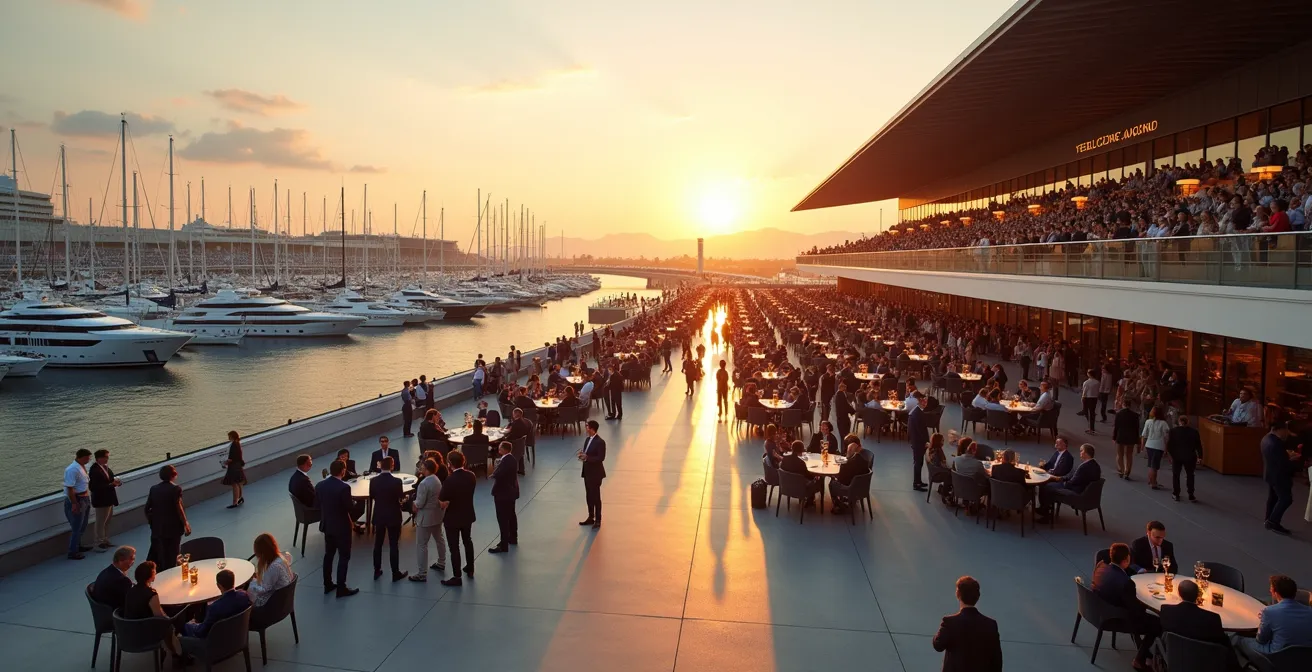
The most valuable networking at the F1 Grand Prix doesn’t happen in the stands; it’s won in the strategic “in-between” moments that most attendees overlook.
- Your ticket choice dictates your social orbit, but real connections are forged by exploiting logistical inefficiencies.
- Challenges like post-race transport and after-party access are not problems; they are engineered opportunities for captive-audience networking.
Recommendation: Shift your mindset from ‘spectator’ to ‘strategist’. Treat the Grand Prix weekend as a 72-hour business campaign where your primary goal is return on relationships, not just return on investment.
For the ambitious professional, the Formula 1 Grand Prix presents a paradox. You’re there for the high-octane energy, the spectacle, and the roar of the engines. But more importantly, you’re there for the unparalleled concentration of capital, influence, and decision-making power gathered in one place. The common advice is predictable: secure a Paddock Club pass and hope for the best. This approach is passive and leaves the most critical variable—your networking success—entirely to chance.
This strategy mistakes the ticket for the key. While access is crucial, true mastery of the F1 networking ecosystem lies not in the designated hospitality zones, but in the transitional spaces and logistical challenges that surround the main event. It’s about understanding the social physics of the weekend and positioning yourself at points of strategic friction where genuine conversations can flourish away from the noise.
But what if the key wasn’t simply getting into the most exclusive room, but rather understanding how to leverage every moment outside of it? What if the post-race traffic jam or the scramble for concert access were actually the weekend’s most potent networking opportunities in disguise? This is where the real ROI is generated. It requires a shift from being an attendee to becoming a social strategist, orchestrating encounters with precision.
This guide deconstructs the Grand Prix weekend into a series of actionable strategic plays. We will explore how to gain access to exclusive events without the prerequisite ticket, turn logistical nightmares into networking gold, and decode the subtle signals that open doors. We will move from basic attendance to mastering the art of high-level connection in the world’s most glamorous sporting arena.
To help you navigate this high-stakes environment, we’ve broken down the essential strategies into a clear roadmap. This guide will provide a framework for turning every aspect of the Grand Prix weekend into a calculated opportunity for building your network.
Summary: A Strategist’s Playbook for F1 Networking and Business Development
- How to Get into the After-Race Concerts Without a Race Ticket?
- The Transport Trick to Escape Yas Island After the Race
- Hotel vs Airbnb: Where to Stay for the Grand Prix on a Budget?
- Paddock Club Dress Code: What Gets You Denied Entry?
- When Do “Early Bird” F1 Tickets Actually Sell Out?
- Why Missing the Abu Dhabi Grand Prix is a Business Strategy Error?
- When to Book Your New Year’s Eve Yacht to Secure a Palm View?
- How to Build a High-Level Network in Dubai From Scratch in 3 Months?
How to Get into the After-Race Concerts Without a Race Ticket?
The after-race concerts are a focal point of the Grand Prix’s social energy, but access is often perceived as exclusive to ticket holders. This is a misconception. For the savvy networker, the concerts represent a prime opportunity for social arbitrage—exploiting the information gap between official access and unofficial entry points. The goal isn’t just to see the show; it’s to mingle with high-value individuals as they decompress from the race day intensity.
The first step is strategic reconnaissance. Weeks before the event, identify the key sponsors, particularly those in sectors relevant to your business like technology, finance, or luxury goods. These companies often host private viewing areas or distribute access passes to their own VIPs. Establishing a professional connection via platforms like LinkedIn, based on mutual business interests, can often yield an invitation. This preemptive digital groundwork lays the foundation for face-to-face interaction.
In the 48 hours leading up to the race, social media becomes your real-time intelligence feed. Monitor event-specific hashtags to identify unofficial after-parties and sponsor events held at nearby hotels. Finally, during the concert itself, your physical position is paramount. Rather than aiming for the front of the stage, position yourself at key egress points from premium hospitality zones like the Paddock Club. As VIPs transition between venues, you create a window for a brief, strategic encounter, turning a fleeting moment into a valuable introduction.
Ultimately, getting into the after-race concert is less about the music and more about placing yourself in the flow of influential people. It’s a calculated play that prioritizes connection over entertainment.
The Transport Trick to Escape Yas Island After the Race
The post-race exodus from Yas Island is legendary for its gridlock. While most see this as a frustrating end to the day, the strategist sees it as the weekend’s single greatest opportunity for strategic friction. When high-net-worth individuals are stationary and captive, their time becomes your most valuable asset. The trick is not to avoid the traffic, but to re-frame the mode of transport itself into a curated networking environment.
Instead of joining the chaotic queue for taxis, pre-organize a shared luxury van or, even better, a chartered speedboat with a select group of 4-6 other professionals. By curating the passenger list with individuals from complementary industries, you transform a one-to-two-hour travel delay into a private, high-powered mobile meeting. The shared experience of bypassing the chaos creates an immediate bond and a relaxed setting for substantive conversation. Certain water taxi routes, particularly those connecting the circuit to five-star hotels like the W Abu Dhabi, become concentrated channels of influential attendees.
This concept is best visualized by picturing a luxury water taxi at sunset, where connections are being made against the backdrop of the marina. It’s the epitome of turning a logistical problem into an exclusive opportunity.
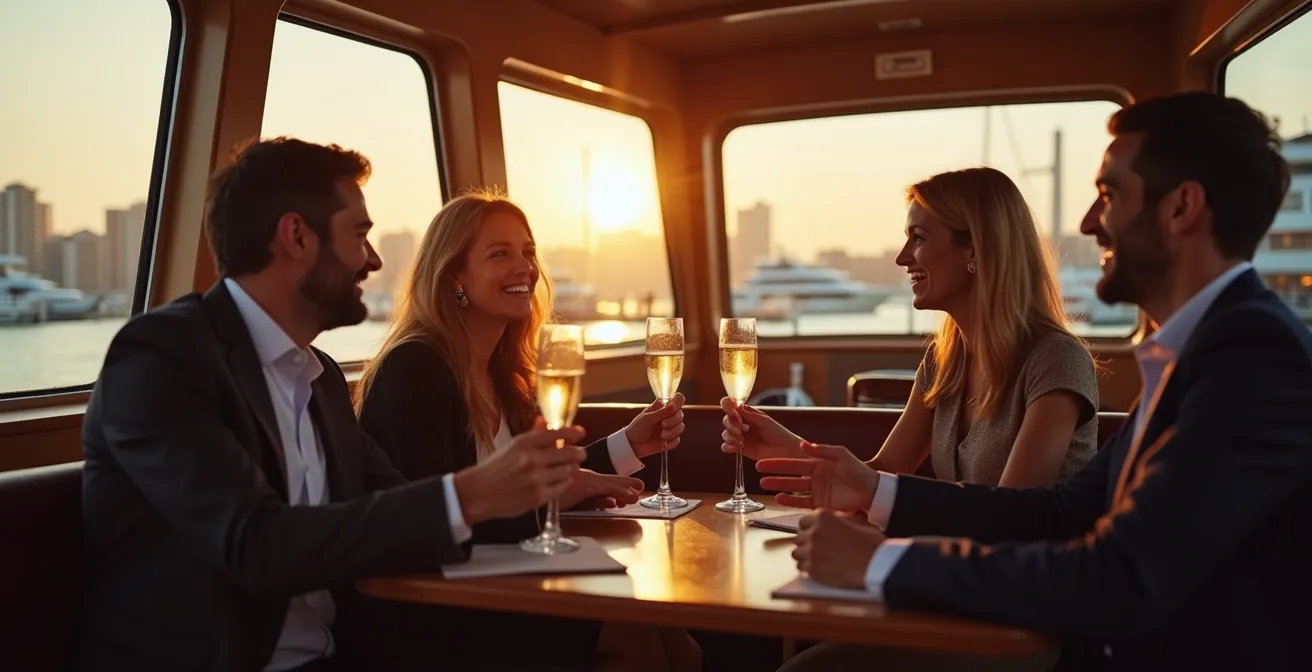
As the image suggests, the right environment fosters genuine connection. The goal is to create a memorable, exclusive experience that separates you and your new contacts from the crowd, both literally and figuratively. This is where deals are initiated and relationships are solidified, long after the checkered flag has fallen.
Your Action Plan: Turning Post-Race Traffic into a Networking Asset
- Book a dinner reservation at a high-end Yas Island restaurant for 2 hours post-race to network with other strategic thinkers while traffic subsides.
- Pre-organize a shared luxury van or chartered speedboat with 4-6 other professionals, turning the 1-2 hour travel time into a captive networking session.
- Target specific water taxi routes from the circuit to 5-star hotels like W Abu Dhabi or Hilton for concentrated encounters with high-net-worth individuals.
- Position yourself in hotel lobby bars immediately post-race, where dealmakers gather while waiting for traffic to clear, creating an impromptu networking hub.
- Create a pre-race WhatsApp group for attendees from similar industries to coordinate shared luxury transport and amplify networking opportunities.
This approach demonstrates foresight and an ability to create value out of a universally acknowledged pain point, a quality that is highly respected in any business circle.
Hotel vs Airbnb: Where to Stay for the Grand Prix on a Budget?
For the professional focused on networking ROI, the choice of accommodation during the Grand Prix is not about comfort; it’s a critical strategic decision that dictates your access and influences your network velocity. The “budget” aspect is relative; it’s about allocating capital where it will generate the highest return in connections. A cheaper Airbnb might save you money, but it could cost you invaluable opportunities that arise from the curated environment of a five-star hotel.
The lobby bar of a top-tier hotel like the W Abu Dhabi or the Yas Hotel becomes an unofficial headquarters for dealmakers, investors, and team principals. It’s a fluid, 24/7 networking environment where spontaneous meetings happen. The hotel concierge also acts as a gatekeeper to private dinners and exclusive sponsor parties. This ambient access has a significant, if unquantifiable, value that an isolated Airbnb cannot offer. Conversely, an exclusive residential tower Airbnb can provide access to influential local residents and a private, controlled space for hosting your own small, curated gatherings.
The savviest operators often employ a “Split Stay Strategy”—using budget-friendly options for practice and qualifying days, then moving to a premium hotel for the race night and the crucial 24 hours that follow. This hybrid approach optimizes both cost and access, placing you in the right place at the right time. The key is to analyze the trade-offs not in terms of dollars saved, but in terms of networking potential gained or lost.
The following analysis breaks down the strategic value of each accommodation option beyond the simple nightly rate, as detailed in an assessment of hospitality environments.
| Accommodation Type | Average Cost (3 nights) | Networking ROI Factors | Strategic Value Score |
|---|---|---|---|
| 5-Star Hotel with Active Lobby Bar | $2,500-4,000 | Direct access to dealmakers, spontaneous meetings, concierge connections to private events | 9/10 |
| Exclusive Residential Tower Airbnb | $1,200-2,000 | Access to resident-only amenities, meetings with influential locals, privacy for hosting | 7/10 |
| Budget Airbnb + Strategic Hotel Day Pass | $600-1,000 | Cost savings for race tickets upgrade, selective lobby access during peak hours | 6/10 |
| Split Stay Strategy | $1,500-2,500 | Budget practice days, premium race night positioning, maximum flexibility | 8/10 |
Ultimately, your accommodation is your base of operations. Choosing it wisely is the first step in executing a successful networking campaign during the Grand Prix.
Paddock Club Dress Code: What Gets You Denied Entry?
Entry to the F1 Paddock Club is about more than just having the right pass; it’s about projecting the right image. The dress code is the first and most crucial filter. While explicit rules forbid shorts and flip-flops, the unwritten rules are far more important for the business professional. Your attire is not just clothing; it is signal attire—a non-verbal communication of your industry, status, and understanding of the environment. Getting this wrong can not only get you denied entry but, more importantly, can close social doors before you even open them.
The official guidance often suggests a simple “business casual.” However, as F1 Las Vegas Grand Prix Officials noted in their business summit guidelines, the real key is “business casual with a race-day twist.”
Business casual with a race-day twist. Think polished yet comfortable—blazers, sport coats, dress shirts, or stylish separates paired with footwear suitable for walking
– F1 Las Vegas Grand Prix Officials, F1 Business Summit Dress Code Guidelines
This means interpreting the code through the lens of your professional identity. A tech founder might opt for premium sneakers, a designer polo, and a luxury smartwatch, signaling a modern, agile approach. In contrast, a private equity partner might choose a tailored suit without a tie and fine Italian leather shoes, projecting tradition and stability. The details matter immensely. A specific watch brand, a discreet university alumni pin, or a subtle logo from a portfolio company can act as powerful conversation starters for those in the know. It is also critical to ensure your guest’s attire matches your own standard, as a mismatch reflects poorly on your judgment and can limit your collective social access.
The most common errors are not just being too casual, but being inappropriately branded. Wearing clothing with large, non-F1 commercial logos marks you as an outsider. The goal is to look like you belong in the inner circle, not like you’re trying to advertise to it. Polish, comfort, and subtle signaling are the three pillars of a successful Paddock Club sartorial strategy.
Your outfit is your opening statement. In an environment where first impressions are formed in seconds, ensuring your attire speaks the right language is a non-negotiable part of your event strategy.
When Do “Early Bird” F1 Tickets Actually Sell Out?
The term “early bird” in the context of F1 tickets is often misunderstood as a simple discount mechanism. For the strategic networker, it’s a critical timing indicator. Securing tickets early is not just about the financial savings, which can be significant. Analysis shows that early bird prices can save you up to 15% on tickets, with some tracks offering even deeper discounts. However, the real value lies in what the timing of your purchase signals and the access it unlocks.
The “sell-out velocity” of certain grandstands is a powerful data point. High-demand areas that sell out within hours of release are populated by the most passionate, engaged, and often most affluent fans and business attendees. Being part of this initial wave positions you among the core audience. For example, a case study of a recent Canadian Grand Prix showed that several popular grandstands sold out within hours of going on sale. Monitoring this velocity helps you identify where the most valuable crowds will congregate.
Executing an early bird strategy requires a proactive, data-driven approach. It’s about more than setting a calendar reminder; it’s about analyzing past sales data, understanding which hospitality packages offer the best networking value, and being prepared to act decisively the moment they are released. This level of planning is a strategic advantage in itself.

As this image conveys, securing the right access is a matter of strategic planning, not luck. The most successful operators treat ticket acquisition like a market analysis, using all available information to secure a position that maximizes their potential for high-value encounters throughout the race weekend. This foresight signals a level of seriousness that resonates with other high-level professionals.
In essence, buying early isn’t about being cheap; it’s about being smart. It’s the first move in a well-played game, setting the stage for a successful and profitable Grand Prix weekend.
Why Missing the Abu Dhabi Grand Prix is a Business Strategy Error?
Viewing the Abu Dhabi Grand Prix as merely an optional entertainment event on the corporate calendar is a fundamental strategic miscalculation. In the regional business landscape, it is the undisputed apex event of the year—a gravitational center for capital, political influence, and cross-border deal flow. To be absent is to be invisible during the year’s most critical concentration of opportunity, especially for closing deals before the fiscal year-end.
The sheer economic scale is staggering. The 2024 race alone demonstrated the immense financial gravity of the event, with an economic impact that underscores its importance. Data confirms that the 2024 Formula One Abu Dhabi Grand Prix generated AED 1.25 billion in visitor spending. This isn’t just tourist money; it’s a direct measure of the high-level business activity happening in and around the circuit. The spending power concentrated in one location over four days is unparalleled.
What makes this event uniquely powerful is the composition of the crowd. It is not a local affair. A recent analysis highlighted that an astonishing 70 percent of spectators came from abroad. This international contingent is not comprised of casual tourists; it is a curated assembly of global CEOs, high-net-worth investors, government ministers, and key decision-makers. The Paddock Club and surrounding hospitality suites become a de facto global business summit, where introductions that would typically take months of travel and effort can happen in a matter of hours.
Missing the Grand Prix is not just missing a race; it’s willingly opting out of the most efficient and potent platform for regional business development. The “chance” encounters in the hospitality suites and at sponsor events are often the catalyst for the region’s most significant enterprise sales and investment deals.
In a world where access is everything, the Abu Dhabi Grand Prix provides the most condensed and valuable access available. Choosing not to participate is a passive decision to let your competitors own the conversation.
When to Book Your New Year’s Eve Yacht to Secure a Palm View?
The strategic mindset cultivated at the F1 Grand Prix extends directly to other apex social events on the Dubai calendar, most notably New Year’s Eve. Securing a yacht with a prime view of the Palm Jumeirah fireworks is not a last-minute decision; it is a continuation of the networking campaign that began at the racetrack. The contacts and social proof gained during the F1 weekend are the currency used to unlock the most exclusive NYE experiences.
The booking timeline for an NYE yacht is a form of social signaling. Booking as early as February to April indicates “old money” planning and foresight, securing the best vessels and mooring positions before the market heats up. This early commitment can also be leveraged; using your confirmed Paddock Club or F1 hospitality booking with yacht charter companies can often result in preferential rates and access. Inversely, booking in the September-October window is more typical for corporate entertainment or “new money” displays of last-minute access.
However, the most valuable yachts are often unbookable through conventional means. As a report on F1’s commercial power notes, the real value is in the ecosystem.
B2B deal flow: Paddock doors open to CEOs, ministers, and investors. Many ‘sponsorships’ pay for themselves through enterprise sales and networking
– Race Sundays Analysis, Inside F1’s Money Machine Report
This same principle applies to NYE. The most coveted invitations are to private yacht parties hosted by the very individuals you met at the Grand Prix. Your F1 networking is the key that transforms you from someone who needs to charter a yacht to someone who is invited onto one. The social capital you build in November directly translates into unparalleled access on December 31st.
Treating these two events as part of a single, continuous campaign maximizes the ROI on both, turning a four-day race weekend into a powerful springboard for months of high-level social and business opportunities.
Key Takeaways
- Strategic ROI over Sightlines: The best “seat” is the one that places you in the flow of your target network, not the one with the best view of the track.
- Master the ‘In-Between’: The most valuable networking happens in transitional moments—transport, queues, and post-event gatherings—not in formal settings.
- Dress to Signal, Not Just to Impress: Your attire is a strategic tool to communicate your industry, status, and understanding of the exclusive environment.
How to Build a High-Level Network in Dubai From Scratch in 3 Months?
Building a high-value network in a dynamic hub like Dubai from a standing start seems daunting, but it can be achieved with a disciplined, three-month strategic sprint culminating at the F1 Grand Prix. This approach treats networking not as a series of random encounters, but as a structured campaign with clear phases: digital reconnaissance, physical engagement at feeder events, and final consolidation at the apex event—the Grand Prix itself. The Paddock Club and its surrounding ecosystem are where this campaign comes to life, a place where teams actively facilitate introductions between sponsors and high-profile guests.
The process begins long before the race. The first month is dedicated to digital reconnaissance, identifying and researching a curated list of keystone individuals in your target sectors. This phase is about understanding their interests and professional activities, allowing for warm, informed outreach on platforms like LinkedIn. The second month transitions to physical engagement. Attending smaller, industry-specific feeder events—such as yacht shows, business forums, or art galas—allows you to secure initial face-to-face introductions in a less-crowded environment. These are the preliminary conversations that lay the groundwork for a more significant meeting later.
The third month is all about consolidation, with the Grand Prix serving as the grand finale. By this stage, you are no longer a stranger. You can leverage the event to reconnect with the contacts made in the previous months, solidifying those nascent relationships in a high-energy, memorable setting. Hosting a small, private gathering or a pre-race breakfast for your new contacts is an excellent way to cement your position as a valuable and well-connected player.
This structured approach transforms a cold start into a warm, established network in a remarkably short period. It requires discipline and a clear understanding of how different social arenas fit into a broader strategy.
| Month | Focus | Key Activities | Expected Outcomes |
|---|---|---|---|
| Month 1 | Digital Reconnaissance | LinkedIn research of 10 keystone individuals, content sharing, initial outreach | 3-4 warm digital connections established |
| Month 2 | Industry Feeder Events | Attend 2-3 smaller industry events, yacht shows, business forums | 5-6 face-to-face introductions completed |
| Month 3 | F1 GP Consolidation | Leverage GP as apex event for all introductions, host private gathering | 10 high-value relationships solidified |
By applying this strategic framework, the F1 weekend ceases to be a one-off event and becomes the powerful culmination of a well-executed campaign to embed yourself within Dubai’s elite business circles.