
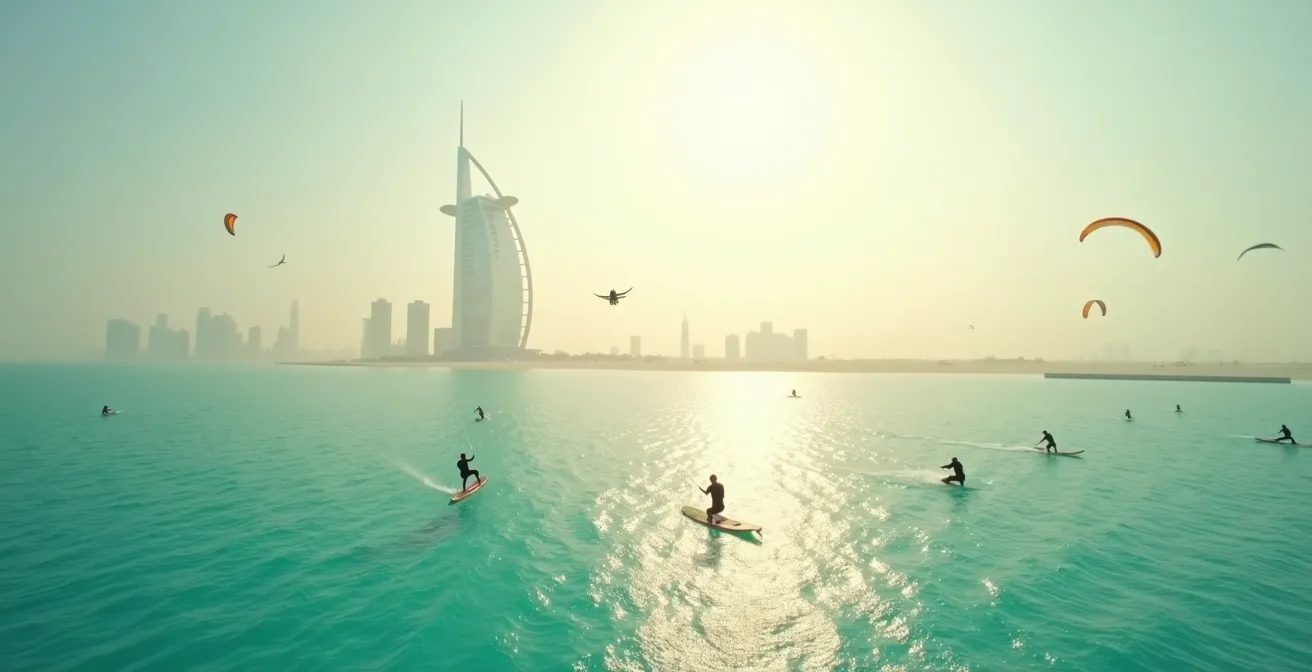
For kiters frustrated by Dubai’s seemingly random conditions, the solution isn’t just knowing which beach to go to, but when. Consistent wind is rarely an all-day affair. The key is mastering a predictive system that decodes the subtle interplay of thermal breezes, seasonal Shamal winds, and tidal patterns. This approach allows you to pinpoint specific, narrow “wind windows” of opportunity for powerful sessions, turning frustrating flat days into predictable moments of adrenaline.
The universal image of kitesurfing in Dubai is one of vibrant kites against a futuristic skyline. Yet, for any kiter who has actually stood on the sand, the reality is often a frustrating dance with the wind gods. You see promising forecasts that never materialize, or you arrive to find either a millpond or dangerously gusty conditions. You’ve heard the standard advice: go to Kite Beach, check the apps, maybe try Nessnass if you’re a beginner. But this advice only scratches the surface and often leads to disappointment.
The truth, as any seasoned local instructor will tell you, is that Dubai’s wind is a complex but predictable system. Most sessions are light; local wind pattern analysis shows that conditions hover between 8-12 knots for 80% of sessions, with strong winds being a rare treat. As one report notes, even in the peak season, you get mostly light winds, and only occasionally do you see days above 20-25 knots. So, what if the secret wasn’t about finding a magically windy beach, but about learning to read the specific environmental cues of the UAE to anticipate when and where the best conditions will align? This is not about luck; it’s about strategy, observation, and understanding the principles that govern all high-adrenaline sports in this unique environment.
To truly master kitesurfing here, you must first adopt the mindset of a well-rounded extreme sports athlete. This guide will delve into the rules, risks, and gear considerations across various disciplines—from desert biking to deep-sea diving—to build a holistic framework. Each section will reveal a principle that circles back to making you a smarter, safer, and ultimately more successful kitesurfer in Dubai.
For those who prefer a visual introduction, the following video captures the unique atmosphere and energy of kitesurfing along Dubai’s iconic coastline, setting the scene for the practical advice in this guide.
In the following sections, we will explore the critical principles of safety, environmental awareness, and equipment management that are essential for any serious athlete in the UAE. This structured approach will equip you with the knowledge to not only find consistent wind but to thrive in Dubai’s dynamic kitesurfing scene.
Summary: Mastering Extreme Sports in the UAE for Better Kitesurfing
- The Rules of Off-Road Biking: Where Can You Legally Ride?
- Fujairah vs Dubai: Where Are the Best Wrecks for Advanced Divers?
- Why Standard Health Insurance Denies Claims for Extreme Sports Injuries?
- Rent or Buy: Is it Worth Owning Your Own Kitesurfing Rig in UAE?
- When Does the Kitesurfing Season Officially End in UAE?
- The License You Need to Captain Your Own Boat in UAE Waters
- What to Eat Before a Jump to Avoid Nausea in Freefall?
- Palm Dropzone vs Desert Campus: Which Skydive Offers Better Views?
The Rules of Off-Road Biking: Where Can You Legally Ride?
Before you can master the wind, you must first respect the ground rules. This principle is vividly illustrated in the world of off-road biking in the UAE. It’s not a free-for-all in the desert; riders are confined to marked trails and designated zones like those at Al Qudra. Venturing off these paths is not only illegal but dangerous, as it increases the risk of getting lost and complicates rescue efforts. This concept of designated zones is a direct parallel to kitesurfing.
Just as a biker must stick to the trail, a kiter must respect the official launch and ride zones at beaches like Kite Beach and Nessnass. These areas are established to keep kiters clear of swimmers, jetties, and other hazards. Ignoring these zones doesn’t just endanger you; it endangers the public and jeopardizes the entire sport’s access to these prime locations. The discipline learned in the desert—following the marked path—is the same discipline required on the water. The table below draws a clear line between the safety protocols of these two seemingly different sports, revealing a shared philosophy of structured risk management.

This comparison highlights a fundamental truth for any extreme sport in the UAE: freedom and adrenaline are earned through strict adherence to a framework of safety rules. Whether it’s the right of way on an uphill dune or on a starboard tack, the underlying principle is identical. Understanding and internalizing these rules is the first step from being a tourist participant to a responsible local athlete.
The following table breaks down the shared safety principles, showing how the logic of desert trail riding directly applies to navigating a crowded kitesurfing spot.
| Safety Principle | Off-Road Biking (Al Qudra) | Kitesurfing (Dubai Beaches) |
|---|---|---|
| Designated Zones | Marked trails only, no desert roaming | Kite Beach & Nessnass official launch zones |
| Buddy System | Minimum 2 riders for desert safety | Never kite alone, especially downwinders |
| Right of Way | Uphill riders have priority | Starboard tack & beach launchers priority |
| Emergency Protocol | GPS beacon + water reserves | Maritime distress signals + float plan |
Fujairah vs Dubai: Where Are the Best Wrecks for Advanced Divers?
The concept of being “advanced” in an extreme sport is often misunderstood. It’s not just about technical skill; it’s about the ability to accurately assess risk and prepare for environment-specific hazards. A comparison between advanced wreck diving in Fujairah and advanced kitesurfing in Dubai illustrates this perfectly. An advanced diver isn’t just someone who can go deep; it’s someone who understands the risks of strong currents, plans for decompression stops, and knows the location of the nearest hyperbaric chamber. They are defined by their preparation, not just their performance.
Similarly, an advanced kitesurfer in Dubai is not just someone who can do complex tricks. It’s a rider who can handle the unique challenges of the local environment, such as a sudden drop in thermal wind while 500 meters offshore. This scenario is the kiter’s equivalent of a diver’s unexpected strong current—both are environmental hazards that demand robust self-rescue capabilities and a pre-planned emergency response. The confidence to go further or deeper comes from knowing you have a plan if things go wrong.
This proactive risk assessment is a mental muscle that must be trained. It involves thinking through worst-case scenarios and having a concrete plan for each. What do you do if your kite deflates offshore? What’s the protocol if a sudden Shamal wind comes through, overpowering your gear? Answering these questions before you launch is the true mark of an advanced rider.
Your Kitesurfing Risk Assessment Framework
- Define ‘Advanced’ Skills: Can you confidently handle offshore winds and self-rescue from beyond 500m from shore? This is the benchmark.
- Environmental Hazards Checklist: Be aware that sudden wind drops in Dubai are as dangerous as strong currents in Fujairah. Ensure your self-rescue skills are current.
- Emergency Response Protocol: Save the local maritime rescue contact (+971 4 345 0444) in your phone and know that Rashid Hospital has the relevant emergency facilities.
- Seasonal Risk Windows: Be extra cautious from May to September. Jellyfish blooms can complicate water rescues, and thermal wind instability increases the chance of sudden drops.
- Equipment Redundancy: For long-distance or downwinder sessions, consider carrying a self-rescue pack or informing a buddy who has a second kite ready on the beach.
Why Standard Health Insurance Denies Claims for Extreme Sports Injuries?
The thrill of progression in kitesurfing is undeniable, but it comes with inherent risks that the administrative world often fails to understand. While an estimated 1.5 million people practice kitesurfing worldwide, a significant number operate under the false assumption that their standard health or travel insurance has them covered. This is a dangerous and costly mistake, particularly in the UAE.
Most insurance policies contain “hazardous activity exclusions.” From an insurer’s perspective, launching yourself into the air with a giant kite is not a standard recreational activity. It’s a calculated risk that falls outside their normal coverage parameters. As industry analyses confirm, kitesurfing is excluded from most standard travel medical benefits. An injury claim, whether for a sprained ankle or something more serious, is highly likely to be denied, leaving you with a massive medical bill. This isn’t a malicious act by insurers; it’s a contractual reality based on risk assessment.
Understanding Hazardous Activity Exclusions in UAE Insurance Policies
Many standard travel and health insurance plans available in the UAE explicitly list activities like kitesurfing, skydiving, and scuba diving in their exclusion clauses. The key takeaway is that “extreme sports insurance” is rarely a standalone product. It’s typically an add-on or a specific type of plan that you must actively seek out. Simply having travel insurance is not enough; you must verify that it includes a rider or specific clause covering “hazardous sports,” and even then, you must check if kitesurfing is on the approved list.
Therefore, securing the right coverage is as critical a piece of safety equipment as your helmet or impact vest. It requires due diligence and asking pointed questions before you purchase a policy. You need to be your own advocate and ensure the coverage is explicit and in writing.
Checklist: Vetting Your Extreme Sports Insurance
- Ask the Specific Question: Directly ask your provider: “Does this policy cover injuries sustained while kitesurfing within 150km of the shore?” Get the answer in writing.
- Confirm Equipment Coverage: Request written confirmation that your policy covers equipment damage or loss up to its full replacement value, not a depreciated amount.
- Verify Evacuation Details: Confirm that emergency evacuation coverage is included and that it specifically mentions helicopter rescue from the water, a critical need in kitesurfing.
- Check Wind Speed Clauses: Some policies have fine print that voids coverage in winds above a certain speed (e.g., 20 knots). Ensure your policy remains valid in typical strong wind conditions.
- Understand Your Risk Tier: Ask if kitesurfing is classified as ‘Sports Group 1’ or an equivalent low-risk tier. A higher tier often means higher premiums or more exclusions.
Rent or Buy: Is it Worth Owning Your Own Kitesurfing Rig in UAE?
For any dedicated kiter, the dream is to own a quiver of brand-new gear. However, in the unique climate of the UAE, the “rent vs. buy” debate is not just a matter of cost—it’s a strategic decision influenced by wind conditions and rapid equipment degradation. While ownership offers freedom, renting in Dubai provides flexibility and safety advantages that are hard to ignore, especially for those who don’t kite multiple times a week.
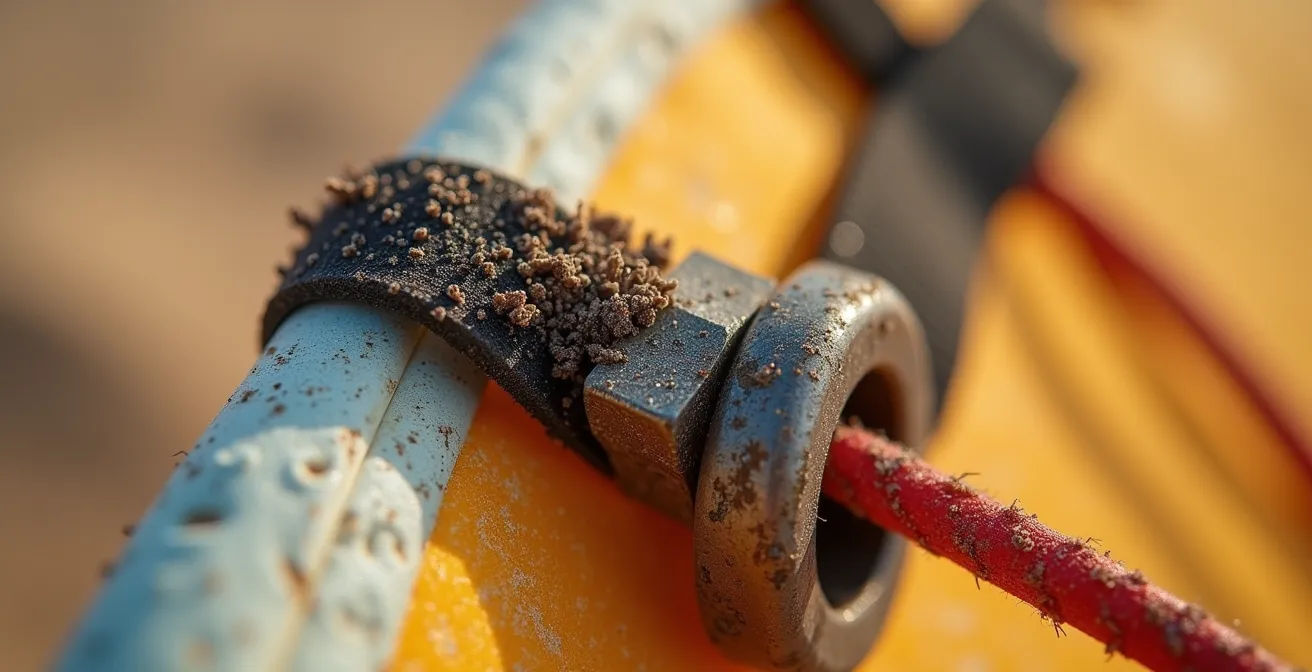
The two biggest arguments against ownership in this region are UV damage and wind variability. The intense desert sun is brutal on kite fabric and lines, significantly shortening their lifespan and compromising safety. Furthermore, Dubai’s light and variable winds mean you ideally need a large quiver (e.g., a 12m for average days and a 17m for light wind sessions) to maximize your time on the water. Owning, storing, and maintaining this gear is a significant financial and logistical commitment. Renting allows you to always have the perfectly sized, professionally inspected kite for the day’s specific conditions without the long-term overhead.
This macro shot reveals the unseen story of equipment wear in the desert heat. The sun-bleached fabric, frayed lines, and salt corrosion are not just cosmetic; they represent a progressive failure of safety-critical components that only a trained eye can spot.
A detailed cost analysis reveals that for the average kiter (around 20 sessions a year), renting is often the more financially sound and safer option. The initial outlay for ownership is just the beginning; maintenance and climate-controlled storage add significant ongoing costs that are often overlooked.
| Factor | Rental (Annual Cost) | Ownership (First Year) |
|---|---|---|
| Equipment | AED 400/session x 20 sessions = AED 8,000 | 2 kites (12m, 17m) + board = AED 15,000 |
| Maintenance | Included | UV damage repair + line replacement = AED 2,000 |
| Storage | None | Climate-controlled unit = AED 3,600/year |
| Safety Advantage | Professional inspection each use | Self-inspection risk |
| Wind Flexibility | Right-sized kite every session | Limited to owned sizes |
When Does the Kitesurfing Season Officially End in UAE?
The term “kitesurfing season” in the UAE is misleading. Unlike colder climates with a definitive end date, Dubai’s season doesn’t stop—it transforms. The prime season, with cooler temperatures and the chance of stronger Shamal winds, typically runs from October to April. However, when summer arrives, the game changes. The season doesn’t “end”; it transitions into the thermal wind season.
During the scorching summer months from May to September, the dominant wind pattern is a thermal sea breeze. This wind is created by the temperature difference between the hot land and the cooler sea. It’s generally lighter, ranging from 10 to 18 knots, and is most consistent in the afternoons. While experts hunting for 25-knot gales might be disappointed, this period is actually a hidden opportunity. The gentler, more predictable thermal winds create an ideal learning environment for beginners looking to practice safely or for intermediate riders wanting to perfect new tricks without being overpowered.
So, the “off-season” is not a time to pack your gear away. It’s a time to adapt your discipline. The lighter winds are perfect for transitioning to other board sports that maintain and build complementary skills. It’s a period for focusing on fitness, learning new techniques like wing foiling in marginal conditions, and giving your primary equipment a much-needed overhaul. A strategic athlete uses this time to become stronger for when the prime season returns.
The Smart Kiter’s Off-Season Training Plan
- May-September (Skill Maintenance): Transition to wakeboarding at a cable park. It keeps your board skills sharp and is not wind-dependent.
- Morning Calm (Core Fitness): Use the calm morning periods for Stand-Up Paddleboard (SUP) fitness training. This builds the core strength essential for kite control.
- Light Wind Days (New Disciplines): When the thermal wind is a gentle 8-10 knots, practice wing foiling. It teaches you to be efficient with wind power.
- Indoor Training (Strength & Flexibility): Join an indoor climbing gym. It’s excellent for improving grip strength and overall flexibility, reducing the risk of injury.
- July-August (Equipment Overhaul): Schedule your annual equipment deep-clean and repair during the hottest part of the year when you’re least likely to be on the water.
The License You Need to Captain Your Own Boat in UAE Waters
While you don’t need a license to fly a kite, you are still expected to know and abide by the laws of the sea. This is a critical point that many kitesurfers overlook. As soon as you are on the water, you are no longer just a beachgoer; you are the captain of a small, fast-moving vessel. The UAE Maritime Authority is clear on this: kitesurfers are part of the marine traffic ecosystem and must behave accordingly.
As the UAE Maritime Authority states in its handbook, “Kitesurfers must understand that they share the water with boat traffic and must follow the same right-of-way rules as vessels, particularly COLREGs regarding collision avoidance.” COLREGs (International Regulations for Preventing Collisions at Sea) are the traffic laws of the water. Knowing the basics, such as the starboard tack rule (the kiter with the wind on their right side has right of way) and rules for overtaking and approaching head-on, is not optional. It is a fundamental safety requirement to prevent collisions with boats, jet skis, and other kiters.
This responsibility extends to knowing how to signal for help. If you get into trouble far from shore, waving your arms might not be enough. Professional mariners use standardized distress signals, and as a responsible water user, you should know them too. Having a waterproof whistle or even a handheld VHF radio on long downwinders is a mark of a serious, safety-conscious athlete. You are a captain, and you must be prepared to act like one.
Maritime Distress Signals Every Kitesurfer Must Know
- International Visual Signal: Slowly and repeatedly wave both arms above your head. This is the universal sign for “I need help.”
- Whistle Signals: Carry a loud, waterproof whistle. Three long blasts, repeated at intervals, is a recognized audible distress signal.
- Kite as a Marker: If you are unable to relaunch, lay your kite flat and spread out on the water. Its bright color makes it a large visual marker for rescue services.
- Signaling Equipment Failure: If you are safe but have an equipment issue, sit still on your board with your kite parked directly overhead at the 12 o’clock position. This signals you need assistance but are not in immediate danger.
- Radio Communication: For serious downwinders or offshore kiting, a waterproof VHF radio is recommended. The UAE Coast Guard monitors VHF Channel 16 for emergency calls.
Key Takeaways
- Dubai’s wind is a predictable system of thermals and tides; master the pattern, not just the location, to find consistent sessions.
- Safety in all UAE extreme sports, including kitesurfing, relies on shared principles: respecting designated zones, proactive risk assessment, and adhering to rules.
- Renting kitesurfing gear is often a smarter financial and safety decision in the UAE due to light wind realities and rapid UV degradation of equipment.
How to Adapt Your Nutrition for Peak Kitesurfing Performance in the Heat
The focus on pre-jump nutrition for skydivers to avoid nausea has a direct and crucial parallel for kitesurfers in Dubai: managing energy and hydration to combat heat exhaustion and performance decline. The physical demands of controlling a kite in 35°C heat are immense, and your body is a core piece of equipment. If it’s not properly fueled, your session will be cut short, and your safety will be compromised.
The single biggest enemy is dehydration. In hot climates, performance plummets rapidly with water loss; sports science research shows dehydration of just 2% of body weight reduces performance by 20%. This translates to slower reactions, poor decision-making, and increased muscle fatigue—all of which are dangerous when you’re managing a powerful kite. You can’t just drink a bottle of water before you go out; you need a strategic nutrition and hydration protocol that starts hours before and continues after your session.
This means loading up on complex carbohydrates for sustained energy, constantly replenishing electrolytes lost through sweat, and consuming protein afterward to aid muscle recovery. Thinking about what you eat and drink is not an afterthought; it’s an integral part of your session planning, just as vital as checking the wind forecast. A well-executed nutrition plan is what allows you to stay on the water longer, perform at your peak, and remain sharp enough to handle any unexpected challenges the conditions throw at you.
The Kitesurfer’s Nutrition Protocol for Dubai Heat
- 3 Hours Before Session: Eat a meal of complex carbohydrates like oatmeal or whole-grain toast. This provides slow-release energy. Drink at least 750ml of water with an electrolyte tablet dissolved in it.
- 1 Hour Before Session: Have a light protein snack like Greek yogurt, and a banana for potassium to help prevent muscle cramps. Drink 500ml of coconut water, which is naturally rich in electrolytes.
- During the Session: Don’t wait until you’re thirsty. Sip 200ml of an isotonic sports drink every 20-30 minutes between runs to maintain hydration and energy levels.
- Immediately After Session: Within 30 minutes of finishing, consume a protein shake to kickstart muscle repair. Eating a few dates will also quickly replenish your glycogen stores.
- 2 Hours Post-Session: Eat a full, balanced meal containing lean protein (like grilled chicken), a quality carb source (like quinoa), and hydrating vegetables such as cucumber or watermelon.
Choosing Your Spot: How a Skydiver’s Viewpoint Applies to Kitesurfing
At first glance, the choice between the Palm Dropzone and the Desert Campus for a skydive seems purely aesthetic: iconic city views versus vast, serene dunes. However, for a professional, the decision also involves managing distractions and maintaining situational awareness. This same thought process is directly applicable to a kiter choosing between the bustling Kite Beach and the more relaxed Nessnass Beach.
The Palm Dropzone, while offering breathtaking views of the islands, is also a high-traffic, high-pressure environment. The visual spectacle can become a dangerous distraction during the critical landing phase. This is the skydiver’s equivalent of a kiter at Kite Beach on a busy weekend. With over 30 kites in the water, the stunning view of the Burj Al Arab can easily pull your focus away from the more immediate threat: another kiter crossing your path or a sudden change in wind. The risk of distraction is high, and situational awareness is paramount.
In contrast, the Desert Campus skydive offers a more peaceful, open environment, allowing the jumper to focus purely on technique. This mirrors the experience at Nessnass Beach, which is known for its local community vibe and less crowded waters. Here, a kiter has more mental bandwidth to focus on their own progression, practice new maneuvers, or simply enjoy the ride without the constant need to navigate a chaotic environment. The choice of spot, therefore, is not just about the background for your photos; it’s a strategic decision about managing your cognitive load.
| Navigation Aspect | Skydiving (Palm/Desert) | Kitesurfing (Beach Selection) |
|---|---|---|
| Iconic but Crowded | Palm Dropzone – tourist heavy | Kite Beach – 30+ kites on weekends |
| Open & Peaceful | Desert Campus – vast spaces | Nessnass – local community vibe |
| Visual References | Palm fronds, desert roads | Burj Al Arab, shoreline angles |
| Distraction Risk | Palm islands view during landing | Skyline watching vs. rider awareness |
Ultimately, becoming a proficient kitesurfer in Dubai is the sum of all these parts. It’s about respecting the rules like a desert biker, assessing risk like a deep-sea diver, securing your finances like a professional athlete, and fueling your body for the unique demands of the climate. By embracing this holistic mindset, you transform from someone who simply kites, to a strategic water user who knows how to find the best conditions and make the most of every single session.