
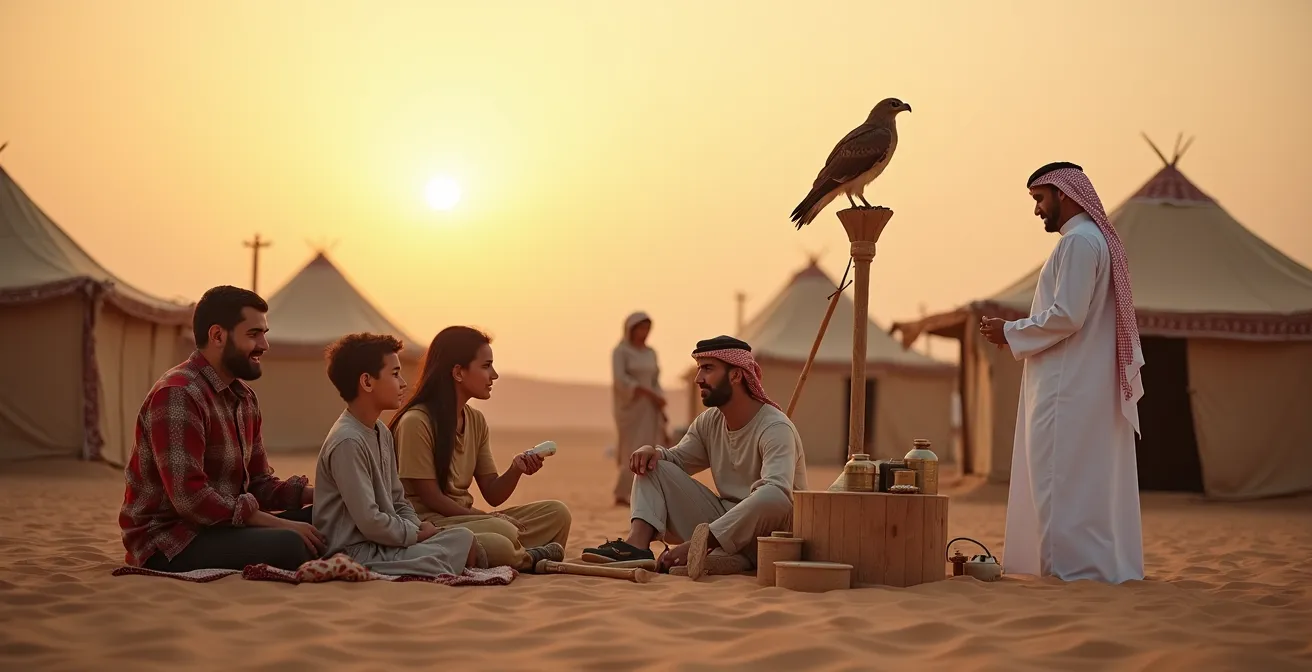
To truly connect your expat children with UAE culture, you must shift their experience from passive observation to active, respectful participation in its living heritage.
- Understanding unwritten social codes, like Majlis etiquette, is more impactful than visiting a museum.
- Engaging in heritage sports like falconry or learning basic Khaleeji dialect builds genuine cultural bridges.
Recommendation: Start by focusing on one core practice, like falconry, and approach it as a family of learners, seeking to understand the story behind the tradition.
As an expat parent in the UAE, you want your children to grow up as global citizens who not only live in a country but also understand and respect its soul. You’ve likely taken them to the dazzling museums and on thrilling desert safaris. Yet, a nagging feeling might persist: are they truly connecting with the deep-rooted heritage of the Emirates, or just skimming the surface? The usual advice often involves ticking off a list of sights, but this rarely fosters the profound respect you’re hoping to cultivate.
The challenge is that authentic culture isn’t found behind glass displays; it’s a living, breathing entity woven into daily interactions, social gatherings, and age-old traditions. The key to unlocking this deeper understanding for your children lies in a fundamental shift in approach. What if the goal wasn’t just to see the culture, but to respectfully participate in it? This means moving beyond the “what” and teaching them the “why” and “how”—the unspoken social codes, the significance of specific customs, and the values that underpin Emirati society.
This guide is designed to take you beyond the school curriculum and tourist brochures. We will explore how to transform your family from observers into respectful participants. We’ll delve into the nuances of cultural etiquette, the modern expression of tradition, and how to engage with iconic heritage practices like falconry and the Majlis in an authentic, meaningful way. By the end, you’ll have a clear roadmap to help your children build a genuine and lasting cultural bridge with their host country.
This article provides a structured path to help you and your children navigate the rich tapestry of Emirati culture with confidence and respect. Explore the key areas below to begin your journey.
Contents: Your Guide to Deepening Cultural Understanding
- What Are the 5 Cultural Etiquette Rules You Must Follow in the UAE?
- Abaya and Sneakers: Is Mixing Traditional Wear with Streetwear Respectful?
- How to Start Falconry as a Hobby if You Are Not Emirati?
- How to Arrange a Private Falconry Session with a Bedouin Master?
- The Seating Etiquette You Must Know Before Entering a Majlis
- The Conversation Mistake That Will Get You Excluded from Majlis Gatherings
- Why Learning “Khaleeji” Dialect is Better Than Modern Standard Arabic for Daily Life?
- When to Visit Heritage Villages to See Live Craftsmen?
What Are the 5 Cultural Etiquette Rules You Must Follow in the UAE?
The first step in building a cultural bridge is to understand and respect the foundational social codes. In a nation where, according to some data, over 88% of the population consists of expatriates, demonstrating cultural sensitivity is not just polite; it’s essential for harmonious living. Teaching these rules to your children from a young age instills a deep-seated respect that goes far beyond memorizing facts. Frame these not as restrictions, but as ways to show you care about the local community.
Here are five core principles to internalize and practice as a family:
- Dress with Mindfulness: Explain to your children that dressing modestly (covering shoulders and knees in public places) is a sign of respect for the local culture. It’s not about erasing personal style but about being considerate in a shared public space. While arrests are rare, indecent dressing is still viewed negatively.
- Respect Physical and Social Boundaries: Teach your children the importance of personal space. When greeting someone of the opposite sex, it’s customary to wait for them to offer their hand first. A simple nod and a smile are always a safe and respectful alternative. This extends to public behavior; explain that overt displays of affection are kept private in Emirati culture.
- Handle Greetings and Offerings Correctly: The right hand is used for eating, shaking hands, and passing items. This is a simple but powerful gesture to teach. When offered a coffee or a date in a social setting, accepting with the right hand is a small act that shows great awareness.
- Practice Digital Respect: In an age of smartphones, this is crucial. Emphasize that taking photos of people, especially women, without explicit permission is a major breach of privacy. This rule is rooted in a deep cultural value of protecting personal and family honor.
- Understand the Role of Alcohol: While available in licensed venues, it is illegal and highly disrespectful to be intoxicated in public. For older teens, this is a critical lesson in understanding and abiding by local laws that are stricter than in many home countries.
These rules are the bedrock of respectful interaction. By explaining the “why” behind them, you transform a list of dos and don’ts into a meaningful lesson on empathy and cultural awareness.
Abaya and Sneakers: Is Mixing Traditional Wear with Streetwear Respectful?
The sight of a flowing abaya paired with trendy sneakers is increasingly common in the malls of Dubai and Abu Dhabi, sparking a question for many expats: is this a sign of disrespect or a symbol of modern identity? This is a perfect teaching moment for your children about how culture is not static but dynamic and constantly evolving. It’s a visual representation of the balance between tradition and modernity that defines the contemporary UAE.
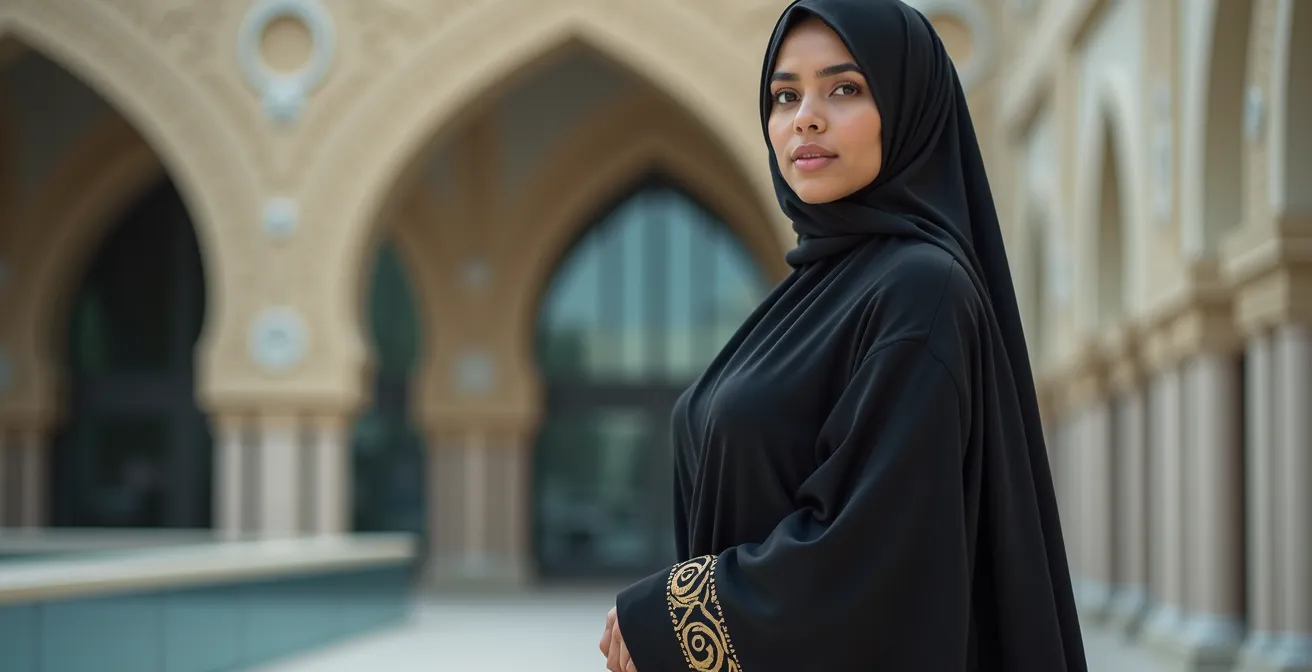
The key here is intent and context. An abaya is a symbol of modesty and cultural identity. For many Emirati women, pairing it with Western fashion items like designer sneakers or handbags is a way to express their individuality while honoring their heritage. It is not seen as a dilution of culture but as a confident fusion. As Tero Graduate Resources notes in a cultural briefing on the UAE, “The presence of expatriates in the community has led Emiratis to be tolerant of other social customs, yet they maintain their own customs as symbols of their cultural identity.” This tolerance extends to their own evolution of style.
For your children, the lesson is that respect is not about blind imitation but about understanding. Rather than feeling they must wear traditional clothes, they should understand the meaning behind them. Explain that the abaya and kandura are powerful symbols. The fusion with streetwear shows that one can be both proudly Emirati and fully engaged with the modern, globalized world. It’s a conversation about identity, not just clothing, and a powerful example of how tradition adapts and thrives.
How to Start Falconry as a Hobby if You Are Not Emirati?
Falconry is more than a sport in the UAE; it is a cornerstone of Bedouin heritage, a symbol of courage, and a deep, symbiotic relationship between man and bird. With an estimated 5,000 falconers actively practicing this heritage sport in the country, it represents a living connection to the desert past. For an expat family, engaging with falconry is a gateway to understanding the very soul of Emirati culture, but it must be approached with profound respect.
Starting this journey is not about buying a falcon. It is about becoming a student of the tradition. The best entry point for a non-Emirati family is through structured, educational experiences. These are not the brief, tourist-focused photo opportunities, but programs designed to teach the history, ethics, and practice of the art. They provide a safe and respectful environment for your children to learn and ask questions.
A prime example is the Abu Dhabi Falcon Hospital. It offers guided tours that go far beyond a simple viewing. Here, your family can learn about the different types of falcons, the intricate care they require, and the history of their role in Bedouin life. You witness the deep affection and respect the falconers have for their birds. This experience provides the foundational knowledge necessary to appreciate the art. It transforms the falcon from a majestic animal into a cherished partner, a key concept in understanding the Bedouin worldview.
How to Arrange a Private Falconry Session with a Bedouin Master?
After gaining a foundational understanding from an institution like the Falcon Hospital, the next step is to seek a more personal and authentic experience. Arranging a private session with a Bedouin master is the ultimate way to witness the living heritage of falconry. This is not a commercial transaction but an invitation into a world of deep-rooted tradition. The goal is learning, not entertainment, and your family should approach it as honored guests.

Finding an authentic master requires moving beyond mainstream tour operators. It involves connecting with the community, building trust, and showing genuine interest. It’s a process of earning an invitation rather than booking a slot. This journey itself is a valuable lesson for your children in patience and respect.
Your Action Plan for an Authentic Falconry Encounter
- Start with Education: Before seeking a private session, participate in high-quality educational programs in the desert. This demonstrates genuine interest and provides you with the basic knowledge and etiquette needed.
- Seek Word-of-Mouth Recommendations: Connect with long-term residents or Emirati friends. Ask for references to a respected falconer known for their willingness to share their knowledge, not just their time.
- Build Cultural Connections: Show you are interested in Bedouin life as a whole, not just the spectacle of falconry. Learn about their values, their history, and their connection to the desert. This builds the rapport necessary for a genuine invitation.
- Prepare as a Respectful Guest: When an opportunity arises, prepare accordingly. Wear modest, practical clothing. Consider bringing a thoughtful gift, such as high-quality dates or a flask of good Arabic coffee, as a sign of respect.
- Focus on Learning, Not Performing: Your role is to be an attentive student. Ask thoughtful questions, listen more than you speak, and encourage your children to observe quietly. The experience is about cultural osmosis and absorbing the master’s passion and skill.
This approach transforms the experience from a simple activity into a profound cultural exchange, leaving your children with a memory and an understanding that will last a lifetime.
The Seating Etiquette You Must Know Before Entering a Majlis
The Majlis is the heart of Emirati social, political, and family life. It is not merely a sitting room but a space where community is forged, decisions are made, and hospitality is extended. For your children, being invited to a Majlis is a rare honor and an unparalleled opportunity for cultural osmosis. However, entering this space requires understanding its deep-seated, unwritten rules, starting with the most fundamental: where to sit.
Seating in a Majlis is not random; it is a clear reflection of the social structure. The society is deeply influenced by Islamic values and Bedouin traditions, remaining largely hierarchical. Age, status, and lineage determine one’s position in the room. The host and the most senior guests or elders will occupy the most prominent seats, often at the head of the room, furthest from the door. Other guests are seated in descending order of importance.
As a guest, you should never choose your own seat. Wait to be guided by your host. This simple act of patience shows immense respect for the established order. Explain to your children that their role is to be humble observers. They should greet elders with a respectful nod and take the seat indicated, understanding that they are there to listen and learn. The serving of coffee and dates also follows a strict protocol, typically starting with the guest of honor and moving down the line, reinforcing the social hierarchy through a ritual of hospitality.
The Conversation Mistake That Will Get You Excluded from Majlis Gatherings
Once seated correctly in a Majlis, the next challenge is conversation. This is where many well-intentioned expats falter. The purpose of a Majlis is to build relationships and reinforce community bonds, not to engage in heated debate or conduct business immediately. As noted in a guide by Universal Relocations, “Emiratis are welcoming towards expatriates who are sensitive and respectful towards local culture. However, those who criticize local norms or demonstrate cultural ignorance may face resentment.” A single inappropriate question can inadvertently close doors.
The biggest mistake is a failure to respect privacy and maintain harmony. Topics that are common in Western small talk can be considered intrusive or rude in this context. For instance, asking direct questions about a man’s wife, sister, or daughter is a major taboo. Instead, the general and respectful inquiry is “Kaif al ahl?” (“How is the family?”). Similarly, jumping straight into business or discussing controversial political views is seen as poor form. The initial phase of conversation is for building personal rapport.
To guide your family, it’s helpful to know which topics are safe and which to avoid. The goal is always to preserve the dignity of everyone present and to foster a feeling of warm, shared community.
| Appropriate Topics | Topics to Avoid | Cultural Reason |
|---|---|---|
| General family wellbeing (‘How is the family?’) | Direct questions about female relatives | Privacy is a paramount value, rooted in Sharia principles. |
| Business after a warm-up period of social chat | Immediate business discussions upon arrival | Building personal trust and rapport is always the priority before business. |
| Poetry, heritage, falcons, camels, weather | Controversial political or religious opinions | The goal is to maintain social harmony, not to win a debate. |
| Shared positive experiences, travel, sports | Personal financial matters or salary details | Such topics can cause embarrassment and are considered highly private. |
Teaching your children to be good listeners and to stick to these safe conversational shores is perhaps the most valuable lesson in Majlis etiquette you can offer.
Why Learning “Khaleeji” Dialect is Better Than Modern Standard Arabic for Daily Life?
While any effort to learn Arabic is appreciated, parents often steer their children towards Modern Standard Arabic (MSA), the formal language of news and literature. However, for building genuine connections in the UAE, learning the basics of “Khaleeji”—the Gulf dialect—is infinitely more powerful. MSA is the language of the head, but Khaleeji is the language of the heart and the home.
The UAE is a linguistic melting pot where numerous languages like Persian, Hindi, and Urdu are widely spoken alongside Arabic. In this diverse environment, no one expects an expat to be fluent. But using a few key phrases in the local dialect sends a powerful message: “I see you, I respect your specific culture, and I am making an effort to connect.” It’s a gesture that builds an immediate cultural bridge. For children, who often soak up languages effortlessly through school and play, picking up Khaleeji is a natural way to bond with their Emirati peers.
Think of it this way: MSA allows you to read a newspaper, but Khaleeji allows you to share a laugh. It’s the dialect you’ll hear in the market, in a taxi, and in a friendly chat with a neighbor. Simple phrases like “Ya’tik al’afiya” (a respectful way of saying “good job” to someone working) or asking “Kaif al ahl?” (“How is the family?”) demonstrate a level of cultural fluency that formal Arabic cannot. It shows you’ve moved beyond the textbook and are engaging with the living, breathing culture of the place you call home.
Key Takeaways
- True cultural learning is about shifting from passive observation to active, respectful participation in living traditions.
- Mastering unwritten social codes, especially in settings like the Majlis, is more impactful than visiting tourist sites.
- Authentic engagement in heritage practices like falconry and using the local Khaleeji dialect are powerful tools for building genuine cultural bridges.
When to Visit Heritage Villages to See Live Craftsmen?
Heritage villages offer a fantastic, consolidated way to witness the traditional skills and crafts that form the backbone of Emirati culture. However, to get the most out of the experience, timing is everything. A visit on a quiet, hot afternoon might yield little more than empty stalls. The goal is to see living heritage, which means visiting when the artisans are actively working and when the atmosphere is vibrant with cultural energy.
The best time to see craftsmen at work—from Sadu weavers to potters—is during the cooler months, from October to April. Plan your visit for a weekday morning or late afternoon when the temperatures are pleasant and the artisans are most active. Weekends are often crowded, making it difficult to have meaningful interactions.
Even more impactful is timing your visit to coincide with one of the UAE’s many cultural festivals. Events like the Al Dhafra Festival in December are specifically designed to preserve and celebrate Bedouin traditions for younger generations. These festivals bring together the best craftsmen from across the region, creating an unparalleled opportunity for immersion. You’re not just seeing a craft; you’re experiencing the entire cultural ecosystem that supports it. Furthermore, keep an eye on large-scale preservation initiatives like the Heart of Sharjah project, a massive restoration effort turning historic areas into vibrant cultural destinations where artisans and galleries bring the past to life for current and future generations. Visiting these living museums provides a dynamic and engaging educational experience for the whole family.
Frequently Asked Questions About UAE Cultural Etiquette
How should children behave in a majlis?
Children should greet elders with a respectful nod, accept any offerings of dates or coffee with their right hand, and understand that their primary role is to listen and observe. The Majlis is a powerful environment for learning through cultural osmosis, so quiet observation is the most respectful form of participation for a child.
What determines seating hierarchy in a majlis?
The UAE is deeply steeped in Islamic values and Bedouin traditions, which emphasize respect for elders and status. Seating is therefore arranged by age and social standing, with the host and the most senior guests placed in the most prominent positions of honor, typically at the head of the room.
How is coffee served in a majlis?
The serving of Arabic coffee (gahwa) is a cherished ritual. The server, holding the pot (dallah) in their left hand and the cups (finjan) in their right, will start with the guest of honor or the person on the host’s right. The service then proceeds counter-clockwise around the room. This ordered ritual maintains social harmony and is a beautiful display of hospitality.