

Successfully retrofitting a smart system into a legacy villa hinges on creating an ‘invisible infrastructure’ that integrates with the home’s core, rather than simply adding visible wireless gadgets.
- Focus on professional-grade modules hidden behind existing switches to preserve architectural integrity.
- Prioritize integrated systems for climate, security, and lighting, as they deliver the highest return on investment and user experience.
Recommendation: Engage a qualified automation integrator during the planning phase of any renovation, no matter how small, to identify cost-effective wiring opportunities before walls are closed.
For the owner of a legacy property, the allure of a modern smart home often clashes with a significant fear: the destructive process of rewiring. The vision of walls being torn down, dust filling the air, and the unique character of an older villa being compromised is enough to halt any modernization project. Many homeowners turn to the seemingly simple solution of smart plugs and standalone Wi-Fi cameras, believing this is the only non-invasive path. This approach, however, often leads to a chaotic collection of devices, unreliable connections, and significant security vulnerabilities.
The fundamental challenge isn’t a lack of wireless technology, but a flawed strategy. What if the key to a successful retrofit wasn’t accumulating more gadgets, but architecting an integrated, invisible system that enhances the property’s core functions? The most effective smart home retrofits are the ones you don’t see. They work silently in the background, using professional-grade modules hidden behind existing light switches and within utility closets, creating a cohesive and reliable ‘invisible infrastructure’ that respects the home’s original design while boosting its IQ.
This technical guide moves beyond surface-level advice. We will dissect the core components of a successful retrofit, from optimizing energy consumption and securing your network to making strategic platform choices. By focusing on integrated systems and understanding the critical role of professional planning, you can transform your older villa into a truly smart, efficient, and valuable property without sacrificing its soul.
Summary: A Technical Framework for Smart Villa Retrofitting
- Why Your AC is Wasting 30% of Energy and How Smart Thermostats Fix It?
- The Security Flaw in Cheap Smart Cameras That Hackers Love
- Google Home vs Amazon Alexa vs Apple HomeKit: Which Works Best in the UAE?
- Does a Full Smart Home System Actually Increase Property Resale Value?
- When to Involve an Automation Integrator During a Renovation?
- The “Show Apartment” Trick: How Developers Make Spaces Look Bigger
- Why Giving Up Some Privacy Data Can Upgrade Your Service Level?
- How AI is Predicting Your Hotel Room Preferences Before You Check In?
Why Your AC is Wasting 30% of Energy and How Smart Thermostats Fix It?
In older villas, particularly those with sprawling layouts, the HVAC system is often the single largest contributor to energy expenditure. Conventional thermostats operate on a crude on/off basis, lacking the intelligence to adapt to real-world usage patterns. This results in cooling empty rooms, running inefficiently during off-peak hours, and failing to account for external factors like solar gain. The consequence is significant energy waste; indeed, some studies indicate that IoT-connected HVAC can reduce energy waste by up to 30%. This is where a smart thermostat-led system provides immediate and measurable ROI.
A smart thermostat is not merely a programmable timer; it’s the brain of an intelligent climate control system. By leveraging features like geofencing, it detects when occupants leave or are approaching the property, adjusting the temperature automatically to prevent unnecessary cooling. Furthermore, occupancy sensors, a key component in a true smart home, can be integrated to create zones, ensuring that only occupied rooms are cooled to the desired temperature. This is especially effective in large, multi-room villas where certain areas may be unused for long periods.
The upgrade is minimally invasive. In most cases, a smart thermostat can replace the existing unit using the same wiring. For more advanced, multi-zone control, wireless sensors communicate with a central hub, eliminating the need for new cable runs. The system learns your schedule, responds to your presence, and ultimately transforms a static, inefficient HVAC unit into a dynamic, energy-saving asset.
Case Study: Dubai Villa Energy Savings with Smart Climate Control
A One Palm Jumeirah villa project in Dubai serves as a powerful example. After implementing a KNX-based smart home automation system featuring intelligent climate control, the property achieved a 30% reduction in its energy bills. This ‘invisible infrastructure’ integrated smart thermostats with automated curtains that close during peak sun hours and occupancy-based cooling zones. The project proves that even luxury properties with high energy demands can achieve significant savings through intelligent retrofitting, without compromising aesthetics or requiring extensive rewiring.
Ultimately, a smart thermostat is the first and most logical step in a retrofit, delivering tangible savings that help fund further automation investments.
The Security Flaw in Cheap Smart Cameras That Hackers Love
When securing an older property, the temptation to deploy inexpensive, consumer-grade smart cameras is strong. They promise easy, wireless installation and remote access. However, from an engineering perspective, these devices often introduce a greater security risk than they mitigate. The primary vulnerability isn’t a sophisticated software exploit, but a fundamental flaw in their architecture and a lack of long-term manufacturer support. Many of these devices utilize P2P (peer-to-peer) connections that route your video feed through insecure, often overseas, third-party servers, creating a built-in backdoor for unauthorized access.
This “phone home” vulnerability is a deliberate design choice to simplify setup for non-technical users, but it relinquishes control of your data stream. Furthermore, the business model for these budget brands does not prioritize ongoing security patches. Once a new model is released, support for the old one often ceases, leaving it unpatched and exposed to newly discovered exploits. As one professional guide notes, this creates a device that is essentially a ticking time bomb on your network.
The biggest flaw is not a bug, but the manufacturer’s decision to stop providing security updates, turning the device into a ticking time bomb.
– AV Experience Smart Home Integration Guide, Smart Home Retrofit Security Best Practices
A robust security retrofit requires a strategic, not a budget-driven, approach. The solution involves creating a segmented network by setting up a separate “IoT” or “Guest” Wi-Fi network. This isolates your cameras and other smart devices from your primary network, which contains sensitive personal and financial data on computers and phones. If a camera is compromised, the attacker’s access is confined to the isolated network, not your entire digital life. Additionally, a hybrid storage solution combining on-site recording (via a Network Video Recorder or NVR) with encrypted cloud backup provides redundancy; if the cloud is hacked, your local footage is safe, and if a burglar steals the NVR, you still have off-site evidence.
Investing in cameras from reputable manufacturers who commit to regular firmware updates and choosing a secure network architecture are non-negotiable for protecting a high-value asset like a villa.
Google Home vs Amazon Alexa vs Apple HomeKit: Which Works Best in the UAE?
Choosing a central ecosystem is a critical decision in any smart home retrofit. The three dominant players—Google Home, Amazon Alexa, and Apple HomeKit—each offer a distinct philosophy on integration, privacy, and user experience. While it’s tempting to pick based on a preferred voice assistant, the optimal choice for a villa owner depends heavily on device compatibility, local service integration, and specific use cases. A platform that excels in one country might be severely limited in another.
For instance, an analysis of the UAE market reveals significant differences. Google Home offers superior support for local Arabic dialects, while Amazon Alexa has deeper integration with regional e-commerce. Apple HomeKit, while often lagging in third-party device support, is widely regarded as having the most robust security and privacy framework, processing many commands locally on a HomePod or Apple TV. This is a crucial consideration for homeowners wary of sending data to the cloud. Therefore, the “best” system is not universal; it is contextual.
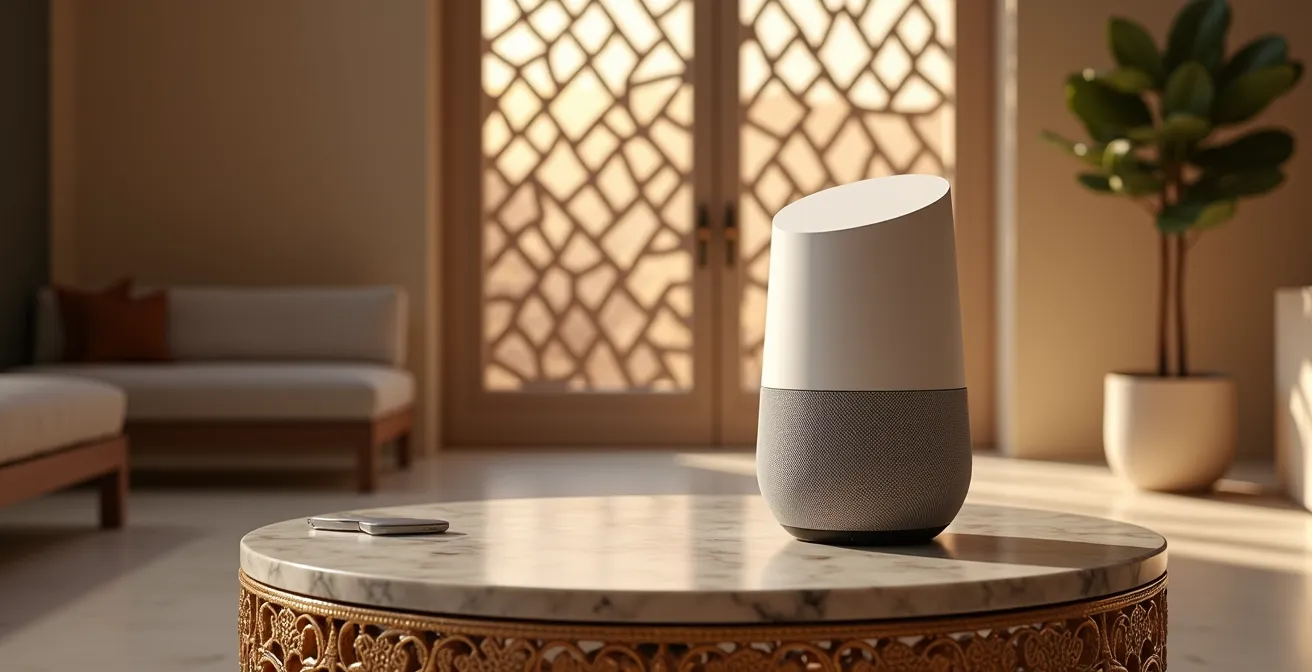
For a villa retrofit, the decision should be driven by the systems you intend to control. If your priority is a sophisticated, multi-room audio and video system, a platform like Alexa may have an edge. If you are integrating high-end, security-focused devices and prioritize privacy, HomeKit’s stringent certification process is a significant advantage. The table below illustrates how these factors can be evaluated in a specific market, serving as a template for your own analysis.
This comparative table, focusing on the UAE, provides a model for how to evaluate voice assistant ecosystems based on factors specific to your own region.
| Feature | Google Home | Amazon Alexa | Apple HomeKit |
|---|---|---|---|
| Arabic Language Support | Full support including Khaleeji dialects | Basic Arabic support | Limited Arabic with Siri |
| UAE Service Integration | Works with local services | Good integration with shopping | Limited local services |
| Device Availability in UAE | Widely available at Sharaf DG, Virgin | Available through official channels | Premium devices at Apple stores |
| Climate-Specific Features | Good for multi-room setups | Best for entertainment systems | Excellent privacy and security |
Ultimately, a professional integrator can often create a hybrid system, using a protocol-agnostic platform like KNX or Control4 to unite the best devices from all ecosystems under a single, seamless interface, delivering the best of all worlds.
Does a Full Smart Home System Actually Increase Property Resale Value?
A common question from property owners is whether the significant investment in a full automation system translates into a higher selling price. The answer is unequivocally yes, but with a critical caveat: the value is driven by integrated, ‘invisible’ systems, not by a collection of DIY smart plugs and mismatched brands. Market analysis shows that homebuyers are not just willing to pay more; they are actively seeking properties with built-in intelligence. In fact, 78% of homebuyers have expressed a willingness to pay a premium for a smart-enabled home.
The perceived value comes from a system that feels like a core feature of the house, not an aftermarket addition. This means smart modules hidden behind existing light switches, in-ceiling speakers, and a centralized control hub. These professionally installed systems signal quality, reliability, and ease of use. Conservative estimates from the real estate industry suggest that cohesive smart home technology adds between 3-5% to a property’s resale value. For a high-value villa, this can represent a substantial financial return that far exceeds the initial installation cost.
Buyer Preferences for Smart Home Features
A comprehensive market analysis confirms this trend, revealing that 7 in 10 buyers are actively looking for properties with smart features. The study drew a sharp distinction in value perception. Homes retrofitted with integrated systems, particularly using ‘invisible’ modules behind existing switches, commanded significantly higher premiums. In contrast, properties showcasing a patchwork of visible smart plugs and devices from various brands were often viewed less favorably, sometimes even as a liability that the new owner would have to deal with.
To maximize this return, sellers must treat the smart system as a key asset during the sale. This requires proper documentation and a smooth handover process to the new owner. A well-prepared handover demonstrates the system’s quality and makes the technology an undeniable selling point rather than a potential headache.
Action Plan: Smart Home Handover Checklist for Sellers
- Document all smart devices with brand, model, and login credentials in a master spreadsheet.
- Focus investment on the ‘Big 3’ value drivers: Smart Climate, Integrated Security, and Automated Lighting/Blinds.
- Create user manuals for each system with simple operating instructions for the new owner.
- Prepare to transfer all device warranties and support contracts to the new owner at closing.
- Provide professional installation certificates to demonstrate quality, safety compliance, and the system’s pedigree.
A well-executed smart home retrofit is not an expense; it is a strategic investment in the property’s long-term marketability and value.
When to Involve an Automation Integrator During a Renovation?
For the owner of a legacy villa, the most critical decision in a smart home retrofit is not which devices to buy, but *when* to engage a professional automation integrator. The answer is simple: as early as possible, ideally alongside your architect and interior designer. Bringing in an integrator after design decisions are made and construction has begun is the most common and costly mistake in a retrofit. An integrator’s primary value is in strategic planning and identifying opportunities to build an ‘invisible infrastructure’ at a fraction of the cost.
The common assumption is that a retrofit must be 100% wireless. A good integrator knows this is a fallacy. Their expertise lies in planning minimally invasive wiring paths for key infrastructure—like Ethernet for reliable streaming and control, or neutral wires to light switches for full smart dimmer compatibility. This planning phase is where the most significant savings are realized.
If your desired system involves more than five devices from more than two different brands, a one-hour consultation with an integrator will save you dozens of hours of frustration and potential rework.
– Frangioni Media Integration Specialists, Smart Home Integration Best Practices Guide
The “pre-drywall window” is a golden opportunity during any renovation, however minor. Even if you’re only remodeling a single bathroom, the exposed walls offer a chance to run cables for future expansion at a minimal cost. Waiting until after the walls are closed can increase the cost of these same additions by a factor of five or more due to the need for demolition, patching, and repainting.
Case Study: The Pre-Drywall Window Opportunity
A retrofit wiring project in Austin perfectly illustrates this principle. By involving an automation integrator before drywall installation during a renovation, the homeowners were able to run essential neutral wires to all light switch locations and add strategic Ethernet ports for future-proofing. The total cost for this crucial pre-wiring was just $2,000 in additional labor and materials. Had they decided to make these same modifications after the drywall was installed, the projected cost would have exceeded $10,000, as it would have necessitated significant demolition and reconstruction work.
An integrator is not just a technician; they are an essential part of the design team, ensuring that technology serves and enhances the architectural vision, rather than conflicting with it.
The “Show Apartment” Trick: How Developers Make Spaces Look Bigger
Developers and interior designers have long used clever tricks to make show apartments feel more spacious and appealing than they are. While some of these involve using undersized furniture, one of the most effective and legitimate techniques lies in the strategic use of lighting. In a modern retrofit, smart lighting systems allow homeowners to replicate and even enhance these professional illusions, fundamentally altering the perception of a room’s size and volume without moving a single wall. This is a prime example of using technology to improve the aesthetic and emotional quality of a space.
The core principle is to draw the eye and create layers of light, which adds perceived depth. For instance, ‘wall washing’—the technique of installing tunable LED strips to cast a smooth, even gradient of light down a wall—can make a room feel wider and the ceiling higher. Similarly, placing uplighting behind furniture or plants creates pockets of brightness and shadow that add dimension and prevent a room from feeling flat and enclosed. Smart lighting automates these effects, allowing you to create scenes that adapt to the time of day or activity.
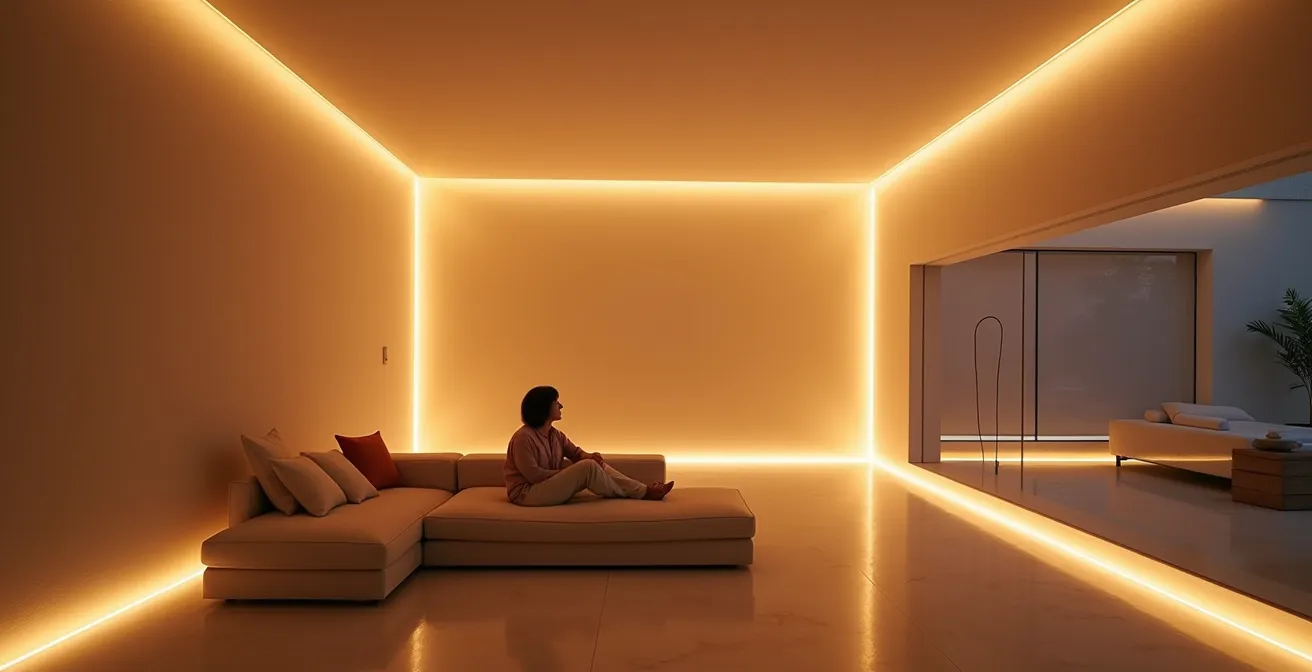
These techniques are perfectly suited for older villas, which may have rooms that feel dark or constrained by modern standards. By programming lighting scenes, you can make a study feel bright and expansive for daytime work, then warm and cozy for evening reading. Key techniques for a successful retrofit include:
- Installing tunable LED strips for wall washing to make rooms appear larger.
- Programming lighting scenes that mimic bright, natural daylight, especially in rooms with limited windows.
- Using smart color-capable lighting (sparingly) to define functional zones in an open-plan space without physical barriers.
- Positioning uplighting behind large furniture or architectural features to create an illusion of depth and vertical space.
- Implementing automated blinds that retract fully into the ceiling, maximizing the window area and the connection to the outdoors.
Ultimately, smart lighting is not about colorful party tricks; it is a powerful design tool for shaping perception and maximizing the perceived space and comfort of your home.
Why Giving Up Some Privacy Data Can Upgrade Your Service Level?
The conversation around smart homes is inseparable from the topic of privacy. A legitimate concern for any homeowner is the amount of personal data being collected by these devices. This has led to a clear divergence in system architecture: cloud-based systems (like Google Home and Alexa) versus local control systems (like Home Assistant). While local control offers maximum privacy by keeping all data within your home network, it comes at the cost of complexity and a loss of the advanced, proactive features that define a truly “smart” home.
Cloud-based systems leverage powerful AI and machine learning algorithms that run on external servers. By analyzing anonymized data patterns, they can move beyond simple commands to offer proactive assistance. For example, Alexa’s “Hunches” can suggest turning off lights you may have forgotten, and Google’s routines can adapt based on your detected presence. This level of service is impossible on a purely local system, which operates on pre-programmed, reactive rules. The trade-off is clear: to get a higher level of intelligent service, a certain amount of operational data must be shared.
The decision between these two philosophies is a personal one, balancing the desire for privacy with the desire for convenience and advanced functionality. The following table breaks down the key differences.
| Feature | Local Control (Home Assistant) | Cloud-Based (Google/Alexa) |
|---|---|---|
| Privacy Level | Maximum – data stays local | Moderate – data processed externally |
| Setup Complexity | High – requires technical knowledge | Low – plug and play |
| AI Capabilities | Limited – basic automation | Advanced – predictive, learning |
| Remote Access | Complex setup required | Seamless out of the box |
| Service Level | Manual programming needed | Proactive suggestions and hunches |
The tangible benefits of this data exchange are often most visible with systems like smart thermostats that use geofencing—a feature that requires sharing your location.
After enabling location sharing with our Nest thermostat, we saw immediate benefits. The system learned our commute patterns and now pre-cools our home 20 minutes before we arrive. On days we work late, it automatically delays cooling, saving energy. This level of service would be impossible without sharing location data, but the convenience and 23% reduction in our cooling costs made the privacy trade-off worthwhile.
– Smart Thermostat User
The solution for many villa owners is a hybrid approach: using a secure, professional-grade system for critical infrastructure like security and access, while allowing cloud-connected convenience for less sensitive systems like lighting and climate.
Key Takeaways
- A successful smart home retrofit prioritizes ‘invisible infrastructure’ over visible gadgets to preserve a villa’s character.
- Engaging a professional integrator before renovations begin is the most critical factor for a cost-effective, future-proof system.
- Integrated systems for climate, security, and lighting deliver a proven 3-5% increase in property resale value, far outweighing DIY solutions.
How AI is Predicting Your Hotel Room Preferences Before You Check In?
The future of smart home technology is moving beyond reactive commands toward a proactive, anticipatory service model, a trend pioneered by the luxury hospitality industry. High-end hotels are now using AI to analyze a guest’s past behavior—what temperature they set, which lights they used, what time they closed the blinds—to automatically pre-configure their room for their next stay. This same predictive intelligence is now the ultimate goal of a residential smart home system. It’s about creating a home that doesn’t just respond, but anticipates.
This leap is powered by AI engines that learn from thousands of small, manual adjustments made by the homeowner over time. If you consistently lower the temperature by two degrees every evening, the system will learn to do it for you. If you always turn on a specific lamp when you enter the study, the system will eventually automate that action based on your presence. This is the promise of the massive investment in the sector; by some estimates, AI automation in real estate is projected to generate annual savings of over $100 billion through efficiency and predictive maintenance.
For the villa owner, this means the system’s value compounds over time. The initial retrofit provides control and efficiency, but the long-term benefit is a home that seamlessly adapts to your lifestyle, requiring less and less direct input. This evolution from a ‘programmed’ home to a ‘learning’ home is the final step in achieving true ambient intelligence.
Case Study: Dubai Smart Home Adoption and AI Integration
Dubai’s smart home market, with its 15% annual growth, provides a glimpse into this future. High-end properties are already integrating AI-driven features that command premium prices. These systems learn from residents’ manual adjustments to lighting and climate to create personalized ‘scenes’ automatically. For example, an automated ‘Guest Mode’ can adjust the entire home’s environment based on the arrival of visitors. This directly mimics the anticipatory service of luxury hotels, where AI pre-sets room preferences, demonstrating a clear market demand for homes that are not just connected, but truly intelligent.
To prepare for this future, the foundational step is to install a robust, integrated system today. A well-architected retrofit provides the necessary data points and control infrastructure for a future AI engine to transform your villa into a home that truly knows you.
Frequently Asked Questions on Retrofitting Smart Home Security
What is the ‘Phone Home’ vulnerability in cheap cameras?
P2P connections in no-name cameras route video streams through insecure third-party servers, often located in other countries, creating a massive backdoor for hackers.
How can I protect my smart camera network?
Create a separate ‘IoT’ or ‘Guest’ Wi-Fi network to isolate smart devices from your personal computers and phones containing sensitive data.
Should I choose cloud or local storage for security footage?
Consider a hybrid approach or Network Video Recorder (NVR) – while cloud can be hacked, local SD cards can be physically stolen, so diversifying storage provides the best protection.