
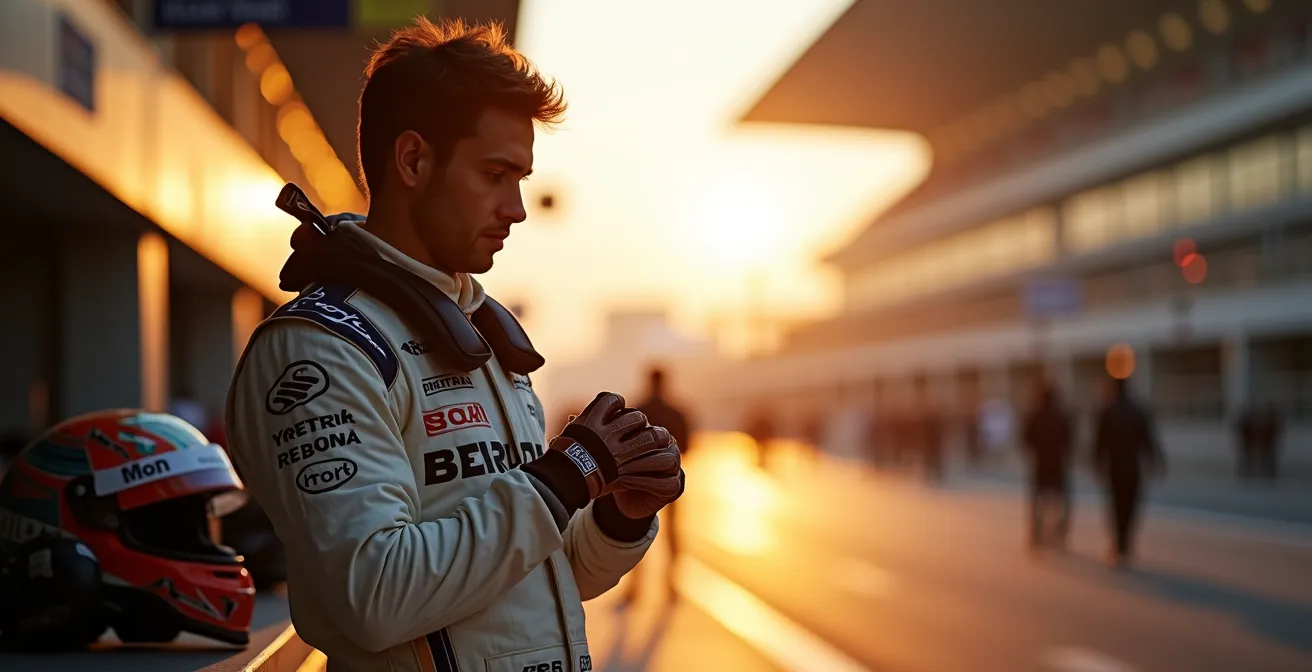
Aspiring to get a racing license for Yas Marina Circuit requires more than just speed; it demands mastering a complex set of regulations and preparations that go far beyond casual track days.
- Standard vehicle insurance is void on track; specialized track day coverage is a non-negotiable prerequisite.
- Safety equipment, particularly your helmet, must meet strict and current certification standards (e.g., Snell SA2020 or FIA) to pass scrutineering.
Recommendation: The first step is to secure appropriate insurance and book an initial, supervised track day to begin building your on-track experience log.
The ambition to hold a racing license and compete on a world-class circuit like Yas Marina is the ultimate goal for many car enthusiasts. However, a common misconception is that this is a simple administrative process. It is not. Acquiring a racing license from a national sporting authority (ASN), such as the Emirates Motorsports Organization (EMSO), is the final step in a rigorous graduation process. It is an endorsement that you are competent, safe, and fully prepared for the demands of competitive motorsport.
This guide abandons the platitudes of “practice makes perfect.” Instead, it is structured as a mandatory curriculum. Each section represents a critical module you must master, treating track days not as a recreational activity, but as the essential training ground for your racing career. From financial scrutineering and asset management to regulatory compliance and mechanical sympathy, completing this curriculum is the true path to being deemed ‘race-ready’. This is your instructional brief for moving from the grandstands to the starting grid.
The following sections detail the core modules of your race-readiness curriculum. Mastering each one is a non-negotiable step on your journey toward acquiring a racing license. This is your roadmap from enthusiast to competitor.
Table of Contents: A Step-by-Step Guide to Race-Readiness
- Does Your Comprehensive Car Insurance Cover Track Day Accidents?
- Rent a Supercar or Use Your Own: Which is Cheaper for a Track Day?
- Dubai Autodrome vs Yas Marina: Which Track is Better for Beginners?
- The Helmet Certification You Need to Pass Scrutineering
- When to Book Track Time to Avoid the Heat Soaking Your Engine?
- Why Does a Hand-Built Supercar Take 12 Months to Deliver?
- Paddock Club Dress Code: What Gets You Denied Entry?
- Marina Views or Grandstand: Which F1 Ticket Offers the Best ROI for Networking?
Does Your Comprehensive Car Insurance Cover Track Day Accidents?
The first and most critical lesson in your track day curriculum is dispelling a dangerous myth: your standard car insurance is completely void the moment your tires touch a racetrack. There is no ambiguity in this policy. In fact, industry analysis confirms that effectively 100% of standard car insurance policies exclude track day coverage. An on-track incident, regardless of fault, will be treated as if you were uninsured, leaving you personally liable for the full value of your vehicle and any other damages.
This introduces the concept of Financial Scrutineering. Before you even consider car setup or racing lines, you must pass your own financial safety check. This involves securing specialized track day insurance. These policies are designed specifically for non-competitive track events and are a mandatory prerequisite. They cover your vehicle for on-track accidents and, crucially, can also cover liability for damage to circuit infrastructure. As an example of potential costs, circuits like the Nürburgring are known to charge drivers for damage to their Armco barriers, a cost that can run into thousands of euros.
Failing to secure proper coverage is not a calculated risk; it is a critical failure in preparation that demonstrates a lack of seriousness and can end a potential racing career before it begins. Your track day insurance checklist must be your first priority:
- Policy Verification: Review your current auto policy to find the specific clause excluding activities on a “racetrack,” “proving ground,” or “closed circuit.”
- Coverage Type: Evaluate single-event policies (ideal for 1-2 track days per year) versus annual policies (more cost-effective for frequent participants).
- Infrastructure Liability: Confirm your policy includes coverage for damage to track property, such as safety barriers, timing equipment, or pit wall structures.
- Value Declaration: Ensure the policy covers the true value of your car, including any modifications. You will need to decide between an “agreed value” or “actual cash value” policy.
Rent a Supercar or Use Your Own: Which is Cheaper for a Track Day?
Once you have addressed insurance, the next module in your curriculum is Asset and Liability Management. The choice between using your personal vehicle or renting a track-prepared car is not a matter of preference but a strategic financial decision. While the idea of driving your own car on a famous circuit is appealing, it introduces significant risks related to wear, tear, and potential catastrophic failure. Consumables like tires and brakes can be worn through in a single day, costing thousands of dollars to replace on a high-performance car.
Renting a supercar from a reputable provider at the circuit often includes insurance, consumables, and technical support in the package price. This provides a fixed-cost, lower-liability entry point into the sport. Your worst-case financial exposure is typically limited to a pre-agreed insurance excess, rather than the total value of your own vehicle. This approach allows you to focus entirely on your driving performance and learning the track, which is the primary objective of your training.

The professional environment of a rental provider, as shown above, also means the vehicle is optimally prepared for the track, with correct tire pressures, fluid levels, and brake conditions. This eliminates mechanical variables, allowing you to build a consistent performance baseline. The following table provides a clear breakdown of the costs involved, demonstrating the financial trade-offs.
This comparative analysis highlights the key financial factors to consider when deciding between using a personal vehicle or opting for a rental. The data is based on typical costs associated with track days at major international circuits. As the cost analysis demonstrates, the “all-inclusive” nature of a rental can often present a more predictable and financially prudent option for beginners.
| Cost Factor | Own Car | Rental Supercar |
|---|---|---|
| Base Track Fee | $300-500/day | Included |
| Insurance/Excess | $200-500 single event | 10% deposit of car value |
| Consumables (tires, brakes) | $500-2000 per track day | Included unless excessive |
| Technical Support | DIY or $500+ for crew | Included |
| Worst-Case Liability | Full vehicle value | €20,000-50,000 excess |
Dubai Autodrome vs Yas Marina: Which Track is Better for Beginners?
Choosing your training ground is a critical part of the curriculum. The UAE is fortunate to have two world-class circuits, but they offer different learning experiences. Your choice of venue should be based on your immediate training objectives. Yas Marina Circuit, an active Formula 1 venue, is known for its wide, flowing layout and extensive, forgiving runoff areas. Its status as an F1 track means it is built to the highest safety standards, making it an excellent environment to learn car control at high speed with a larger margin for error.
The Yas Marina track is not static; it undergoes continuous improvement. At 5.281 km with recent modifications to improve flow, the layout has been altered specifically to enhance overtaking opportunities and overall pace. For a beginner, this translates to a less technically punishing experience where you can focus on mastering fundamentals like the racing line, braking points, and throttle application without the constant threat of a tight, unforgiving barrier.
The Dubai Autodrome, by contrast, offers several configurations, some of which are more technical and narrow. While it is an outstanding circuit that hosts international championships, its tighter sections and less generous runoffs in certain corners demand a higher level of precision from the outset. For an absolute beginner, this can be intimidating. The recommended progression is to use Yas Marina to build confidence and master the fundamentals of car control at speed. Once a consistent level of performance is achieved, advancing to the more technical challenges of the Dubai Autodrome becomes a logical next step in your driver development.
The Helmet Certification You Need to Pass Scrutineering
Regulatory Compliance is a non-negotiable module. In motorsport, safety equipment is not a suggestion; it is a strict set of rules, and the helmet is the most critical piece of personal protective equipment. You will not be allowed on track if your helmet does not pass scrutineering. The key is understanding the difference between certifications. A standard motorcycle helmet (DOT or ECE rated) is insufficient.
For automotive sport, you must have a helmet with a Snell SA (Special Application) rating. The ‘M’ rating is for motorcycles and is not suitable due to different impact and fire-resistance testing standards. Snell ratings are updated every five years (e.g., SA2015, SA2020), and a helmet is typically valid for about 10-12 years from its certification date. For any serious track work in 2024 and beyond, an SA2020-rated helmet is the minimum standard to ensure compliance for the foreseeable future. Some events may also require or accept an FIA certification (e.g., FIA 8859-2015), which has its own validity period. Always verify the specific requirements of the track day organizer or the racing series you aim to enter.

The material and construction of the helmet, often a composite of carbon fiber, kevlar, and fiberglass, are designed to withstand multiple impacts and resist fire—hazards specific to closed-car racing. This advanced construction is what the certification guarantees. An uncertified or expired helmet is an automatic failure at scrutineering and a signal to officials that you are not serious about safety protocols.
Your Pre-Track Personal Safety Scrutineering Plan
- Points of Contact: List all personal safety gear required for the event (helmet, fire-retardant suit, gloves, shoes, and HANS device if applicable).
- Collecte: Inventory the certification labels on your current gear. Document the standard (e.g., Snell SA2020, FIA 8856-2018) and check for expiry dates.
- Cohérence: Cross-reference your gear’s certifications with the specific event’s technical regulations document. Confirm every item meets or exceeds the minimum requirement.
- Fit & Condition: Inspect each item for wear, damage, or contamination. Ensure your helmet has a snug fit with no pressure points and the visor is clean and unscratched.
- Plan d’Intégration: Create a prioritized purchase list for any non-compliant, expired, or ill-fitting gear. Do not leave this to the last minute.
When to Book Track Time to Avoid the Heat Soaking Your Engine?
A competent driver understands that performance is not just about their own skill, but also about managing their equipment within its operational limits. This module covers Mechanical and Environmental Sympathy. In the UAE, ambient heat is the single biggest enemy of a high-performance engine on a racetrack. High temperatures lead to “heat soak,” a condition where the engine and its surrounding components become so hot that performance drops significantly. The intake air becomes less dense, reducing power, and fluids like oil and coolant can exceed their effective operating temperatures, risking catastrophic engine damage.
Therefore, scheduling your track time is a strategic decision. The optimal track season in the UAE runs from October to April, when cooler ambient temperatures allow engines to perform at their peak for longer. During the hot summer months (May to September), track activity is not impossible but requires a different strategy. Evening and night sessions are essential, as temperatures drop significantly after sunset. Driving under the glamorous lights of Yas Marina is not just an aesthetic choice; it’s a practical necessity for vehicle preservation.
During hot weather, your on-track strategy must also adapt. Abide by the following heat management protocols:
- Session Timing: Book evening sessions, typically starting from 6 pm onwards, during the peak summer months.
- Session Length: Run shorter 15-20 minute sessions, followed by longer 30-40 minute cool-down periods in the pits with the engine bay open.
- Data Monitoring: Pay constant attention to your oil and coolant temperature gauges. If they approach the upper limits, pit immediately.
- Cool-Down Lap: Always use your final lap as a dedicated cool-down lap. Drive at a significantly reduced pace with minimal throttle and brake use to allow air to circulate and temperatures to stabilize before stopping in the pits.
Ignoring these protocols will not only degrade your performance but can cause premature wear and permanent damage to your engine and transmission. It is a fundamental aspect of racecraft to manage your machinery with as much skill as you manage your racing line.
Why Does a Hand-Built Supercar Take 12 Months to Deliver?
This module may seem peripheral, but it concerns the core mindset of motorsport: an appreciation for engineering, precision, and patience. Understanding why a hand-built supercar has a delivery timeline of a year or more provides insight into the level of detail that defines high-performance. It is not simply an assembly line; it is a meticulous process of crafting and curing materials that operate at the very edge of their physical limits.
For example, the carbon fiber monocoque chassis, which provides the vehicle’s core strength and safety, requires a long and precise curing process in an autoclave—a giant industrial pressure cooker. Each composite layer is laid by hand, and the curing cycle can take many hours to achieve the required rigidity. The engine, often assembled by a single master technician, is built to tolerances measured in microns. Every component, from the engine block to the pistons, is balanced and matched for optimal harmony and performance. This process cannot be rushed.
This culture of patience and precision is directly applicable to your journey as a driver. Your racing license will not be delivered overnight. It is the result of a long process of learning, practice, and demonstrating consistency. Just as a supercar is built layer by layer, your skill set must be built session by session. Rushing the process, cutting corners on safety, or ignoring the fundamentals will lead to failure. Appreciating the time and dedication invested in the machine teaches you to apply the same dedication to your own development as a driver.
Paddock Club Dress Code: What Gets You Denied Entry?
Your curriculum extends beyond the driver’s seat. As an aspiring racer, you are entering a professional environment. How you present yourself in the paddock and hospitality areas is a reflection of your seriousness and respect for the sport. The Paddock Club and other premium areas have a strict dress code that is rigorously enforced. This is not about fashion; it is about maintaining a standard of professionalism and safety.
You must understand that certain attire is explicitly forbidden. As the Official Track Day Requirements from Yas Marina Circuit state directly, there are no exceptions for safety-related rules. This extends to the paddock environment. A direct instruction from the circuit clarifies what is unacceptable:
UAE national dress and open-toed or loose-fitting sandals are prohibited for safety. Sandals or high heels are not permitted.
– Yas Marina Circuit, Official Track Day Requirements
Being denied entry for a dress code violation is an embarrassing and entirely avoidable error. It signals to officials and other participants that you have not done your basic homework. Regulatory compliance means reading and adhering to *all* the rules, not just the ones that apply on the track. Before attending any event, you must internalize the dress code. The general expectation is “smart casual” with a focus on safety, especially footwear.
- Required for Men: Closed-toe shoes (leather shoes or smart trainers), tailored trousers or chinos, and a collared shirt or polo.
- Required for Women: Closed-toe shoes (flats or smart wedges, no high heels), a smart dress, or tailored separates.
- Strictly Prohibited: Any form of open-toed footwear (sandals, flip-flops), shorts, team merchandise (unless you are part of a team), and torn or overly casual clothing.
- Climate Tip: Opt for lightweight, breathable fabrics like linen or cotton, but always bring a light jacket or blazer as hospitality suites are heavily air-conditioned.
Key Takeaways
- Your journey to a racing license is a structured curriculum, not a single application. Master each module before advancing.
- Financial preparedness is as critical as driving skill. Standard insurance is void; specialized track insurance is mandatory.
- Regulatory compliance is absolute. From helmet certifications (Snell SA) to paddock dress codes, the rules are not optional.
Marina Views or Grandstand: Which F1 Ticket Offers the Best ROI for Networking?
The final module of your curriculum focuses on understanding the culture and business of motorsport. The sport is not just what happens on the track; it is also a powerful networking ecosystem. The choice of where you position yourself during a major event like the Formula 1 Grand Prix can have a significant return on investment (ROI) for your future racing career. While a grandstand seat offers a fantastic view of the action, it is a passive experience.
For an aspiring driver, the goal is to immerse yourself in the sport’s inner circle. This is where high-end hospitality packages, such as the Paddock Club or suites with marina views, become a strategic tool. These environments are the meeting points for team principals, sponsors, technical partners, and other drivers. The investment in such a ticket is not for a better view of the cars, but for access to the community. It provides an opportunity to observe the business side of the sport, listen to discussions, and make invaluable connections in a relaxed, professional setting.
Think of it as the final part of your education. You have mastered the car, the track, and the regulations. Now you must learn to navigate the human element of the sport. Building relationships is how you find opportunities, secure sponsorship, and get advice from seasoned veterans. Approaching this with a professional demeanor—not as a fan seeking autographs, but as a future peer learning the landscape—can open doors that would otherwise remain closed. Choosing your ticket is, therefore, a calculated decision about your career trajectory. It’s about deciding whether you want to remain a spectator or begin integrating into the fabric of the motorsport world.
Now that you have completed the curriculum, from financial and regulatory compliance to on-track strategy and cultural immersion, you understand that a racing license is an endorsement of your total competence. Your final step is to put this knowledge into practice. To begin this process, your first action is to contact the Yas Marina Circuit or a certified track day organizer to book an initial driver assessment session.