

Contrary to popular belief, you don’t find secret supper clubs by searching online; you earn an invitation by mastering the local food scene’s unwritten rules.
- This involves deciphering the economics behind food festivals, spotting genuine value during Restaurant Week, and knowing which membership clubs offer real connection.
- True access comes from demonstrating you can distinguish authentic culinary signals from commercial noise.
Recommendation: Start by treating every dining experience as a lesson in ‘culinary literacy’—the true key to unlocking the underground scene.
Every serious foodie dreams of it: the secret supper club. An intimate dinner in a private home or a clandestine location, hosted by a brilliant chef, shared with a handful of strangers who are as passionate about food as you are. These are the experiences you can’t find on TripAdvisor or book through an app. They exist in a world of whispers and referrals. The common advice—trawling hashtags, asking busy bartenders—is a frustrating dead end. It’s noise.
The truth is, you don’t just stumble upon these events. You earn your way in. Finding them isn’t a search task; it’s a skill issue. Before you can be invited to the inner sanctum, you must prove you understand the language of the city’s entire culinary ecosystem. You need to develop what insiders call culinary literacy: the ability to read the signals, understand the economic undercurrents, and spot the patterns that hide in a city’s more public-facing food scene. It’s about knowing why one food truck park thrives while another doesn’t, or how to tell a genuine Restaurant Week deal from a cynical marketing ploy.
This guide isn’t another list of hashtags to follow. It’s your training ground. Each section is a lesson in decoding a different part of the public food scene. By mastering these visible layers, you’ll develop the acumen and instincts that get you noticed by the gatekeepers of the underground. You will learn to see the matrix behind the menu. And once you see it, the invitations will find you.
To navigate this complex world, we will break down the essential skills you need to acquire. This roadmap covers everything from analyzing public food venues to decoding the value of exclusive memberships, turning you from a passive diner into an active culinary detective.
Summary: Mastering the Unwritten Rules of the Culinary Scene
- Last Exit vs Kite Beach: Which Food Truck Park Has Better Variety?
- Why Can Some Festivals Serve Alcohol While Others Cannot?
- How Vegan-Friendly are Traditional Food Festivals in UAE?
- When Does the Al Fresco Dining Season Officially Become Unbearable?
- How to Eat Your Way Through a Food Festival for Under 100 AED?
- How to Join a ‘Hidden Gem’ Food Tour Without a Guide?
- Business Club vs Beach Club: Which Membership ROI is Higher for Networking?
- Restaurant Week: How to Spot the ‘Filler’ Menus vs Real Deals?
Last Exit vs Kite Beach: Which Food Truck Park Has Better Variety?
Your first lesson in culinary literacy begins at the most visible of venues: the food truck park. A tourist sees a collection of trucks; an insider sees a complex ecosystem. The difference in quality between two popular parks isn’t accidental. It’s a result of curation, rent structures, and customer flow. Analyzing these spaces teaches you to look beyond the flashy branding and assess the true diversity and quality of offerings. It’s about recognizing the difference between a dozen trucks selling slight variations of burgers and a truly diverse culinary lineup.
Understanding this requires a systematic approach. Comparing key metrics gives you a high-level overview of the operational differences that shape the diner’s experience, from wait times to basic comfort. An insider knows that better restrooms or ample parking are not just conveniences; they are indicators of a better-managed, more professional operation, which often correlates with higher-quality food vendors who are willing to pay a premium for a spot.
| Factor | Last Exit | Kite Beach |
|---|---|---|
| Total Trucks | 20-25 | 15-18 |
| Unique Cuisines | 12 distinct types | 10 distinct types |
| Seating Capacity | 400+ seats | 200+ seats |
| Peak Hour Wait | 15-20 minutes | 25-30 minutes |
| Restroom Quality | 4/5 (air-conditioned) | 3/5 (basic facilities) |
| Parking Availability | Ample free parking | Limited street parking |
| Family Amenities | Kids play area | Beach access |
A data table is a starting point, but to truly master this, you must learn to perform your own analysis. It’s about identifying ‘culinary clones’—trucks with nearly identical menus—and scoring for true uniqueness. This practice of active evaluation is a core skill. It trains your eye to spot genuine variety versus the illusion of choice, a skill that is directly transferable to identifying authentic experiences elsewhere.
Why Can Some Festivals Serve Alcohol While Others Cannot?
The presence or absence of alcohol at an event is a powerful signal. It’s not an arbitrary rule; it’s a window into the event’s legal structure, commercial partnerships, and target audience. Understanding the nuances of licensing reveals the economic undercurrents of the food scene. A festival in a public park operates under different constraints than one held in partnership with a hotel or beach club. The latter can leverage an existing liquor license, instantly creating a different, often more adult-centric, atmosphere.
This knowledge is crucial for managing your own expectations and for understanding the very nature of an event before you even attend. Savvy event-goers learn to decode marketing materials for clues. Mentions of a hotel partner, VIP packages with ‘beverage inclusions,’ or logos of beverage brands are all dead giveaways. As one analysis of exclusive events notes, organizers often partner with licensed venues to legally serve alcohol, creating a controlled environment where access is managed, often by referral-only mailing lists—a structure that mirrors secret supper clubs themselves.

Learning to spot these licensing footprints is a key part of your training. An event’s alcohol policy tells you about its budget, its relationship with established venues, and the type of crowd it aims to attract. This is a powerful lesson in reading between the lines—a skill essential for navigating the world of exclusive, invite-only gatherings.
How Vegan-Friendly are Traditional Food Festivals in UAE?
Navigating a food festival as a vegan, especially a traditional one, is an advanced exercise in reading the ‘signal vs. noise’. On the surface, you’ll see vegetable stews and grain-based salads. The noise. The signal, however, is what’s hidden: the ghee in the rice, the chicken stock in the “vegetable” soup, the laban in the sauce. True culinary literacy means knowing what questions to ask and which dishes are inherently safer bets. This isn’t just about dietary needs; it’s about understanding the foundational ingredients and cooking methods of a cuisine.
The landscape is evolving. A 40% increase in dedicated vegan vendors at UAE food festivals since 2023 shows a clear market response. However, at traditional stalls, the responsibility still falls on you. The skill lies in your ability to deconstruct a dish in your mind before ordering. You need to know the common pitfalls and have a strategy. For example, a ‘build-your-own-mezze’ approach, where you combine trusted individual components like hummus, muhammara, and tabbouleh from different vendors, is a classic insider move.
The ultimate tool is communication. Knowing a few key phrases in the local language can be the difference between a delicious meal and a dietary disaster. This effort to communicate and understand the food at a deeper level is noticed. Chefs and vendors are far more likely to engage with and help a customer who shows genuine interest and knowledge. This is how relationships—and by extension, access to more exclusive experiences—begin to form.
- Hidden non-vegan ingredients to ask about: ghee in rice dishes, whey/laban in sauces, chicken stock in ‘vegetable’ soups
- Safe traditional options: Plain falafel, tahini-based hummus, fattoush without cheese, manakish zaatar
- Key Arabic phrases: ‘Bidun lahm, dajaj, samak, beid, halib’ (without meat, chicken, fish, eggs, dairy)
- Vendor red flags: Pre-mixed batters, shared fryers, unmarked sauces
When Does the Al Fresco Dining Season Officially Become Unbearable?
Timing is everything. An insider doesn’t just know *where* to eat, but *when*. In climates with extreme weather, understanding the subtle shifts in the al fresco dining season is a critical piece of culinary literacy. Anyone can tell you it’s hot in August, but a true connoisseur knows the precise week in May when humidity tips from ‘pleasant’ to ‘challenging,’ or how a sea breeze can extend the comfortable outdoor dining window by two or three crucial weeks. This is about mastering your environment.
The data tells a clear story. Looking at a month-by-month breakdown of temperature, humidity, and the resulting ‘Heat Index’ provides an objective measure of comfort. This isn’t just weather forecasting; it’s strategic planning for maximizing enjoyment. An event planned for late May is a gamble; one in mid-November is a guaranteed pleasure. Recognizing this allows you to predict the quality of an experience before you book.
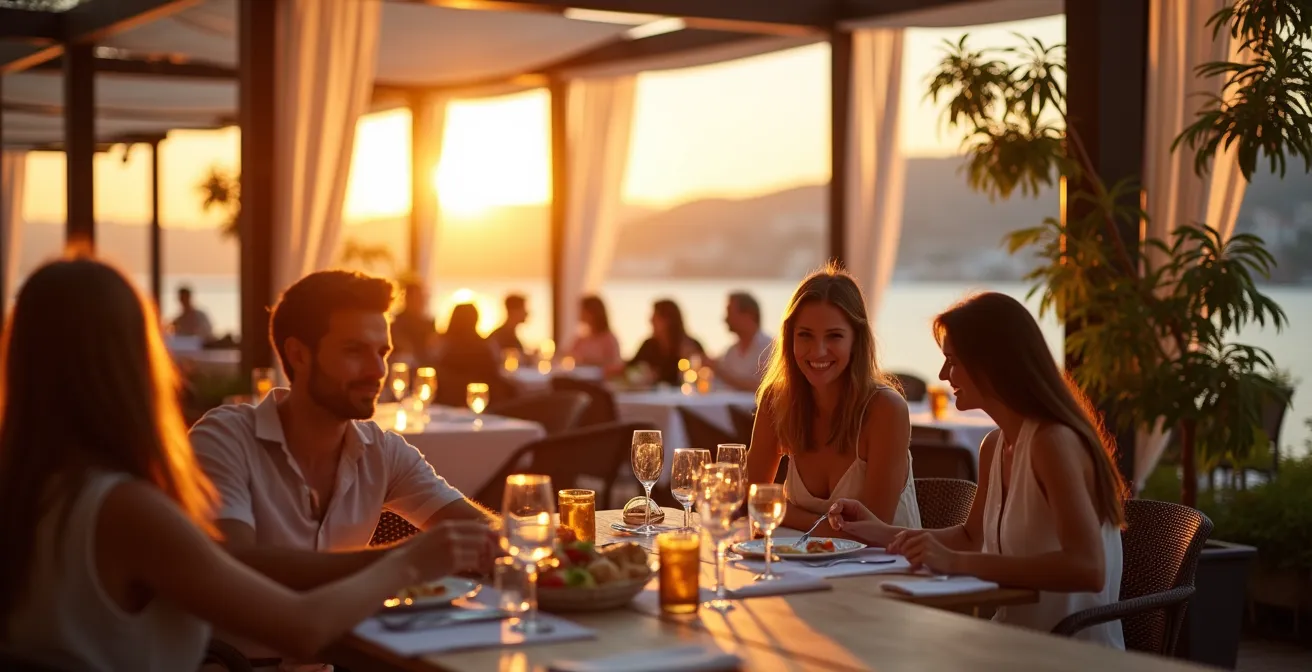
However, the most skilled observers look for exceptions to the rule. According to one chef who specializes in adapting to climate challenges, the key is finding venues with engineered or natural microclimates. These successful outdoor dining venues use strategic design, like waterfront locations that catch sea breezes or shaded courtyards with misting systems. These ‘hidden cool spots’ can remain comfortable long after other terraces have become unbearable. Learning to identify these oases is a powerful skill, demonstrating an understanding of space and environment that goes far beyond just reading a menu.
How to Eat Your Way Through a Food Festival for Under 100 AED?
Managing a budget at a food festival is the ultimate test of strategy and discipline. It’s a microcosm of resource management. Most people fail, with analysis revealing that 65% of festival-goers exceed their planned budget by 40-50 AED. They are led by impulse, falling for the ‘drink trap’ or ordering full-sized portions that limit their variety. An insider, however, approaches a festival with a clear plan. It’s not about being cheap; it’s about being smart to maximize the culinary return on investment.
The strategy involves a set of non-negotiable rules. The first is to prioritize tasting portions over full meals. This allows for greater variety and discovery. The second is the protein-first rule: allocating the bulk of your budget to more satiating protein-based items. The most common mistake is wasting money on expensive, sugary drinks; a refillable water bottle is a non-negotiable tool for the savvy festival-goer. Sharing larger, more interesting dishes with friends is another key tactic, effectively multiplying your tasting opportunities.
Perhaps the most advanced tactic is timing. Arriving an hour before closing can often lead to vendors offering discounts to clear their remaining stock. This requires patience and a bit of luck, but it’s a classic insider move. This entire exercise—of planning, prioritizing, and executing a strategy—sharpens your ability to assess value and make calculated decisions in a chaotic environment. It’s a discipline that serves you well when evaluating any dining experience, from a food truck to a fine-dining menu.
How to Join a ‘Hidden Gem’ Food Tour Without a Guide?
This is where your training becomes proactive. You’ve learned to analyze and decode. Now, you must learn to discover. Creating your own ‘hidden gem’ food tour is the bridge from understanding the public scene to uncovering the private one. It requires shifting from a passive recipient of information to an active hunter. Instead of being led, you follow the breadcrumbs left by other food lovers. This is how you find the places that aren’t in the guidebooks—and the people who frequent them.
A powerful technique is the Instagram Location Tag Method. Start with one critically acclaimed but off-the-beaten-path restaurant. Go to its location tag on Instagram. Then, explore the photos and posts from people who have tagged themselves there. What other, lesser-known spots in the immediate vicinity have they also tagged? You’re not looking for influencers; you’re looking for patterns among locals and serious foodies. This digital sleuthing can reveal clusters of beloved local spots that formal guides miss. It’s the modern-day version of asking a local, but with a much larger dataset.
Secret dining clubs operate as ‘clandestine culinary gatherings that blur the line between restaurant and private event,’ often in ‘undisclosed locations or private residences, providing a sense of exclusivity and intrigue.’
– The Gastronomy Gazette
Once you have a list of targets, the next step is to build a thematic itinerary. Focus on a single ingredient (‘The Ultimate Shawarma Quest’) or a type of cuisine. Map your stops, visit during off-peak hours for better interaction with staff, and, most importantly, ask each vendor for their personal recommendation for your *next* stop. This creates a chain of referrals built on professional respect, the very same social currency that governs the world of supper clubs.
Business Club vs Beach Club: Which Membership ROI is Higher for Networking?
Understanding exclusive spaces is the final frontier of culinary literacy. Clubs, whether for business or leisure, operate on a principle of curated access. Analyzing them teaches you about social dynamics, value propositions, and the art of the ‘soft network.’ While seemingly unrelated to food, the skills required to assess the ROI of a club membership are directly applicable to gaining access to supper clubs. Both are about understanding culture, identifying key players, and making genuine connections.
A business club offers structured events and targeted networking. A beach club offers serendipitous social encounters in a relaxed setting. Neither is inherently ‘better’; the right choice depends on your goals and personality. An insider doesn’t just look at the annual fee; they use guest passes and trial periods to assess the reality of the club’s culture. They observe member engagement, event attendance, and the quality of conversations before committing. This ‘try before you buy’ strategy is about gathering real-world data, not just believing the marketing brochure.

Just as a festival has distinct zones with different rules, so too do these social clubs. There are formal areas and casual spaces, each with its own unwritten code of conduct. Learning to navigate these environments, to switch between professional and social modes, and to build relationships authentically is a master-level skill. It’s in these spaces, over a casual drink or a shared meal, that information about more private events, like supper clubs, is often exchanged. Access is granted not to those who ask for it, but to those who have become a trusted part of the community.
Key takeaways
- Develop Culinary Literacy: True access comes from learning to read the unwritten rules, economic drivers, and social dynamics of the entire food scene.
- Signal vs. Noise: Practice distinguishing genuine quality and value from clever marketing and ‘filler’ content, whether at a festival or a fine dining restaurant.
- Active Discovery is Essential: Don’t wait to be invited. Create your own food tours and follow the trail of referrals left by other connoisseurs to uncover hidden gems.
Restaurant Week: How to Spot the ‘Filler’ Menus vs Real Deals?
Restaurant Week is the final exam in your culinary literacy course. It’s the moment where all your skills in spotting value, decoding signals, and understanding economics come together. For the average diner, it’s a chance to eat at a nice restaurant for less. For the insider, it’s a high-stakes game of separating the genuine offers from the ‘filler’ menus—cheaply-conceived dishes created specifically to hit a price point, which bear no resemblance to the restaurant’s actual quality.
Like the best secret dinners which are curated specifically for each event to be a unique experience, a quality Restaurant Week menu should be a thoughtful representation of the chef’s vision, not a compromise. The best restaurants maintain their standards by offering slightly smaller portions of their signature dishes rather than inventing new, inferior ones. Your job is to tell the difference. Vague terms like ‘Chef’s selection’ or ‘Daily special’ are major red flags. A real deal will proudly list the specific dishes you’ll be getting.
To do this systematically, you need a method. Before the event begins, you must do your homework by analyzing the regular menu. This allows you to calculate the true à la carte value of the offer and determine if the savings are substantial enough. This analytical rigor is the hallmark of a true food connoisseur.
Your Action Plan: The Restaurant Week Value Audit
- Screenshot the regular menu prices for comparison before Restaurant Week begins.
- Calculate the actual à la carte value – a genuine deal should offer a minimum of 30-40% savings.
- Check for signature dishes – at least one course on the promotional menu should be a celebrated house specialty.
- Decode vague terms – be wary of menus that use generic descriptions like ‘Chef’s selection’ or ‘fish of the day’.
- Compare portion sizes by checking recent, non-promotional Instagram posts from regular diners to spot any drastic reductions.
Stop searching and start training. Your next truly great meal isn’t on a list; it’s an experience waiting for you to prove you’re ready for it. Begin applying this framework today, and you will find that the doors to the world of secret dining will begin to open on their own.