
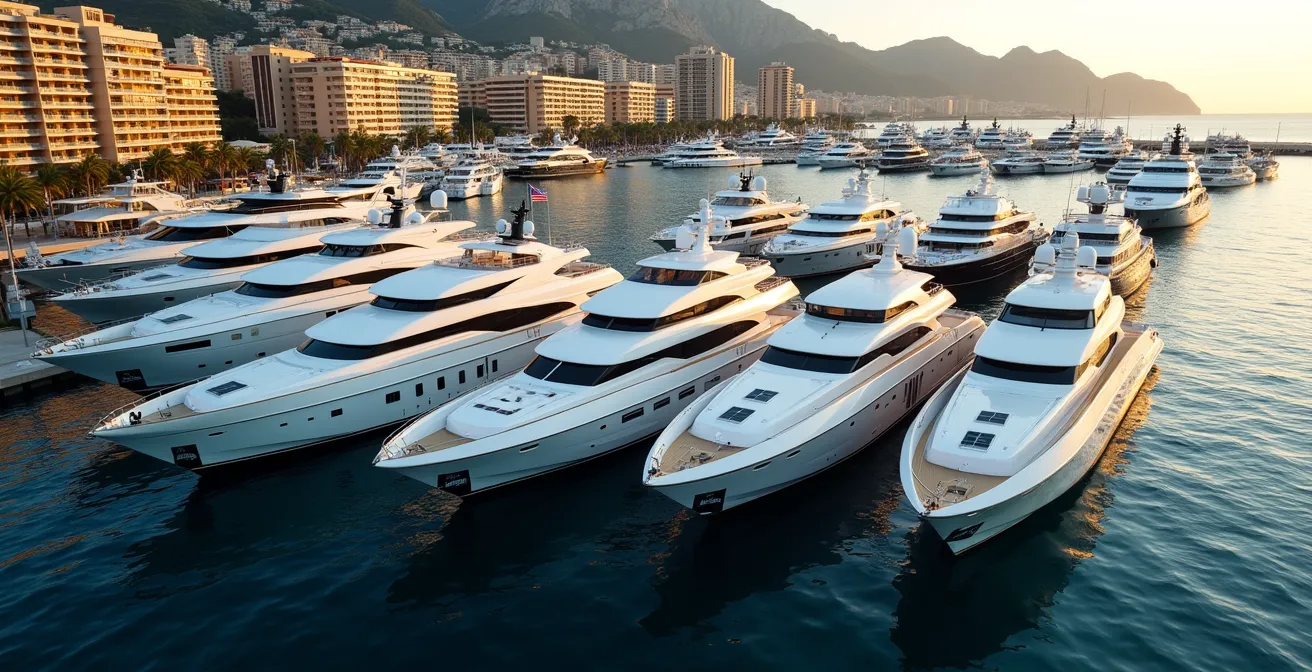
Securing a trackside superyacht for the Formula 1 weekend is less about your budget and more about mastering the hidden logistics and negotiation levers that define a successful corporate event.
- Understanding the true costs of yacht ownership gives you a powerful advantage when negotiating charter fees.
- Success lies in flawless logistical execution, from legal cross-border itineraries to implementing strict VIP service protocols.
Recommendation: Shift your focus from the sticker price to the operational details; this is where you can avoid the “event premium” and deliver an unparalleled experience.
The image is iconic: a gleaming superyacht moored trackside at the Formula 1, guests enjoying front-row seats to the world’s most glamorous sporting event. For a corporate host, it’s the ultimate statement. The common wisdom is that securing this experience is a simple, if expensive, transaction: book years in advance and have a colossal budget. This approach, however, is precisely how you end up overpaying for a logistical headache.
As a broker specializing in high-stakes event charters, I can tell you the game is far more nuanced. The real art lies not in outspending the competition, but in out-planning them. It’s about understanding the owner’s financial pressures, navigating complex regional regulations, and executing a level of service protocol that goes far beyond simply pouring champagne. The “event premium” that inflates charter prices is often a tax on poor planning.
But what if you could sidestep that premium? What if the key wasn’t a bigger budget, but smarter strategy? This playbook moves beyond the generic advice. We will dissect the financial logic of yachting, explore the critical operational details that amateurs overlook, and reveal how to orchestrate an F1 experience that is as seamless as it is spectacular. It’s time to stop being a simple buyer and start being a strategic host.
text
This guide will walk you through the insider knowledge needed to master your F1 yacht charter. Below is a summary of the key strategic pillars we will cover, from financial leverage to logistical excellence.
Summary: The Insider’s Playbook for F1 Yacht Chartering
- Buy vs Charter: At What Usage Level Does Owning a Yacht Become Logical?
- The License You Need to Captain Your Own Boat in UAE Waters
- How to Plan a 3-Day Cruise to Musandam Avoiding Border Delays?
- The Hull Issue That Tropical Water Causes Faster Than You Think
- When to Book Your New Year’s Eve Yacht to Secure a Palm View?
- How to License Your Waterfront Villa as a Holiday Home Legally?
- Do You Talk to a Limousine Driver in Dubai: Protocol for VIPs?
- How to Navigate the Maritime Borders Between UAE and Oman for a Weekend Trip?
Buy vs Charter: At What Usage Level Does Owning a Yacht Become Logical?
Before we even discuss your F1 charter, let’s establish a crucial piece of negotiation leverage: understanding the owner’s financial reality. Many clients fantasize about owning, but the numbers reveal a harsh truth. The real cost isn’t the purchase price; it’s the relentless operational expense. Financial analysts confirm that annual operating costs for a superyacht are staggering, typically representing 10-20% of the yacht’s purchase price annually. For a $10 million vessel, that’s $1-2 million per year, whether it leaves the dock or not.
This financial pressure is your advantage. Owners are not just renting their prized possession; they are often trying to offset these crippling costs. The “12-week rule” is an industry benchmark: if an owner can charter their yacht for 12 weeks a year, the revenue often just covers the annual running costs. Anything less, and they are losing money. This knowledge transforms you from a price-taker to an informed negotiator. You aren’t just chartering a boat; you are helping an owner solve a significant financial problem, and that has value.
Case Study: The Thin Margins of a Charter Yacht
The owners of a Sunseeker 105 in Florida illustrated this perfectly. After a total investment of around $3 million, they generated $1,170,000 in revenue by chartering the yacht for a busy 18 weeks. However, their annual running costs, including a $177,000 refit, totaled $1,149,100. Their net profit for the year was just over $20,000. This demonstrates that even a popular charter yacht is a business with tight margins, not a simple cash cow.
So, the logical conclusion for nearly all but those who spend several months a year at sea is clear: chartering is vastly more intelligent. You gain all the benefits of the superyacht lifestyle without the immense financial and logistical burdens of ownership.
The License You Need to Captain Your Own Boat in UAE Waters
Now that we’ve established chartering as the smart move, let’s address a common client impulse: the desire to “be the captain,” even if just for the yacht’s tender. As your broker, my advice is unequivocal: resist this urge. During the high-stakes, high-traffic F1 weekend, liability is paramount. The regulatory landscape in the UAE is a patchwork of local and federal rules, creating traps for the uninformed. Understanding this complexity reinforces why a professional, licensed crew is a non-negotiable part of your charter agreement.
The jurisdictional nuance is critical. A license issued by the Dubai Maritime City Authority (DMCA) is valid only in Dubai’s waters. Venture into Abu Dhabi for the Grand Prix, and you’re in a different jurisdiction under the Federal Transport Authority (FTA), now part of the Ministry of Energy and Infrastructure (MOEI). The requirements differ on everything from minimum age—the FTA requires applicants to be at least 16 years old for boats up to 12m—to medical certifications. Entrusting this to a professional crew isn’t just a luxury; it’s a critical risk management strategy to protect your event, your guests, and yourself.
The following table breaks down the key differences, illustrating why navigating these waters requires specialized local knowledge and is not a task for an amateur, no matter how experienced they may be elsewhere.
| Aspect | Dubai (DMCA) License | Federal (FTA/MOEI) License |
|---|---|---|
| Valid Waters | Dubai waters only | All UAE Emirates waters |
| Training Duration | 2-3 days typically | 2 days minimum |
| Medical Requirements | Medical certificate required | Medical OR valid UAE driving license |
| Vessel Size | Up to 24 meters standard | Up to 24 meters standard |
| Age Requirement | 18 years minimum | 16 years for boats up to 12m |
Ultimately, your role as host is to direct the experience, not the vessel. Leaving the helm to certified professionals ensures your focus remains on your guests, while the crew handles the complex operational and legal details seamlessly.
How to Plan a 3-Day Cruise to Musandam Avoiding Border Delays?
The F1 weekend is an adrenaline-fueled marathon of networking and entertainment. The mark of a truly exceptional host is what comes next: the “de-compression.” A three-day post-event cruise to the dramatic fjords of Musandam, Oman, is the perfect epilogue. However, this is where amateur hosts fail. A smooth maritime border crossing between the UAE and Oman is a matter of meticulous preparation, not luck. Any delay can sour the experience for your most important guests. This is an exercise in logistical arbitrage, applying the same precision to a leisure trip as we do to the F1 event itself.
The key is proactive, detailed planning. This isn’t a casual weekend trip; it’s a coordinated international movement. Documentation must be submitted weeks in advance. Passenger manifests must be flawless to avoid penalties. Using a specialized port agent who understands the nuances of the UAE-Oman route is not an extravagance; it’s a necessity. Even in our digital age, physical copies of passports are essential backups. This level of planning is what separates a seamless journey from a frustrating ordeal spent waiting for clearance.
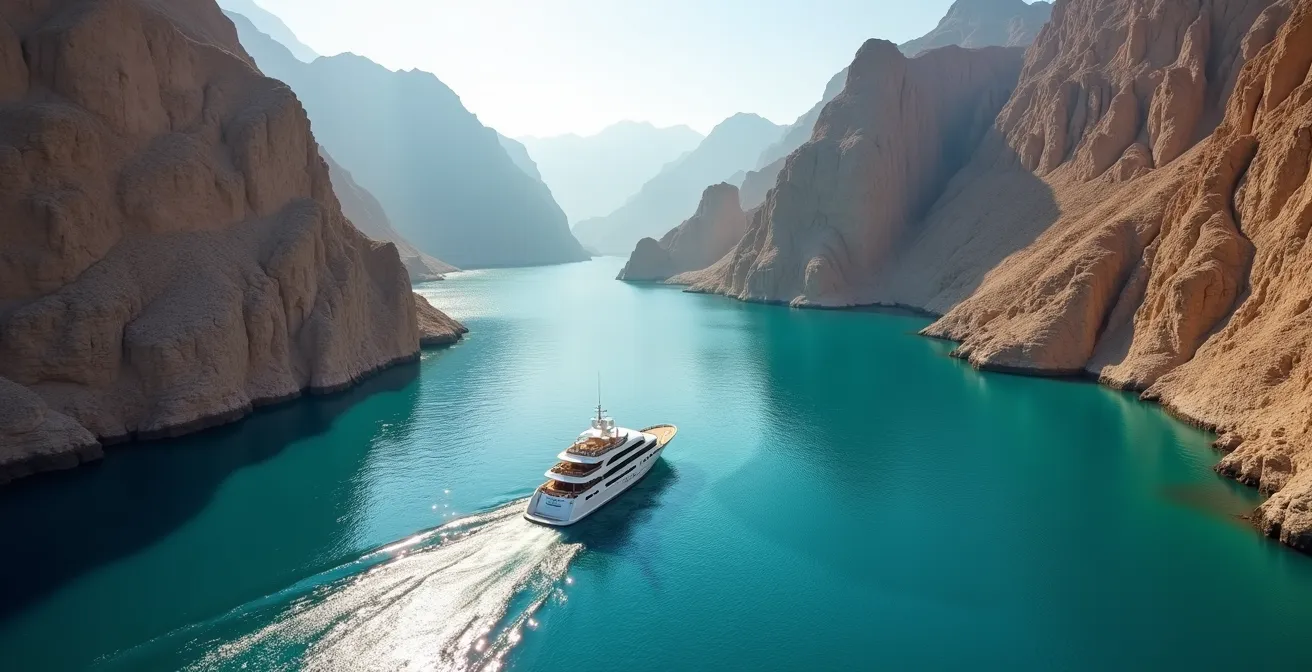
The reward for this diligence is an unforgettable experience, cruising through serene, turquoise waters flanked by towering limestone cliffs. But this serene beauty is only accessible through rigorous, behind-the-scenes work. The following checklist outlines the critical path to success.
Your Action Plan for a Seamless Musandam Escape
- Submit all vessel documentation to the relevant maritime authorities at least two weeks before your planned departure.
- Ensure every single passenger and crew member is listed on the official manifest to avoid ‘ghost rider’ penalties and delays.
- Engage a specialized port agent with proven experience in UAE-Oman pre-clearance procedures.
- Prepare a folder with physical copies of all guest passports and visas as a crucial backup to digital systems.
- Coordinate with the yacht’s management company to secure the necessary No Objection Certificate (NOC) for the charter.
- Build a buffer of 4-6 hours into your itinerary specifically for potential border processing delays.
By mastering these logistics, you transform a simple cruise into a powerful statement about your ability to deliver flawless, high-end experiences, extending the positive impression of the F1 weekend.
The Hull Issue That Tropical Water Causes Faster Than You Think
Here is a piece of deep insider knowledge that directly impacts your charter’s quality and cost. When we select a yacht for your F1 event, we are looking far beyond the jacuzzi and sun deck. We are analyzing its maintenance log, specifically its history with biofouling. Yachts operating in the warm, tropical waters of the Arabian Gulf face a significant challenge: accelerated marine growth on the hull. This isn’t just a cosmetic issue; it’s a performance and cost issue that savvy brokers watch closely.
This organic growth—algae, barnacles, and other marine life—creates drag, which increases fuel consumption and can reduce the yacht’s speed. To combat this, yachts require regular “haul-outs” for cleaning and the application of special antifouling paint. In tropical waters, this is needed far more frequently. Industry data shows that yachts here need to be hauled out every 12-18 months, compared to every 24 months in cooler, temperate waters. This accelerated maintenance cycle is a significant expense for the owner.
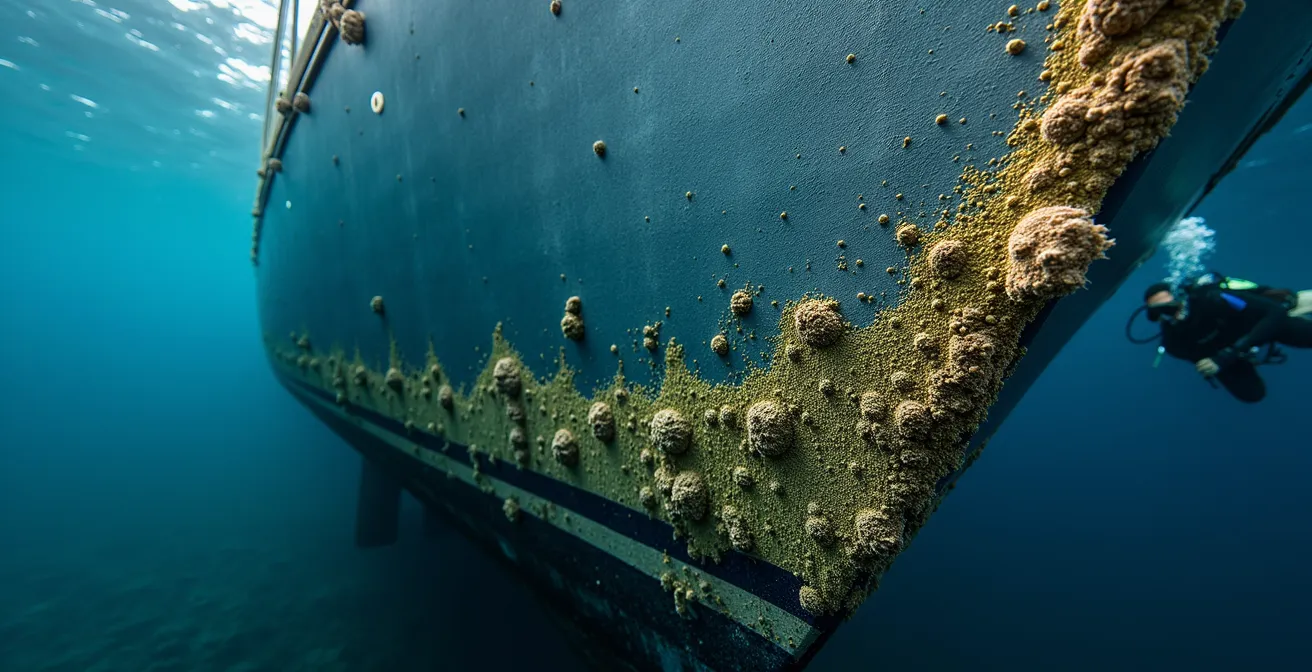
Knowing this gives us a critical data point. A yacht with a recent and consistent haul-out history is likely well-maintained and will perform as expected. One with a spotty record may be cheaper to charter, but you risk inheriting problems, from poor performance to potential mechanical issues. According to industry analysis, a 180-foot superyacht in the tropics can face minimum annual maintenance costs of $4.75 million, with hull treatments being a major factor. We select vessels where the owner has clearly invested in proper upkeep, ensuring your charter is smooth and efficient.
This focus on the unseen details is what ensures the vessel we choose for you is not just beautiful, but also a reliable, high-performance platform for your F1 event.
When to Book Your New Year’s Eve Yacht to Secure a Palm View?
To understand the urgency and strategy for securing a prime F1 trackside berth, let’s use a perfect parallel: booking a yacht for New Year’s Eve in Dubai with a view of the Palm Jumeirah fireworks. The dynamics are identical. Both are “pinnacle events” with a finite number of premium spots and an overwhelming demand. This isn’t a standard charter; it’s a high-stakes real estate play on the water, and the booking window is far smaller and earlier than most people realize.
Waiting until a few months before is a recipe for disappointment, leaving you with subpar yachts, distant locations, or exorbitant last-minute pricing. The strategic process for these events begins long before the public buzz. For the Monaco Grand Prix, a comparable event in terms of prestige and demand, the process is starkly clear. Charter brokers don’t wait for the year of the event to begin their work. Prime berths are often spoken for immediately after the previous year’s race concludes.
Industry insiders and leading charter companies are unanimous in their advice for such high-demand slots. They recommend booking prime event berths 12-18 months in advance. This is the professional standard. This timeline allows for the best selection of yachts, preferred docking locations, and, most importantly, provides leverage for negotiating terms before the peak demand frenzy kicks in. Thinking about the F1 in Abu Dhabi? The moment one race ends, the clock starts ticking for the next one.
Therefore, the conversation about your F1 charter shouldn’t start in the spring of the race year, but rather the summer of the year before. This foresight is what distinguishes a well-positioned host from one left on the sidelines.
How to License Your Waterfront Villa as a Holiday Home Legally?
The ultimate F1 hospitality strategy involves creating a seamless ecosystem for your guests, combining the excitement of a trackside yacht with the privacy and comfort of a waterfront villa. This land-sea package offers a base for shoreside meetings, private dinners, and guest accommodation, representing logistical arbitrage at its most sophisticated. However, this is an area fraught with legal risk. Many attempt to run such an operation “off the books,” exposing themselves and their guests to significant penalties and potential shutdowns by authorities.
As your broker, I advise a fully compliant approach. The key is to legally license the property as a holiday home through the appropriate local tourism authority, such as Dubai’s Department of Economy and Tourism (DET). This process transforms the villa from a private residence into a legal commercial asset for your event. This structure is essential for securing the right insurance and protecting all parties involved. You need comprehensive liability coverage that explicitly includes land-sea guest transfers, and your maritime and property insurance policies must be coordinated to eliminate any gaps.
Executing this requires careful planning and adherence to a clear set of legal and administrative checkpoints. Key steps include:
- Registering the property with the local tourism authority to obtain a holiday rental permit.
- Obtaining a No Objection Certificate (NOC) from the property developer, especially if it’s in a managed community.
- Establishing a clear legal framework that distinguishes periods of private use from commercial rental.
- Documenting and implementing strict safety protocols, particularly for features like helicopter pad access if applicable.
By taking these steps, you create a robust and fully legal hospitality environment that elevates the guest experience while completely mitigating the risks associated with non-compliance.
Do You Talk to a Limousine Driver in Dubai: Protocol for VIPs?
The VIP experience you provide at the F1 is an end-to-end service. It doesn’t start when your guest steps onto the yacht; it begins the moment they are met by a limousine at the airport. The protocol governing interactions with service staff is a subtle but critical element of high-end hospitality. For C-suite executives, celebrities, and high-net-worth individuals, privacy and discretion are the ultimate luxuries. The unwritten rule in this world is often “silent service.”
This concept, where drivers and other staff operate as “ghosts,” is designed to create a bubble of privacy. Communication is not unwelcome, but it is typically initiated by the client. All logistical requests are channeled through a single point of contact, such as a personal assistant or, on a yacht, the Chief Steward or Captain. This hierarchical structure prevents information leaks and ensures the guest is not bothered with operational minutiae. This is the exact service protocol we enforce on board, creating a consistent environment of discreet, anticipatory service from shore to sea.
Understanding these different but related service environments is key to orchestrating a truly seamless VIP experience. The table below outlines how this protocol is adapted across different luxury settings.
| Setting | Primary Contact | Communication Style | Privacy Level |
|---|---|---|---|
| Limousine Service | Personal Assistant/Security | Silent unless addressed | Maximum discretion |
| Yacht Charter | Chief Steward/Captain | Hierarchical channels | Controlled access |
| Private Jet | Lead Flight Attendant | Anticipatory service | Cabin isolation |
| Villa Service | House Manager | Scheduled interactions | Zoned privacy |
By implementing this level of service discipline across all touchpoints, you signal to your guests that their privacy and comfort are your absolute top priorities, reinforcing the premium nature of the event you are hosting.
Key Takeaways
- Negotiation Power: Understanding the high operating costs of yacht ownership gives you significant leverage in charter negotiations.
- Logistical Mastery: Seamless experiences, like a cross-border cruise, depend on meticulous advance planning and professional coordination, not luck.
- The Booking Window: For premier events like the F1, securing the best yachts and berths requires booking 12-18 months in advance.
How to Navigate the Maritime Borders Between UAE and Oman for a Weekend Trip?
We’ve discussed the strategic plan for a post-F1 Musandam cruise; now we must focus on the most critical component: the paperwork. Navigating the maritime border between the UAE and Oman is an exercise in absolute documentary precision. While the journey itself is short, the legal crossing is complex. A single missing or invalid document can lead to significant delays, turning a luxury escape into a bureaucratic nightmare. This is the granular detail that separates a professional charter operation from a risky venture.
The checklist of required documents is extensive and unforgiving. It goes far beyond just passports. The yacht’s registration and insurance must be current and valid. For instance, the Dubai Maritime Authority requires marine craft to maintain at least 13 months of insurance validity at all times. Crew licensing needs to be in order, with equivalency certificates for any foreign qualifications. A No Objection Certificate (NOC) from the sponsor is often required for expatriate crew members.
Furthermore, technical compliance is scrutinized. This includes having an approved VHF transponder, a stability booklet for yachts carrying more than 12 passengers, and environmental certificates for the engines. This is not red tape; it’s a non-negotiable part of the maritime legal framework in the region. Our job as your broker is to work with the yacht’s captain and management to ensure this entire package of documents is prepared, validated, and ready for inspection long before you set sail. This meticulous preparation is the only guarantee of a smooth passage.
To deliver a truly seamless F1 hospitality experience from start to finish, the next step is to partner with a broker who not only understands these strategic nuances but has a proven track record of executing them flawlessly. Evaluate your options and choose a partner who focuses on this level of operational excellence.