

The next wave of hotel AI isn’t just about personalization; it’s about creating a ‘Digital Twin’ of your perfect stay—a dynamic virtual model that anticipates your needs in real time.
- This model is fueled by a transparent value exchange, where sharing data unlocks unprecedented levels of proactive and tailored service.
- Success hinges on blending AI efficiency (chatbots, biometrics) with human empathy and giving guests ultimate control to avoid intrusion.
Recommendation: Embrace technologies that offer clear, tangible benefits in exchange for your data, and familiarize yourself with the platforms that give you control over your own ‘Digital Twin’ experience.
Imagine checking into a hotel where the room temperature is already set to your exact preference, the playlist quietly streaming is curated from artists you love, and a reservation has been preemptively made at a restaurant that matches your culinary tastes. This isn’t science fiction. This is the new frontier of hospitality, powered by artificial intelligence. For the tech-savvy traveler, the conversation is no longer about whether our data is being used, but how it’s being used to elevate our experiences from merely comfortable to truly extraordinary. While many hotels talk about personalization—remembering if you prefer a foam or feather pillow—this is a rudimentary first step.
The true revolution lies in a concept far more powerful: the creation of a ‘Digital Twin’ for every guest. This is not just a static profile based on past stays. It’s a living, breathing model of your ideal experience that learns and adapts in real time. It’s a predictive orchestration engine that doesn’t just react to your requests but anticipates your needs, optimizes your environment, and curates moments of delight before you even think to ask. This shift requires a new understanding of the relationship between guest and hotel, one built on a transparent value exchange where data becomes the currency for an unprecedented level of service.
This guide explores the architecture of this future. We will deconstruct how your data powers this Digital Twin, examine the balance between human and AI service, and reveal how you can leverage these systems to craft your perfect stay. We’ll also navigate the critical line between helpful and intrusive, and project forward to a world of seamless, biometric-driven experiences.
This article breaks down the essential components of this technological revolution in hospitality. Explore the sections below to understand how each piece contributes to building your ultimate, AI-powered travel experience.
Summary: The Blueprint for Your AI-Powered Hotel Stay
- Why Giving Up Some Privacy Data Can Upgrade Your Service Level?
- Chatbot vs Human Concierge: Which Solves Complex Problems Faster?
- How to Use Hyper-Personalization to Increase Client Retention by 40%?
- The Line Between Helpful and Intrusive: Mistakes Luxury Brands Make
- When Will Biometric Data Replace Your Loyalty Card Completely?
- Google Home vs Amazon Alexa vs Apple HomeKit: Which Works Best in the UAE?
- Oura Ring vs Apple Watch: Which Tracks REM Sleep More Accurately?
- How to Retrofit a Smart System in an Older Villa Without Rewiring?
Why Giving Up Some Privacy Data Can Upgrade Your Service Level?
The notion of handing over personal data often triggers privacy alarms. However, in the new era of hospitality, this is best viewed as a transparent value exchange. You are not simply giving up data; you are investing it in a superior experience. When a hotel knows your preference for a high floor, your post-workout smoothie order, or that you always request a late check-out, it can move from a reactive service model to a proactive one. This is the foundational layer of your Digital Twin—a data-driven profile that allows the hotel to anticipate and serve your needs seamlessly.
The appetite for this is clear. Hospitality industry research shows that 78% of travelers are more likely to book accommodations that offer tailored experiences. This isn’t about generic marketing emails; it’s about tangible, in-the-moment upgrades. For instance, Zoku Hotels implemented AI-driven campaigns analyzing guest data to create personalized offers for on-site amenities, generating significant revenue by offering guests things they actually wanted. The data from your restaurant choices, spa bookings, and service requests feeds the AI, which in turn crafts an experience that feels uniquely yours.
Ultimately, the goal of this data exchange is to eliminate friction and elevate your stay. It’s about ensuring your room is an oasis tailored to you, the services offered align with your lifestyle, and every interaction feels personal and effortless. The more value the hotel provides, the more willing guests are to provide the data that fuels this virtuous cycle. It’s a partnership where both sides win.
Chatbot vs Human Concierge: Which Solves Complex Problems Faster?
The modern hotel concierge desk is becoming a hybrid of human empathy and AI efficiency. A common question is which one solves problems faster. The answer depends entirely on the nature of the problem. For transactional, data-heavy, and immediate needs, the AI chatbot is unbeatable. It operates 24/7, handles countless simultaneous queries, and can process a dinner reservation or book a spa appointment in seconds. With 80% of hotels using chatbots to handle basic inquiries, they have become the frontline of guest service, freeing up their human counterparts for more complex tasks.
This is where the human concierge shines. While an AI can book a table, a human can read your subtle cues, understand you’re looking for a “quiet, romantic spot with a modern twist,” and recommend an unlisted local gem. They possess the emotional intelligence and cultural nuance that AI currently lacks. The future isn’t a choice between one or the other; it’s a seamless collaboration. The chatbot is the efficient interface for your Digital Twin, handling the logistics, while the human concierge is the curator of your experience, handling the emotion.
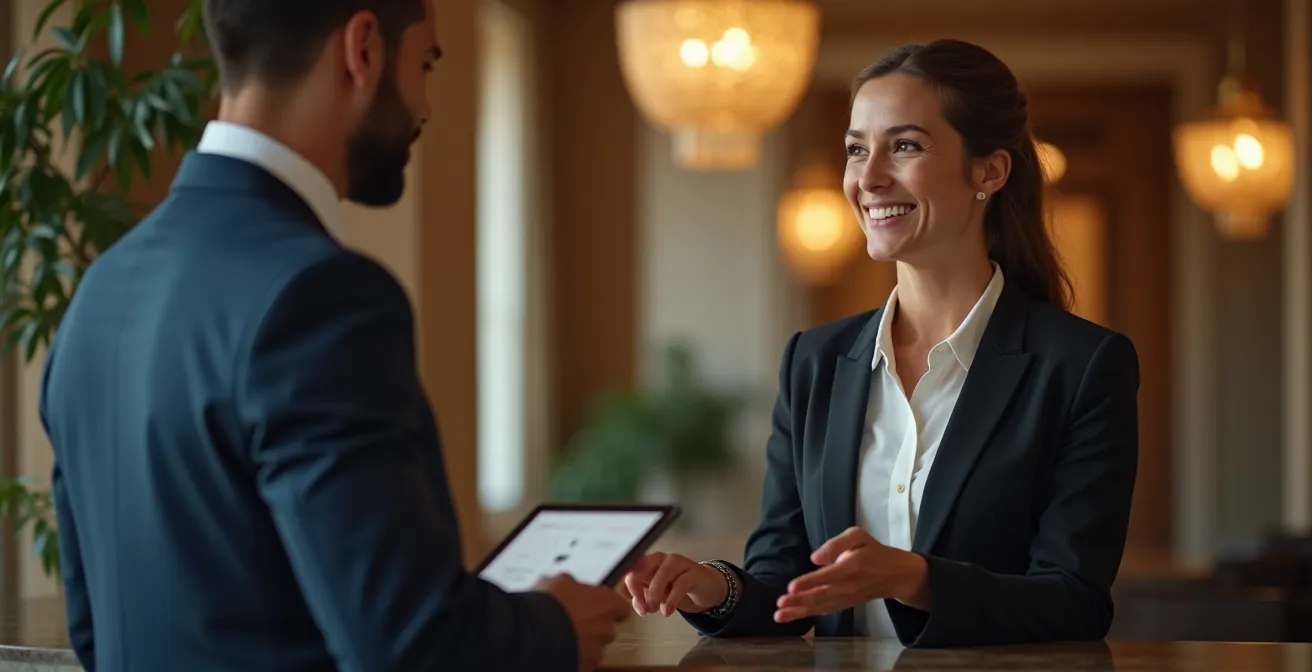
This collaborative model provides the best of both worlds. The AI handles the “what” and “when,” while the human excels at the “why” and “how.” The following table breaks down their distinct capabilities, illustrating how they complement each other to create a holistic service ecosystem.
| Capability | AI Chatbot | Human Concierge |
|---|---|---|
| Availability | 24/7 instant response | Limited hours, potential wait times |
| Handling Volume | Unlimited simultaneous queries | One guest at a time |
| Complex Logistics | Excellent for multi-step bookings | Good but slower |
| Emotional Support | Limited empathy | High emotional intelligence |
| Cultural Nuance | Programmed responses only | Deep cultural understanding |
| Problem Escalation | Requires handoff protocols | Direct resolution capability |
How to Use Hyper-Personalization to Increase Client Retention by 40%?
Hyper-personalization is the active implementation of the Digital Twin concept. It’s about using predictive orchestration to not just meet but anticipate guest needs, a strategy that fosters profound loyalty. While a survey found that 61% of hotel guests would pay more for customized experiences, only 23% report receiving them. This gap represents a massive opportunity. Hotels that close it are building more than a customer base; they are building a loyal community.
A prime example is The Arca hotel, which uses AI to analyze guest profiles from past stays. If a guest frequently requested extra pillows or a specific brand of water, the system ensures those items are already in the room upon their next arrival. This proactive approach, which is a core function of the Digital Twin, makes guests feel seen and valued. This simple but powerful method of collecting and actioning guest data has been instrumental in building loyalty and driving significant lifetime revenue. It transforms the hotel from a temporary lodging to a home away from home.
Achieving this level of service requires a strategic approach to data integration and AI implementation. It’s about creating a unified view of the guest across all touchpoints—from the initial booking to in-room service and post-stay feedback. This holistic data is what allows the AI to identify patterns and predict future desires, turning a one-time visitor into a lifelong advocate for the brand.
Action Plan: Implementing AI-Driven Hyper-Personalization
- Integrate guest touchpoints: Unify all data sources (booking, check-in, room service, spa) into a single, cohesive platform.
- Deploy AI analytics: Use machine learning algorithms to identify patterns in guest preferences and behaviors from historical data.
- Create dynamic guest profiles: Develop Digital Twins that automatically update based on real-time interactions and feedback during the stay.
- Implement predictive personalization: Use the profiles to proactively adjust room settings, offer tailored amenities, and recommend services.
- Establish real-time adjustments: Monitor guest sentiment during their stay and use AI to trigger immediate service recovery or enhancement protocols.
The Line Between Helpful and Intrusive: Mistakes Luxury Brands Make
As hotels collect more data to power a guest’s Digital Twin, they walk a fine line between providing anticipatory service and becoming intrusive. The key to staying on the right side of this line is a combination of transparency and control. A common mistake is making assumptions. Just because a guest enjoyed a particular service once doesn’t mean they want it every time. The system becomes intrusive when it removes choice and agency from the guest.
Virgin Hotels masterfully navigates this with their ‘Lucy’ mobile app. The app allows guests to control everything from room temperature and lighting to ordering room service. The system remembers preferences from past visits, but—crucially—it empowers the guest to easily modify them for their current stay. This opt-in, control-oriented approach ensures the technology serves the guest, not the other way around. The guest feels empowered, not surveilled. The personalization is a feature they control, not a background process they are subjected to.
This philosophy is perfectly captured by Karen Stephens, Revinate’s Chief Marketing Officer, on the Hotel Moment podcast, who emphasizes that the ultimate test is utility:
If it’s not delivering value to the customer, they’re not going to use it.
– Karen Stephens, Revinate Chief Marketing Officer on the Hotel Moment podcast
The lesson is clear: technology, no matter how intelligent, must always be in service of the guest’s experience and subject to their control. Intrusiveness arises from a lack of perceived value or a loss of autonomy. The most successful luxury brands use AI to present better options, not to make decisions for the guest.
When Will Biometric Data Replace Your Loyalty Card Completely?
The evolution of the Digital Twin culminates in a completely frictionless experience, and biometrics are the final frontier. Your loyalty card, room key, and credit card will all merge into one thing: you. Your face, fingerprint, or even your gait will become your unique identifier, granting you seamless access to your room and hotel services. This isn’t a distant future; it’s already being pioneered. The desire for this is growing, as a Hilton study reveals that 63% of travelers prefer digital keys to avoid queues at reception—a clear signal that guests are ready to trade physical tokens for digital convenience.
Alibaba’s FlyZoo Hotel in China offers a stunning preview of this reality. Guests can check in using facial recognition in under 30 seconds. The same biometric data grants them access to their rooms and elevators and allows them to pay for services at restaurants and the spa. This creates a completely cardless, cashless, and seamless journey throughout the property. The guest’s biometric identity becomes the master key that unlocks their hyper-personalized world, all orchestrated by their Digital Twin.
The transition will be gradual, requiring significant infrastructure investment and robust security protocols. However, the path is clear. As guest acceptance of biometric technology grows in other areas of life (like unlocking smartphones), its adoption in hospitality is inevitable. The convenience of a truly frictionless experience, where the hotel instantly recognizes you and adapts to your preferences, is too compelling to ignore. The loyalty card won’t just be replaced; the very concept will become obsolete, superseded by an identity-based system of recognition and reward.
Google Home vs Amazon Alexa vs Apple HomeKit: Which Works Best in the UAE?
The in-room voice assistant is a critical component of a hotel’s AI ecosystem, acting as a key interface to the guest’s Digital Twin. The choice between major platforms like Amazon’s Alexa, Google Assistant, and Apple’s HomeKit is a strategic one for any hotel. While the title specifies the UAE, the fundamental comparison of the platforms is global, though regional factors like Arabic language support and local service integrations would be the deciding factors for any property in that region.
Amazon has a head start with its ‘Alexa for Hospitality’ program, a dedicated platform that many major chains have adopted. Wynn Las Vegas, for example, successfully implemented Alexa across thousands of rooms, allowing guests to control room settings, request services, and get information with simple voice commands. This deployment led to a 20% reduction in call volume to the front desk and a marked increase in positive guest feedback. Google Assistant is a strong competitor, especially with its superior multi-language capabilities and support for the new ‘Matter’ smart home standard, which promises broader device compatibility. Apple’s HomeKit remains a more premium, privacy-focused option, often appealing to luxury brands that want to align with Apple’s ecosystem, though its integration can be more restrictive.
The decision for a hotel often comes down to a balance of integration ease, data ownership policies, and perceived guest familiarity. The following table highlights the key differences for hospitality applications.
| Feature | Amazon Alexa for Hospitality | Google Assistant | Apple HomeKit |
|---|---|---|---|
| Hotel Integration | Dedicated hospitality program | Limited partnerships | Premium positioning |
| Data Ownership | Shared with Amazon | Shared with Google | More privacy-focused |
| Multi-language Support | Extensive | Most comprehensive | Growing but limited |
| Room Control Integration | Wide compatibility | Matter standard support | Apple ecosystem locked |
| Guest Adoption Rate | Highest (40% familiar) | High (35% familiar) | Moderate (25% familiar) |
Oura Ring vs Apple Watch: Which Tracks REM Sleep More Accurately?
While tech enthusiasts debate the granular accuracy of sleep tracking between devices like the Oura Ring and Apple Watch, the more revolutionary question for hospitality is this: what happens when your hotel knows how well you slept? The integration of wearable health data is the next evolution of the Digital Twin, enabling a new category of service: proactive wellness. It’s no longer just about comfort, but about actively enhancing your well-being during your stay.
Imagine this scenario: your wearable device communicates to the hotel’s system that you had a restless night with little REM sleep. Your Digital Twin orchestrates a response. The blackout shades stay down a little longer, the coffee you ordered is automatically delayed by 30 minutes, and the in-room display suggests a light yoga session or a reservation at the spa for a relaxation treatment. This is hyper-contextualization in action—using real-time, personal health data to tailor the environment and services to your current physiological state.
Implementing this requires a robust and secure framework. Hotels must establish explicit opt-in consent protocols, create secure API integrations with major health platforms (like Apple Health and Google Fit), and develop automated environmental adjustments based on key metrics. The focus must be on strict data security and delivering clear value. A guest is far more likely to share this data if it results in a demonstrably better, more restorative stay. This transforms the hotel from a place to sleep into an active partner in your health and wellness journey.
Key Takeaways
- The future of hotel AI is the ‘Digital Twin,’ a dynamic model of your ideal stay that anticipates needs in real-time.
- Sharing data is a value exchange: you provide information in return for a demonstrably superior, frictionless, and personalized experience.
- The best service models blend AI’s efficiency for transactions with human empathy for complex, emotional needs, always keeping the guest in control.
How to Retrofit a Smart System in an Older Villa Without Rewiring?
The vision of a fully automated, AI-driven hotel experience might seem limited to new, purpose-built properties. However, the rise of wireless IoT technologies means this future is accessible to all, including historic villas and boutique hotels. The key is retrofitting smart systems that operate without the need for invasive and costly rewiring. This is not a niche market; analyst estimates show that AI technology in hospitality is expected to grow at 60% annually, reaching $8 billion by 2033, and much of this growth will be in upgrading existing properties.
IHG Hotels provides a powerful case study. They successfully use AI to optimize energy consumption in both new and retrofitted properties by adjusting HVAC and lighting based on real-time occupancy data. This is achieved using wireless IoT sensors and protocols like Zigbee, Z-Wave, and the emerging Matter standard, which allows devices from different brands to communicate seamlessly. These technologies allow a hotel to install smart thermostats, lighting, and sensors that communicate over a low-power wireless mesh network, all managed by a central AI hub.
This approach democratizes the smart hotel revolution. An older property can offer the same level of ambient intelligence and personalization as a futuristic new build. Guests can enjoy voice-activated controls, automated climate adjustments, and personalized lighting scenes, regardless of the building’s age. It proves that the Digital Twin concept is not contingent on architecture but on a smart, adaptable technological framework. The future of hospitality is an upgrade available to everyone.
Now that you understand the components of this AI-driven future, the next logical step is to embrace it. Seek out properties that are transparent about their technology, offer you control over your data, and deliver tangible value in return, transforming your every stay into a perfectly orchestrated experience.