
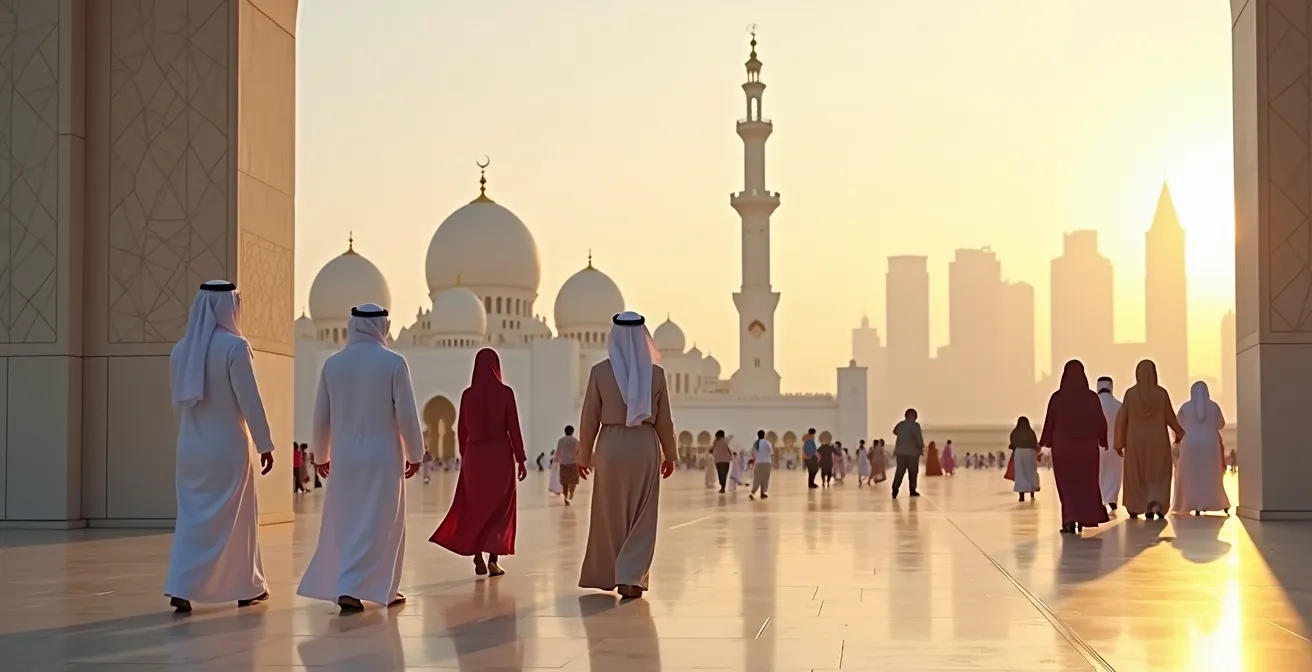
True cultural mastery in the United Arab Emirates isn’t about memorizing rules, but about understanding the ‘why’ behind the ‘what’ and navigating the nation’s diverse social contexts with intelligence.
- The most critical skill is differentiating between international “tourist bubbles” and traditional local spaces, as etiquette, especially dress code, varies significantly.
- Proactive signs of respect, such as learning conversation etiquette for a *Majlis* or understanding the ritual of serving coffee, unlock far more doors than simply avoiding prohibitions.
Recommendation: Instead of focusing only on what not to do, invest in learning the cultural logic behind Emirati traditions. This approach transforms you from a tourist into a welcomed guest, opening doors to more authentic and exclusive experiences.
For the first-time Western business traveler or luxury tourist, the United Arab Emirates presents a dazzling duality: a landscape of hyper-modern architectural wonders built upon a bedrock of deep, conservative tradition. Many online guides offer generic advice on dress codes and public behavior, but they often miss the crucial nuances that separate a smooth, successful trip from one fraught with unintentional missteps. These platitudes—”dress modestly,” “be respectful”—are correct but incomplete. They fail to equip the sophisticated visitor with the cultural intelligence needed to navigate the subtle, yet significant, shifts in protocol from a beach club in Dubai to a government office in Sharjah.
The real key to a flawless visit isn’t a checklist of prohibitions, but a deeper understanding of context. It’s about recognizing that the UAE is not a monolith; it is a federation of emirates with distinct characters. It’s about appreciating that true respect is demonstrated not just by what you avoid, but by what you proactively do—the topics you choose for conversation, the way you accept hospitality, and the awareness you bring to every interaction. This is the difference between simply visiting and truly connecting.
This guide moves beyond the basics. We will explore specific, high-stakes scenarios where cultural awareness is paramount, from the logistical challenges of the climate to the subtle etiquette of a traditional gathering. By understanding the underlying principles in these situations, you will gain the confidence to navigate any social or professional setting in the UAE with grace and assurance.
To help you master these nuances, this article is structured around key situations that demand cultural and practical awareness. The following summary outlines the critical areas we will explore, providing a roadmap for your journey into the heart of Emirati etiquette.
Summary: Mastering the Critical Nuances of a UAE Visit
- Why Visiting the UAE in August Can Ruin Your Outdoor Plans?
- Shorts or Trousers: What to Wear in Sharjah vs Dubai?
- How to Experience Traditional and Modern UAE in Just 3 Days?
- The Medication Mistake That Can Get Tourists Detained at the Airport
- Taxi or Rental Car: Which is Best for Traveling Between Abu Dhabi and Dubai?
- The Receipt Mistake That Can Cost You Double at Customs Back Home
- The Conversation Mistake That Will Get You Excluded from Majlis Gatherings
- How to Access “Money Can’t Buy” Experiences in Dubai Without a Membership?
Why Visiting the UAE in August Can Ruin Your Outdoor Plans?
The most immediate and unforgiving element of UAE life for a newcomer is the climate, especially during the peak summer months of July and August. This isn’t just a matter of discomfort; it’s a serious health and safety concern that dictates the entire rhythm of life. While a high temperature reading is expected, the real danger lies in the “wet-bulb” temperature—a measure combining heat and humidity. When this metric rises, the human body’s ability to cool itself through sweating is severely compromised. Recently, weather services reported that Dubai experienced a “feels like” temperature of 62°C, a level that makes any outdoor activity hazardous.
For the unprepared traveler, this reality can dismantle an entire itinerary. Plans for desert safaris, beach days, or exploring outdoor souks during daytime hours become not just unpleasant but physically dangerous. Even short walks between a taxi and a building can be draining. The local culture has long adapted to this reality by creating an entire ecosystem of climate-controlled environments, from sprawling indoor theme parks and ski slopes to fully air-conditioned walkways connecting metro stations to malls. Understanding this is the first step in planning a successful summer visit.
The strategic traveler adapts by adopting a “nocturnal shift.” Outdoor activities are moved to the late evening or early morning, while daytime is reserved for exploring the UAE’s world-class indoor attractions. This isn’t a compromise; it’s an intelligent alignment with the local way of life and the only way to truly enjoy the country during its harshest season. Ignoring this fundamental rule is the fastest way to turn a dream vacation into a confined, hotel-bound experience.
Shorts or Trousers: What to Wear in Sharjah vs Dubai?
The question of what to wear is perhaps the most common source of anxiety for Western visitors. The simple advice to “dress modestly” is a starting point, but it lacks the crucial element of context. The UAE is not a single entity in this regard; etiquette varies significantly between emirates and even between different zones within a single city. The key is to understand the social function of the space you are entering. Your attire at a private hotel beach in Dubai will be vastly different from what is appropriate in a government building in Sharjah.
Sharjah, for instance, holds a special status that directly impacts its dress code. As Commisceo Global notes in their guide, this emirate has a distinct cultural focus. This cultural identity translates into more conservative social norms, which are visibly reflected in public dress expectations for both residents and visitors.
In 1998 the City of Sharjah was voted the Cultural Capital of the Arab World
– Commisceo Global, UAE Language, Culture, Customs And Etiquette Guide
A helpful mental model is to think in terms of “contextual zones.” International Tourist Bubbles (resorts, beach clubs) have the most relaxed rules. Transitional Zones (malls, modern restaurants, tourist souks) are a middle ground where more coverage is expected (shoulders and knees covered is a good rule of thumb). Finally, Local/Conservative Zones (government buildings, traditional markets, residential areas, and most public spaces in Sharjah) demand the highest level of modesty, with long trousers or skirts and shirts with sleeves being required. Mastering this zoning concept is the essence of dressing with cultural intelligence.
This table breaks down the expectations, moving you from generic advice to a practical, context-aware strategy for dressing appropriately across the UAE. As this comparative analysis of dress codes shows, context is everything.
| Zone Type | Location Examples | Men’s Dress Code | Women’s Dress Code |
|---|---|---|---|
| International Tourist Bubbles | Jumeirah Beach, Hotel Pools | Shorts acceptable, swimwear at beach | Beachwear acceptable at designated areas |
| Transitional Zones | Dubai Mall, Souk Al Bahar | Long pants preferred, avoid sleeveless | Cover shoulders and knees |
| Local/Conservative Zones | Government buildings, Traditional markets in Sharjah | Long pants and shirts with sleeves required | Modest clothing covering arms and legs |
How to Experience Traditional and Modern UAE in Just 3 Days?
A short trip to the UAE, especially for business, can easily become a blur of glass towers and luxury hotels, leaving the visitor with a one-dimensional view of the country. To truly understand the Emirates, one must experience its core duality: the dynamic tension and synergy between its deep-rooted Bedouin heritage and its futuristic ambition. The most rewarding itineraries are those that intentionally weave together “Then & Now” experiences, often within the same day. This approach provides a richer, more authentic understanding than visiting historical and modern sites in isolation.
This strategy is about creating deliberate contrasts. For example, you might spend a morning at the Etihad Museum in Dubai, which chronicles the nation’s recent history and formation, followed by an afternoon journey on a traditional *abra* (water taxi) across Dubai Creek, a waterway that has been the city’s lifeblood for centuries. This juxtaposition of the formal, modern narrative with the timeless, sensory experience of the creek creates a powerful connection. The key is to look for these bridges between past and present, which are often curated by cultural institutions.

As the image above illustrates, this “Then & Now” narrative is a central theme in the UAE’s identity. It’s visible in the transition from traditional pearl diving to modern aquaculture, and from desert life to urban metropolis. By actively seeking out these juxtapositions, you move beyond simple sightseeing and begin to grasp the complex soul of the nation.
The ‘Then & Now’ Dubai Experience Strategy
The Sheikh Mohammed bin Rashid Centre for Cultural Understanding offers curated experiences pairing traditional and modern elements. Morning visits to the Etihad Museum (modern history) are followed by traditional abra rides on Dubai Creek. Contemporary art galleries in Alserkal Avenue showcase young Emirati artists reinventing tradition, while high-end restaurants like Siraj serve modernized Emirati cuisine that bridges old and new culinary traditions.
The Medication Mistake That Can Get Tourists Detained at the Airport
Of all potential cultural and legal missteps, few carry consequences as severe as arriving with unapproved medications. The UAE has a zero-tolerance policy for narcotic and psychotropic substances, and the list of controlled medicines is extensive and includes items commonly prescribed in Western countries, such as certain painkillers, antidepressants, and even over-the-counter cold remedies containing codeine. Arriving with these medications without prior approval can lead to questioning, confiscation, and in the worst-case scenario, detention and legal action. This is not a matter of cultural sensitivity but of strict federal law.
Ignorance of the law is not considered an excuse. The Emirati authorities have streamlined the process for visitors who genuinely require controlled medications, placing the responsibility squarely on the traveler to seek pre-approval. According to official guidelines, UAE regulations permit medicines to be brought in for a maximum duration of three months’ personal use, provided the correct protocol is followed. Failure to adhere to this process is seen as a serious breach.
The only way to ensure a seamless entry is by following the official protocol with meticulous care. This involves using the government’s online portal to declare your medications and obtain an approval certificate before you even pack your bags. This proactive step transforms a high-risk situation into a routine procedure, demonstrating your respect for the country’s laws and ensuring your trip begins without any issues at immigration.
Your Pre-Travel Medical Approval Checklist
- Digital Pre-Approval: Access the official UAE Ministry of Health and Prevention (MoHAP) portal to upload your prescriptions and obtain an import certificate before you travel.
- Documentation Dossier: Compile a comprehensive medical file including a doctor’s letter, your original prescriptions (dated within 3 months of travel), and your MoHAP approval certificate.
- Original Packaging Integrity: Keep all medications in their original, clearly labeled packaging. Never transfer them to other containers to avoid suspicion.
- Quantity Justification: Carry a supply of medication that logically corresponds only to the duration of your stay to prevent any misinterpretation.
- Airport Readiness: Have your complete digital and physical medical dossier organized and ready for potential inspection upon arrival to guarantee a smooth customs process.
Taxi or Rental Car: Which is Best for Traveling Between Abu Dhabi and Dubai?
For any traveler planning to visit both Abu Dhabi and Dubai, the question of inter-emirate transport is a key logistical decision. The roughly 150-kilometer journey can be approached in several ways, and the best choice depends on a balance of cost, convenience, and your itinerary’s flexibility. While the UAE has an excellent and modern road infrastructure, navigating it as a first-time visitor comes with its own set of challenges, including electronic toll systems (*Salik*), complex interchanges, and the potential for significant traffic fines.
For the business traveler or first-time luxury tourist, ride-hailing services like Uber or Careem, or a standard city taxi, often present the most stress-free option. The cost is fixed, there are no hidden fees for tolls or parking, and you can use the travel time to work or relax. The primary drawback is the lack of spontaneity; you are limited to point-to-point travel and cannot easily make impromptu stops along the way. This is a trade-off between door-to-door convenience and exploratory freedom.
Renting a car offers the ultimate flexibility to explore at your own pace, discover hidden gems between the two cities, and manage a multi-stop schedule. However, this freedom comes at a cost beyond the daily rental fee. The driver must contend with *Salik* toll charges (which rental companies often surcharge), finding and paying for parking, and navigating high-speed, dense traffic. For a sophisticated traveler looking for value and comfort without the stress of driving, the RTA’s luxury bus service offers a surprisingly compelling middle ground—it’s economical, comfortable, and eliminates all logistical hassles, albeit at the cost of a fixed schedule.
The following table provides a clear comparison to help you make an informed decision based on your specific travel priorities.
| Option | Cost Range | Advantages | Disadvantages | Best For |
|---|---|---|---|---|
| Taxi/Uber/Careem | AED 250-350 | No navigation stress, no parking hassles, avoid Salik tolls directly | Limited spontaneous exploration | Business travelers, first-time visitors |
| Rental Car | AED 100-200/day + extras | Freedom to explore, flexible schedule | Salik toll surcharges, parking fees, traffic fines risk | Experienced drivers, multi-stop trips |
| RTA Luxury Bus | AED 25-40 | Comfortable, stress-free, economical | Fixed schedule, limited stops | Budget-conscious sophisticated travelers |
The Receipt Mistake That Can Cost You Double at Customs Back Home
The UAE is a global hub for luxury shopping, and many visitors take advantage of the 5% VAT refund scheme available to tourists. Using an app like Planet Tax Free, you can easily claim back this tax on high-value purchases at the airport before departure. However, this is where a critical and costly mistake often occurs. Many travelers mistakenly believe that successfully claiming a VAT refund in the UAE absolves them of their customs declaration responsibilities in their home country. This is a dangerous and incorrect assumption.
The two tax systems are entirely separate. The UAE’s VAT refund is an incentive for tourists, while your home country’s customs duty is a tax on imported goods. When you claim a VAT refund, you are creating a clear, digitized record of your purchase. This information can, and often is, shared between international tax authorities. Failing to declare these same high-value items—such as a luxury watch, designer handbag, or expensive jewelry—upon re-entry to your home country is a major red flag for customs officials. It can lead to inspections, severe penalties, and the confiscation of your goods. In essence, trying to save 5% in Dubai could lead to you paying a far higher duty rate plus fines back home.
The savvy traveler understands this “two-tier tax trap” and practices meticulous documentation. It’s not about avoiding shopping; it’s about managing the process with transparency to ensure a smooth journey through customs on both ends of your trip. Proper receipt management is paramount.
The Two-Tier Tax Trap Scenario
Luxury shoppers in Dubai often claim VAT refunds through the Planet Tax Free system, recovering 5% on purchases. However, failing to declare these items when returning home creates a customs red flag. High-value goods like watches, jewelry, and designer bags require complete documentation including certificates of authenticity and original receipts. The Planet Tax Free app digitizes this process, creating a clear audit trail for both UAE VAT refunds and home country customs declarations.
Key takeaways
- Cultural etiquette in the UAE is highly contextual; rules for dress and behavior change dramatically between tourist zones and local spaces.
- Proactive gestures of respect, such as learning polite conversation topics and understanding the rituals of hospitality, are more impactful than simply avoiding taboos.
- Navigating legal and logistical frameworks, from medication imports to VAT refunds, requires meticulous pre-planning to avoid severe consequences.
The Conversation Mistake That Will Get You Excluded from Majlis Gatherings
For a business professional or esteemed visitor, an invitation to a *Majlis*—a traditional space for social and business gatherings—is a significant honor. It is an opportunity to build relationships in a setting that is central to Emirati culture. However, this is also where the most subtle and damaging cultural mistakes can be made. Western communication styles, which often value directness, critical inquiry, and getting straight to business, can be perceived as abrupt, intrusive, or even disrespectful in this context. The single biggest mistake is failing to adapt your conversation style to one that prioritizes relationship-building over transactional discussion.
The flow of a *Majlis* is governed by indirectness and courtesy. Business is rarely, if ever, the first topic of discussion. Instead, conversation revolves around esteemed cultural topics: the beauty of falconry, the heritage of Arabian horses, the richness of Arab poetry, and praise for the country’s development. Inquiring about family is acceptable, but only in general, respectful terms (“How is the family?”). Direct questions about a host’s wife or female relatives are strictly taboo. Even when discussing policy or business, it’s more appropriate to use indirect phrasing, such as, “I have read that the new vision is bringing great success,” rather than, “What is your opinion on the new policy?” This allows your host to engage on their own terms, without feeling put on the spot.
Even non-verbal cues are critical. Accepting the small cup of Arabic coffee is a key part of the ritual. As Fodor’s Travel Guide explains, this act is steeped in meaning.
In Emirati culture, coffee is a sign of generosity and respect and is always served hot to indicate that it was freshly prepared to welcome the guest
– Fodor’s Travel Guide, 10 Important Etiquette Rules to Follow in Dubai
You must always accept it with your right hand. When you have had enough, you gently jiggle the cup from side to side before returning it. Simply handing it back implies you want a refill. Mastering these small but powerful signals of respect demonstrates your cultural intelligence and makes you a welcome guest, paving the way for the trust upon which all business in the region is built.
How to Access “Money Can’t Buy” Experiences in Dubai Without a Membership?
Dubai is synonymous with exclusivity, from members-only clubs to invitation-only events. For the visitor without an extensive local network, accessing the city’s most authentic and unique experiences can seem impossible. However, there is a powerful currency that can open doors where money cannot: professional and cultural capital. For the sophisticated traveler, particularly one with a professional background, your expertise and genuine interest in the culture can be leveraged to create unparalleled opportunities.
This strategy is rooted in the concept of *wasta*—the influence derived from one’s personal network and connections. While a visitor may not have pre-existing *wasta*, it can be built. Instead of being a passive consumer of luxury, you can become an active participant. An architect can gain a private tour of a landmark development by engaging with the firm and offering professional insights. A tech entrepreneur can secure meetings at a local incubator through an exchange of knowledge. The key is to offer value beyond tourism. This approach shifts the dynamic from a simple transaction to a relationship of mutual interest and respect.
The gateway to these opportunities often lies in boutique establishments and specialized cultural events rather than large, impersonal international chains. A concierge at a boutique hotel with deep local roots can arrange experiences that a global chain cannot, from a private falconry demonstration with a respected handler to an invitation to a private art gallery viewing. Participating in high-end cultural or sporting events, such as polo matches or art auctions, also places you in a context where genuine connections can be forged with influential local figures.
The Professional Capital Strategy for Exclusive Access
Business professionals leverage their expertise to access exclusive experiences in Dubai. An architect gained private tours of new developments by offering professional insights, while tech entrepreneurs secured meetings at local incubators through knowledge exchange. The concept of ‘wasta’ (personal networks) remains powerful – boutique hotel concierges with deep local connections can arrange experiences that larger chains cannot, from private falconry demonstrations to invitation-only art auctions.
By moving beyond a superficial list of rules and embracing a deeper, context-aware understanding of Emirati culture, you transform your visit. You become a participant, not just an observer, equipped with the cultural intelligence to build genuine connections and navigate any situation with confidence and respect. This approach is the true key to unlocking the very best the UAE has to offer.