

High utility bills are often caused by hidden inefficiencies in your villa’s core systems, not just daily habits.
- Your AC system is likely your biggest energy drain, but its waste can be cut significantly with smart controls and regular maintenance.
- The “building envelope”—especially window seals—is a critical failure point that can secretly increase your cooling load.
Recommendation: Conduct a systematic audit of your home’s infrastructure, from cooling systems to the roof, to identify and fix these costly energy leaks.
For villa residents, the shock of a high utility bill is a familiar feeling. The immediate reaction is often to blame daily habits—longer showers, leaving lights on, or setting the AC too low. While personal conservation is important, it rarely addresses the root cause of excessive consumption. The title of this article mentions smart flow restrictors, a perfect example of a small engineering fix that yields significant, automatic water savings. However, this is just one piece of a much larger puzzle.
The most substantial waste in a large home doesn’t come from occasional lapses in behavior. It stems from deep-seated, systemic inefficiencies within the building’s infrastructure. Your HVAC system, the integrity of your window seals, the type of cooling contract you have, and even the orientation of your roof are all silent drivers of high costs. These are engineering problems that require an engineering mindset to solve. Simply trying to use less of a fundamentally wasteful system is a losing battle.
This guide shifts the focus from personal guilt to practical, system-level auditing. We will deconstruct the key areas where your villa is likely hemorrhaging energy and water. By adopting an engineer’s approach to identify and rectify these foundational flaws, you can achieve dramatic and permanent reductions in your utility bills—often without any noticeable change to your lifestyle. We’ll explore how to diagnose these hidden leaks, from your AC’s performance to your home’s power source, providing a clear roadmap to a more efficient and cost-effective home.
To navigate this comprehensive audit of your home’s efficiency, this article is structured to tackle each major system. The following summary outlines the key areas we will investigate, providing a clear path to understanding and reducing your consumption.
Summary: A Villa Owner’s Guide to Slashing Utility Bills
- District Cooling vs Chiller Free: Which System is Cheaper for Tenants?
- The Roof Constraint That Might Stop You From Installing Solar Panels
- How to Use “Off-Peak” Hours to Run High-Consumption Appliances?
- The Window Seal Failure That Doubles Your AC Load
- When to Service Your AC to Prevent Mid-Summer Breakdowns?
- Why Your AC is Wasting 30% of Energy and How Smart Thermostats Fix It?
- Solar vs Nuclear: What Powers Your Home in the Emirates?
- Why LEED Platinum Buildings Command Higher Rents Than Standard Towers?
District Cooling vs Chiller Free: Which System is Cheaper for Tenants?
In many modern developments, particularly in warmer climates, the cost of air conditioning is governed by one of two systems: District Cooling or “Chiller-Free.” Understanding the difference is critical, as it has a direct and significant impact on your monthly expenses. A “Chiller-Free” arrangement sounds appealing because the landlord covers the building’s cooling charges, meaning you have no separate AC bill. However, this cost is often factored into a higher base rent. This model typically uses less efficient, individual building chillers, leading to a greater overall environmental impact.
District Cooling, conversely, operates like a utility. A central plant generates chilled water and pipes it to multiple buildings, offering significant gains in energy efficiency and lower carbon emissions. While environmentally superior, the tenant pays for their consumption directly. These costs can be substantial, often including a fixed demand charge plus a variable consumption fee. For example, in a market like Dubai, these fees can easily add up to AED 625-800 per month for a family-sized apartment, and potentially more for a villa. The choice is often a trade-off between the visible monthly bill of district cooling and the hidden, bundled cost of a chiller-free unit.
The following table, based on common market structures, breaks down the fundamental differences for a resident. It highlights the direct vs. indirect cost structure that determines who ultimately pays for the energy consumed.
| Aspect | District Cooling | Chiller-Free |
|---|---|---|
| Monthly Cost | Variable (tenant pays) | Included in Rent (landlord pays) |
| Installation Cost | Higher upfront | Lower upfront |
| Energy Efficiency | More efficient | Less efficient |
| Environmental Impact | Lower emissions | Higher emissions |
The Roof Constraint That Might Stop You From Installing Solar Panels
Installing solar panels is one of the most effective long-term strategies for reducing your electricity bill and gaining energy independence. For a villa owner, the large, unobstructed roof seems like the perfect canvas for a solar array. However, not all roofs are created equal. Before investing, a thorough assessment of your roof’s viability is a critical engineering step. Several constraints can prevent a successful installation or severely limit its return on investment. The most significant factors include the roof’s orientation, age, shading, and material.
In the Northern Hemisphere, a south-facing roof is optimal for maximizing sun exposure throughout the day. East or west-facing roofs can still be viable but will generate less power. The age and condition of your roof are also paramount; a solar installation is designed to last over 25 years, so it should be installed on a roof with at least 10-15 years of life remaining. Installing panels on an old roof means you’ll pay twice: once for the installation, and again to remove and reinstall them when the roof needs replacing. Finally, persistent shading from nearby trees or adjacent buildings can drastically reduce a panel’s output, making the investment uneconomical. A single shaded panel can impact the performance of the entire string.
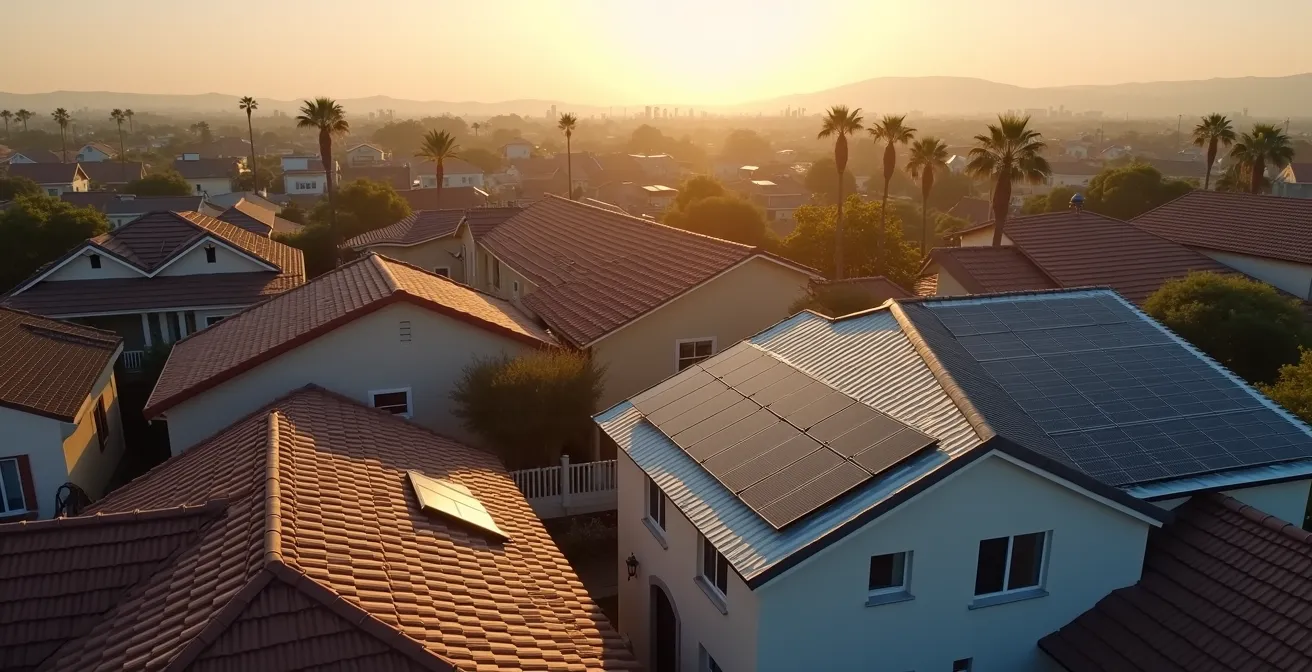
As the image above illustrates, a proper assessment involves analyzing shadow patterns and available space. A roof may seem large, but only certain areas might be suitable for optimal production. You need approximately 100 square feet of viable roof space for every kilowatt (kW) of solar capacity you plan to install.
Action Plan: Assess Your Roof’s Solar Viability
- Check Orientation: Use a compass app to determine if your primary roof surfaces face south. South-facing roofs are ideal in the Northern Hemisphere for maximum sunlight exposure.
- Evaluate Age & Condition: Review your home’s records to find the roof’s age. It should have at least 10-15 years of life left. Look for signs of wear like cracked shingles or leaks.
- Analyze Shading: Observe your roof at different times of the day (9 AM, 12 PM, 3 PM) to identify any shadows cast by trees, chimneys, or neighboring structures. Use an online solar calculator for a more detailed analysis.
- Verify Material Compatibility: Confirm your roof material is suitable. Composite shingles and standing-seam metal roofs are excellent for solar installations, while materials like slate or clay tiles can be more complex and costly to work with.
- Calculate Usable Space: Measure the dimensions of the clear, unshaded sections of your roof. You’ll need about 100 square feet of usable space per kilowatt of solar capacity desired (a typical villa might require a 5-10 kW system).
How to Use “Off-Peak” Hours to Run High-Consumption Appliances?
One of the most overlooked strategies for cost reduction is aligning your energy use with your utility’s pricing structure. Many energy providers have moved to “Time-of-Use” (TOU) rates, where electricity costs more during periods of high demand (“on-peak”) and significantly less during periods of low demand (“off-peak”). For a villa with numerous high-consumption appliances, shifting usage away from peak hours can lead to substantial savings without reducing overall consumption. This is a classic efficiency engineering tactic: optimizing timing to reduce cost.
On-peak hours typically coincide with the busiest times of the day, such as late afternoons and early evenings (e.g., 4 PM to 9 PM), when most people are home from work and using electricity. Off-peak hours are usually late at night and in the early morning (e.g., 9 PM to 7 AM) and all day on weekends and holidays. The price difference can be dramatic, with on-peak rates sometimes costing twice as much as off-peak rates. Identifying these windows is the first step to building a cost-saving schedule.
The appliances that offer the greatest savings potential are those that consume a large amount of energy but do not need to run at a specific time. This includes electric vehicle chargers, dishwashers, washing machines, dryers, and pool pumps. Instead of running your dishwasher right after dinner, you can use its delay-start feature to run it overnight. Similarly, scheduling your EV to charge only during off-peak hours can cut its charging cost in half. Modern smart home technology, like smart plugs and home automation systems, can make this process effortless by automatically scheduling these devices to operate only when electricity is cheapest.
The Window Seal Failure That Doubles Your AC Load
Your home’s windows are a primary component of its “building envelope”—the physical barrier between the conditioned interior and the outside elements. When this envelope is compromised, your HVAC system is forced to work much harder to maintain a stable indoor temperature. One of the most common and costly points of failure is the window seal. A deteriorated or broken seal creates air leaks that allow cooled air to escape in the summer and heated air to escape in the winter. This constant, invisible exchange can dramatically increase your AC’s workload and energy consumption.
According to the U.S. Department of Energy, these seemingly small gaps are a major source of waste, as air leaks can waste 10-25% of heating and cooling energy. In a villa with extensive window surfaces, this percentage translates into a significant financial loss. The problem is often insidious; you may not feel a major draft, but the cumulative effect of many small leaks is a constant strain on your AC unit. In double-pane windows, a failed seal is often indicated by condensation or fogging between the glass panes, a clear sign that the insulating gas has escaped and moisture has entered.
Conducting a simple audit of your window seals can quickly reveal these hidden energy drains. Identifying and fixing them with caulking or weatherstripping is one of the highest-return-on-investment home maintenance projects you can undertake. It directly reduces the energy load on your HVAC system, leading to immediate savings and improved comfort.
Checklist: Your DIY Window Seal Audit
- Visual Inspection: Walk around your villa, both inside and out. Look for any visible cracks, gaps, or dried, crumbling caulk around the window frames and sashes.
- Incense Test: On a cool, windy day, close all windows and doors. Light a stick of incense and hold it near the edges of your windows. If the smoke wavers or is drawn inward, you have an air leak.
- Hand Test: During periods of extreme outdoor temperatures (hot or cold), run your hand slowly around the perimeter of your window frames. You will be able to feel drafts where seals have failed.
- Condensation Check: Examine your double-pane windows for any signs of moisture, fog, or haziness trapped between the two panes of glass. This is a definitive sign of a broken seal.
- Energy Bill Analysis: Compare your heating and cooling bills from the current year to the previous year. An unexplained, steady increase in consumption can be an indicator of a degrading building envelope.
When to Service Your AC to Prevent Mid-Summer Breakdowns?
For a villa owner, the air conditioning system is not just a convenience; it’s a critical piece of infrastructure, and often the single largest consumer of electricity. Letting it run until it breaks down is a recipe for disaster—a costly emergency repair during the hottest week of the year. An engineering approach to AC ownership involves proactive, preventative maintenance designed to ensure peak performance and efficiency. Scheduling a professional service at the right time is key to preventing mid-summer failures and controlling energy costs.
The ideal time to schedule a professional AC service is in the early spring, before the peak cooling season begins. During this period, HVAC technicians are less busy, and you can get an appointment easily. A pre-season tune-up allows a professional to clean the coils, check refrigerant levels, test electrical components, and catch any potential issues before they escalate under the heavy strain of summer use. An AC unit that is running efficiently can use 15% less energy than a neglected one, translating directly into lower monthly bills.

While an annual professional inspection is crucial, there are several DIY tasks you should perform to keep the system in top shape. Regularly changing air filters is the most important, as a clogged filter restricts airflow and forces the system to work harder. Keeping the outdoor unit clear of debris ensures proper heat exchange. These simple tasks, combined with a yearly professional check-up, form a comprehensive maintenance strategy that extends the life of your unit and prevents costly, inconvenient breakdowns.
Why Your AC is Wasting 30% of Energy and How Smart Thermostats Fix It?
Even a well-maintained AC system can be a major source of energy waste if it’s not controlled intelligently. Traditional thermostats operate on a simple on/off basis, running at full power to reach a set temperature and then shutting off. They lack the ability to adapt to your actual presence in the home, meaning you are often paying to cool an empty villa. This operational inefficiency is a significant drain on your finances. A smart thermostat is the engineering solution to this problem, designed to eliminate waste by aligning cooling with your real-world behavior.
Smart thermostats use a combination of scheduling, geofencing (using your phone’s location to know when you’re home or away), and learning algorithms to optimize your AC’s runtime. Instead of maintaining a constant 22°C all day, a smart thermostat can automatically set the temperature higher when you leave and begin cooling the house just before you arrive. This prevents the system from running unnecessarily for hours on end. The impact is substantial; studies from the EPA indicate that homeowners can achieve a 23% reduction in HVAC costs by using a programmable or smart thermostat correctly.
The return on investment is typically very fast. An analysis of over 50,000 homes by Energy Star found that smart thermostats saved an average of $180 annually on heating and cooling. With the device itself costing between $150 and $250, the payback period is often just one to two years. For a large villa with multiple HVAC zones, the savings are even more pronounced. By precisely controlling the single biggest energy user in your home, a smart thermostat acts as a central command for energy efficiency, paying for itself quickly and delivering savings for years to come.
Solar vs Nuclear: What Powers Your Home in the Emirates?
While optimizing your home’s systems is crucial, the cost and carbon footprint of your energy are also determined by forces beyond your property line: your region’s energy grid. The mix of power sources used by your local utility has a direct impact on your electricity rates and environmental footprint. To understand this dynamic, the United Arab Emirates provides a fascinating case study of a nation rapidly transitioning its energy mix, balancing massive solar projects against new nuclear power.
Historically reliant on natural gas, the UAE is aggressively diversifying its grid. This strategy is driven by two landmark projects: the Mohammed bin Rashid Al Maktoum Solar Park and the Barakah Nuclear Power Plant. As a resident, the electricity powering your villa comes from a blend of these sources. Solar power, generated at the MBR Solar Park, provides cheap, clean energy during peak daylight hours. Nuclear power from Barakah, on the other hand, provides a consistent, 24/7 “baseload” of carbon-free energy, ensuring grid stability day and night. According to the UAE’s Energy Strategy 2050, the country is pushing to expand this clean energy portfolio significantly.
The table below compares these two key pillars of the UAE’s modern energy grid. For a resident, this mix means that energy consumed during the day is more likely to be solar-powered and cheaper to produce, while energy consumed at night relies on the steady output from nuclear and gas. This reinforces the financial benefit of using high-consumption appliances during the day (to leverage solar) or late at night (to leverage off-peak baseload), depending on your utility’s specific rate structure.
| Energy Source | Current Capacity | Cost per kWh | Availability |
|---|---|---|---|
| Mohammed bin Rashid Solar Park | 5,000 MW by 2030 | $0.024/kWh | Daytime peak |
| Barakah Nuclear Plant | 5,600 MW | $0.032/kWh | 24/7 baseload |
| Natural Gas | Majority of grid | Variable | On-demand |
Key Takeaways
- Your home’s infrastructure, not just your habits, is the primary driver of high utility bills.
- The “building envelope,” especially window and door seals, is a critical point of energy loss that must be audited.
- Proactive, scheduled maintenance of core systems like HVAC prevents costly failures and ensures peak efficiency.
Why LEED Platinum Buildings Command Higher Rents Than Standard Towers?
The individual efficiency measures we’ve discussed—from smart thermostats to a robust building envelope—are all components of a larger, globally recognized standard for sustainable building: LEED (Leadership in Energy and Environmental Design). When a building achieves a high level of certification, like LEED Platinum, it signifies a holistic commitment to efficiency, health, and sustainability. For property owners, this certification is not just an environmental badge of honor; it’s a powerful financial asset that translates into higher rental income and lower operating costs.
LEED-certified buildings are engineered from the ground up to be more efficient. They incorporate superior insulation, high-performance windows, water-saving fixtures, and intelligent energy management systems. This integrated design results in a building that is simply cheaper to run. A government analysis of buildings in Washington DC, for instance, found that LEED-certified properties reduced operating expenses by $2.53 per square foot and utility costs by $0.80 per square foot compared to non-certified buildings. This creates a win-win: the owner saves on common area and operational costs, while the tenant benefits from lower direct utility bills.
This proven performance and enhanced living environment allow owners to command higher rents. As Richard Barkham, CBRE’s Global Chief Economist, notes, there is a consistent and measurable “green premium.” An extensive market analysis confirmed this, finding that LEED-certified properties command 31% higher average rent than their non-certified counterparts. Tenants are willing to pay more for a space that offers lower utility bills, better air quality, and the prestige of a sustainable address. For a villa owner, implementing LEED-style upgrades not only cuts current costs but also builds long-term asset value.
The current average 4 percent premium for LEED-certified buildings is at the low end of the historical window of a 4 percent to 8 percent premium.
– Richard Barkham, CBRE Global Chief Economist
Frequently Asked Questions on Home Energy Savings
What are typical off-peak hours?
Generally, off-peak hours are from 9 PM to 7 AM on weekdays and all day on weekends and public holidays. However, this can vary significantly by utility provider, so it’s essential to check your specific Time-of-Use (TOU) rate plan.
Which appliances benefit most from off-peak scheduling?
The best candidates are high-consumption appliances that don’t need to run immediately. This includes electric vehicle chargers, water heaters, dishwashers, washing machines, and pool pumps, all of which show the greatest potential for cost savings.
Can smart home systems automate off-peak usage?
Yes, absolutely. Modern smart plugs, smart appliances, and integrated home automation systems can be programmed to automatically run devices based on your utility’s time-of-use rates, making the savings process effortless.