
True responsible travel in the UAE is not about a checklist of rules, but about understanding the direct impact of your choices on fragile ecosystems.
- Your choice between a shared or private safari has a measurable per-person carbon and land footprint.
- Activities like glamping and wildlife photography require conscious decisions to avoid disrupting delicate ecological balances and local communities.
Recommendation: Before any activity, assess its systemic impact—from water use in the desert to your physical distance from wildlife—to actively contribute to conservation rather than just minimizing harm.
The United Arab Emirates offers a landscape of staggering contrasts, from the silent, sweeping dunes of its deserts to the vital, teeming life within its coastal mangroves. For the outdoor enthusiast, the call to explore these environments is powerful. Yet, the typical advice often feels insufficient, boiling down to a simple “leave no trace” mantra that barely scratches the surface of what it means to be a responsible visitor in such a unique and often fragile part of a world.
Many guides will point you to the most popular spots or the most luxurious “eco-resorts,” but they rarely equip you with the knowledge to look deeper. They fail to explain the systemic impact of your decisions: why one safari is better than another, how your presence can unintentionally harm a recovering species, or what true respect looks like when interacting with ancient villages. The common platitudes about respecting wildlife and culture lack the practical, terrain-focused detail needed to make genuinely ethical choices on the ground.
This guide takes a different approach. The core principle isn’t just to avoid negative impact, but to make informed choices that actively support the preservation of the UAE’s natural and cultural heritage. We will move beyond the superficial to understand the “why” behind the rules. It’s about shifting your mindset from a passive tourist to an active custodian, however temporary your visit. It’s about understanding the interconnectedness of a desert ecosystem, the hydrology of a wadi, and the social fabric of a mountain village.
Throughout this article, we will examine specific scenarios an outdoor enthusiast will face. We will analyze the real-world impact of your choices, providing you with the framework to assess situations like a wilderness guide, ensuring your exploration leaves a positive legacy. This is not just about what not to do; it’s about learning how to see the environment differently and interact with it in a more meaningful, sustainable way.
This article will guide you through the critical considerations for responsible travel in the UAE’s diverse terrains. Each section addresses a specific challenge, providing the context and practical advice needed to make choices that honour the environment and local culture.
Summary: A Guide to Responsible Exploration in the UAE’s Natural Landscapes
- How to Glamp in the Desert Without Leaving a Carbon Footprint?
- The Interaction Mistake That Harms Arabian Oryx Populations
- Why You Should Avoid Wadis During the Rainy Season?
- The Ethics of Photographing Local Villages: What is Respectful?
- When to Visit the Mangroves to See Migratory Flamingos?
- How to Join Mangrove Planting Initiatives in Abu Dhabi?
- How to Spot a Safari Company That Respects the Desert Ecosystem?
- Private vs Shared Safari: Is the $200 Difference Worth It?
How to Glamp in the Desert Without Leaving a Carbon Footprint?
Glamping, or glamorous camping, offers a comfortable way to experience the desert’s stark beauty, but its convenience can mask a significant environmental toll. In a region where residential consumption is a major factor, tourist activities must be scrutinized. The reality is that luxury in an arid environment—with its demand for water, energy for cooling, and waste management—creates a substantial footprint. Even well-intentioned structures have an impact, though the use of sustainable materials can help; research shows the integration of wood within glamping yields considerable carbon sequestration, but this is only one part of the equation.
The true measure of a sustainable operation goes beyond building materials. It lies in the operator’s commitment to a circular resource model. This means prioritizing renewable energy sources like solar, implementing advanced water conservation and recycling systems, and aggressively managing waste. A truly “eco” resort isn’t just one that looks rustic; it’s one that can demonstrate a minimal drain on the desert’s scarce resources. As a visitor, your choice of where to stay is your most powerful tool. By selecting operators with verified green credentials and transparent sustainability practices, you vote with your wallet for a lower-impact model of tourism.
To make an informed decision, you must look past marketing claims and audit a potential glamping site’s real-world operations. This requires a shift from being a passive consumer to an active investigator, questioning how the facility handles its environmental responsibilities in one of the world’s most challenging climates.
Your Action Plan: Vetting a Zero-Waste Glamping Operator
- Assess energy and water systems: Inquire specifically about their use of solar energy and closed-loop water conservation systems, not just vague “eco-friendly” promises.
- Investigate waste management: Ask if they use AI-powered food waste management or have comprehensive, verifiable recycling programs that go beyond basic separation.
- Verify certifications: Look for internationally recognized accreditations like Green Globe, which require rigorous, third-party audits of sustainability practices.
- Examine infrastructure footprint: Favor properties that use self-contained, low-impact structures (like luxury tents with private pools) over those requiring extensive, permanent construction that scars the landscape.
- Evaluate commitment to conservation: Choose resorts that actively contribute to local environmental initiatives, demonstrating a stake in the long-term health of the ecosystem.
The Interaction Mistake That Harms Arabian Oryx Populations
The story of the Arabian Oryx is one of the world’s greatest conservation triumphs. Once declared extinct in the wild, dedicated reintroduction efforts have brought the population back to over 10,000. In fact, these programs were so successful it became the first animal to revert to vulnerable status after being classified as extinct. Seeing this majestic, snow-white antelope against the dunes is a profound experience, but it comes with immense responsibility. The single greatest mistake a visitor can make is attempting to get close for a better photo or to offer food.
This act, often born of admiration, is deeply harmful. First, it causes habituation, where wild animals lose their natural fear of humans and vehicles. Habituated oryx are more likely to approach roads, leading to vehicle collisions. They may also venture into agricultural areas or human settlements in search of easy food, creating conflict. Second, feeding wildlife disrupts their natural diet and can introduce diseases, weakening the very population that conservationists have worked so hard to rebuild. A wild oryx’s health depends on its ability to forage for specific desert plants, not on handouts from tourists.
The only ethical way to view Arabian Oryx is from a significant distance, using binoculars or a telephoto lens. Your goal should be to observe their natural behaviors without altering them in any way. If an oryx changes its path, stops feeding, or looks alert because of your presence, you are too close. True respect for this iconic species is not about getting a selfie; it’s about ensuring its wildness endures for generations to come.
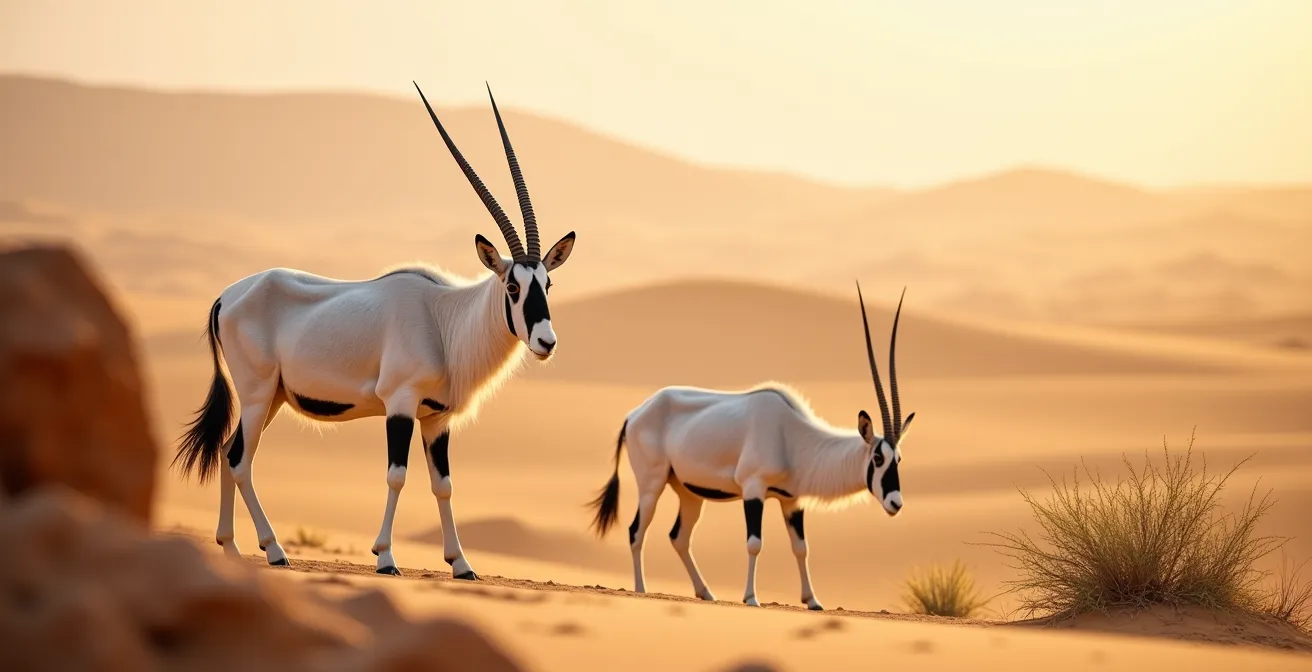
As the image demonstrates, appreciating wildlife is about seeing them thrive in their environment, undisturbed. The best encounter is one where the animal is completely unaware of your presence, allowing you to witness a truly authentic moment in the wild. This principle of non-interference is the cornerstone of ethical wildlife viewing.
Why You Should Avoid Wadis During the Rainy Season?
Wadis—dry riverbeds that carve through the mountains and desert—are tempting corridors for hiking and off-roading. For most of the year, they are serene and safe. However, during the winter rainy season (roughly November to March), they transform into one of the region’s most significant natural hazards. The danger is not just rain overhead, but rainfall happening many kilometers away in the mountains, which can send a sudden, powerful wall of water rushing down the wadi with no local warning. This is the phenomenon of a flash flood.
The arid, sun-baked ground of the UAE has a very low absorption rate. When intense rain falls, the water does not soak into the soil; it runs off a wide catchment area, channeling with incredible speed and force into the narrow confines of a wadi. The scale of these events can be immense. For instance, in April 2024, the UAE experienced an event that saw a record 254.8 mm of rainfall in some areas, the heaviest in 75 years, leading to widespread, devastating floods. Even much smaller storms can trigger lethal flash floods in localized wadis.
The risk is compounded by historical development patterns. As researchers have pointed out, many communities and roads were built in or around these natural drainage paths. According to a study in the Natural Hazards Journal, this creates a situation of high susceptibility. As the experts state:
The model identifies several urban areas and major roads at risk of flooding, a risk linked to historical development trends in arid regions where communities often develop around wadis that later become main transportation routes. These locations are particularly susceptible to runoff accumulation due to their low infiltration rates.
– Natural Hazards Journal researchers, Unprecedented rainfall in the United Arab Emirates study
For the outdoor enthusiast, the rule is simple and non-negotiable: if there is any rain in the forecast for the entire mountain region, do not enter a wadi. This includes canyons and any low-lying areas. Check the national weather service (NCM) for alerts before any trip, and never camp in a wadi during the rainy season. The serene beauty is not worth the life-threatening risk.
The Ethics of Photographing Local Villages: What is Respectful?
The traditional mountain villages of the UAE, with their stone houses and ancient irrigation systems (falaj), offer a powerful glimpse into the region’s heritage. As a photographer, capturing this beauty is a natural desire. However, these are not open-air museums; they are private homes and communities where people live their daily lives. The ethics of photography here hinge on one concept: informed consent, which goes far beyond a quick nod or a smile.
Photographing people, especially women and children, without their explicit and enthusiastic permission is a profound violation of privacy and cultural norms. Even photographing private homes or property up close can be considered intrusive. The challenge for a visitor is to capture the essence of a place without treating its inhabitants as props. This requires a fundamental shift in perspective from taking a photo to creating one collaboratively and respectfully.
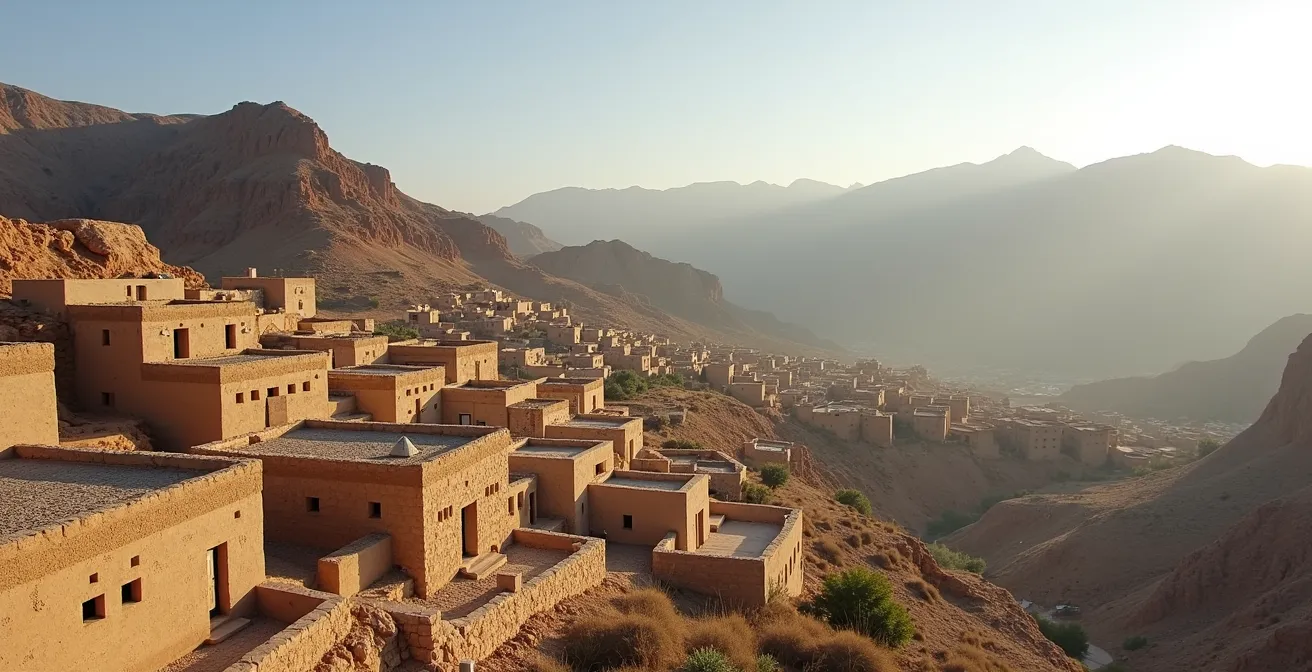
A more ethical approach often involves focusing on the relationship between the settlement and its landscape, as seen in the image above. Capturing the architecture as a whole, the patterns of the date palm farms, or the intricate stonework from a respectful distance tells a powerful story without infringing on anyone’s personal space. If you do wish to photograph a person, the “Ask, Show, Share” method is a practical framework for ethical interaction:
- Ask: Always ask for permission before you even raise your camera. Use hand gestures if there is a language barrier. A smile and a point to your camera is a universal question. If there is any hesitation, the answer is no.
- Show: Immediately after taking a picture, show it to the person on your camera’s screen. This act builds trust and gives them a chance to approve or disapprove of the image.
- Share: Ask them how they would feel about you sharing the photo. This is a crucial step. Also, a deeply respectful practice is to never geotag the specific location of small villages, which can lead to over-tourism; use a general region name instead.
Ultimately, the best guideline is empathy. Ask yourself if you would be comfortable with a stranger taking the same photo of you or your home. If the answer is no, then put the camera down.
When to Visit the Mangroves to See Migratory Flamingos?
The mangrove forests of the UAE are critical ecosystems, acting as a nursery for marine life, a filter for water, and a powerful carbon sink. For visitors, they are also a prime location for birdwatching, most notably for the Greater Flamingos that use these areas as a vital stopover and wintering ground. Seeing flocks of these vibrant pink birds against the green and blue of the mangroves is a spectacular sight, but timing is everything—and it’s governed by the tides.
Flamingos are filter-feeders, using their specialized beaks to sift for brine shrimp and other small invertebrates in shallow, saline water. Their behavior, and therefore your ability to see them, is directly linked to the water level. Understanding the tidal cycle is key to a successful and respectful viewing experience. Attempting to get closer by walking onto the mudflats is not only dangerous but also severely disturbs the feeding birds, forcing them to expend precious energy.
The conservation of these habitats is paramount. Efforts across the Emirates work to protect these sanctuaries, which are vital for numerous species beyond flamingos. As a case in point, the conservation of Khor Kalba’s mangroves has proven crucial for another vulnerable species.
Case Study: The Khor Kalba Mangrove Conservation Success
When the Khor Kalba mangrove forest was largely closed to the public over a decade ago for a major conservation project, the goal was to restore its ecological health. After extensive cleanup and nurturing, it has re-emerged as a safe sanctuary not just for birds, but also for sea turtles from the Indian Ocean. The nearby Mangrove Centre now plays a role in rehabilitating sick and injured turtles before they are returned to the wild, showcasing the interconnected benefits of protecting these coastal forests.
To best plan your flamingo-watching trip, consult a local tide chart. The following table breaks down what you can expect to see at different tide levels, allowing you to plan for the best viewing with the least disturbance.
| Tide Level | Flamingo Activity | Viewing Distance | Best Observation Method |
|---|---|---|---|
| Low Tide | Feeding on exposed mudflats | Far from shore (100-200m) | Spotting scope required |
| High Tide | Resting near shore | Close to shore (20-50m) | Binoculars sufficient |
| Mid Tide | Moving between zones | Variable (50-150m) | Binoculars recommended |
How to Join Mangrove Planting Initiatives in Abu Dhabi?
For the outdoor enthusiast looking to make a direct, positive impact, participating in a mangrove planting initiative can be a deeply rewarding experience. These projects are a cornerstone of the UAE’s strategy to bolster its “blue carbon” ecosystems—coastal habitats that are exceptionally effective at sequestering carbon. However, not all “voluntourism” opportunities are created equal. To ensure your time and effort contribute to genuine, long-term conservation, it is crucial to vet the organization you join.
A credible restoration program is about more than just putting seedlings in the mud; it’s a scientific endeavor. Effective initiatives are transparent about their methods and their metrics for success. They focus on survival rates, not just the number of trees planted, and have long-term monitoring plans to ensure the new mangroves thrive. They are also part of a larger ecological strategy, often connected to national frameworks like the Al Basma Al Beeiya (Ecological Footprint) initiative. This national campaign was born from the finding that the household sector is a significant driver of consumption, accounting for 57 percent of the country’s Ecological Footprint. Participating in a well-run planting program is a tangible way for individuals, both residents and tourists, to actively offset this footprint.
Before signing up, do your due diligence. A reputable organization will welcome your questions and be able to provide clear answers about their scientific backing, their partnerships, and their long-term vision. Your participation should support a project that is creating a resilient, lasting ecosystem, not just a temporary photo opportunity.
- Check for official partnerships: Genuine programs often collaborate with government bodies like the Environment Agency Abu Dhabi (EAD) or academic institutions.
- Inquire about monitoring: Ask about their long-term plans for monitoring the survival and growth of the mangroves you help plant.
- Verify species selection: They should be planting native mangrove species (like Avicennia marina) that are appropriate for the local environment.
- Request survival rate data: A focus on high survival rates over sheer planting numbers is a sign of a scientifically-grounded project.
How to Spot a Safari Company That Respects the Desert Ecosystem?
The desert safari is a quintessential UAE tourist experience, but its most popular component—dune bashing—can be highly destructive if done irresponsibly. Unregulated off-road driving compacts soil, destroys fragile vegetation that is slow to recover, and disrupts wildlife habitats. Choosing a safari operator is therefore not just a matter of price or comfort; it’s an environmental decision. In a country whose climate performance shows room for improvement—where the UAE receives a medium rating in Climate Policy but very low ratings for GHG Emissions and Energy Use—tourist choices can help drive demand for more sustainable practices.
A responsible safari company views the desert not as a playground, but as a living ecosystem to be preserved. Their operations reflect this ethos. Their guides are trained naturalists, not just drivers. They can educate you about the flora, fauna, and geology of the desert, turning the trip into a learning experience. They stick to designated tracks to minimize land degradation and are certified by local environmental authorities. They also maintain a respectful distance from any wildlife encountered, adhering to the principles of ethical viewing.

The visual evidence of a company’s practices is written on the sand itself. Widespread, chaotic tracks indicate a disregard for the environment, while operations confined to single, well-managed routes show respect. Furthermore, a top-tier operator often contributes to conservation. Look for companies that partner with or donate to organizations like the Dubai Desert Conservation Reserve (DDCR) or the Environment Agency Abu Dhabi. They may offer specialized “eco-safaris” that focus on nature and heritage rather than high-octane thrills. While these may come at a premium, that extra cost is an investment in the long-term health of the desert you’ve come to admire.
Before booking, ask pointed questions: Are your guides certified? Do you operate within a protected reserve? What percentage of your tour is dedicated to environmental education? Their answers will reveal whether they are truly stewards of the desert or simply exploiting it for profit.
Key Takeaways
- Informed consent is non-negotiable when photographing local people and their homes; prioritize respect over the ‘perfect shot’.
- Understanding natural cycles, like tides for flamingo viewing and rain patterns for wadi safety, is crucial for both success and survival.
- True eco-consciousness lies in an operator’s verifiable actions—like waste management and conservation partnerships—not just their marketing.
Private vs Shared Safari: Is the $200 Difference Worth It?
When booking a desert safari, you’re often faced with a choice: a seat in a shared 4×4 with five other passengers, or a private vehicle for your group, often at a significant price increase. From a purely economic standpoint, the shared option seems logical. But when viewed through the lens of environmental impact and ethical tourism, the calculation becomes more complex. The roughly $200 difference can indeed be worth it, depending on your priorities as a responsible explorer.
The most direct environmental metric is the per-person carbon footprint. A shared vehicle distributes the total emissions of the trip across six passengers, resulting in a much lower individual footprint compared to a private safari with only two. The same logic applies to the physical impact on the land; the tyre tracks and soil compaction caused by one vehicle are divided among more people. From a purely resource-efficiency perspective, the shared safari is the clear winner.
However, a private safari offers a crucial advantage that the standard shared tour cannot: customization for conservation. With a private vehicle, you have the agency to dictate the experience. You can specifically request to skip the aggressive dune bashing in favor of a slower, more observational drive focused on spotting wildlife and learning about the terrain. You can ask the guide to spend more time in a conservation area or to visit a heritage site. This transforms the trip from a standardized thrill ride into a personalized ecological and cultural tour. The higher price can be seen as paying for the privilege to dictate a more sustainable and educational itinerary.
The following table analyzes the trade-offs, helping you make a decision that aligns with your personal values as a traveler.
| Aspect | Private Safari (2 passengers) | Shared Safari (6 passengers) |
|---|---|---|
| Carbon Footprint per Person | High (100% vehicle emissions/2) | Low (100% vehicle emissions/6) |
| Land Impact per Person | High (full track impact/2) | Low (full track impact/6) |
| Customization for Conservation | High (can request eco-focused routes) | Limited (standard tourist route) |
| Wildlife Disturbance | Potentially lower (flexible timing) | Standard (fixed schedule) |
| Cost Difference | +$200 | Base price |
The choice between a shared or private safari is a microcosm of the challenge facing every responsible traveler. It requires balancing your personal experience with your impact on the environment. By applying this critical thinking to every aspect of your journey—from where you stay to what you photograph—you move beyond being a simple tourist and become a true advocate for the incredible natural landscapes of the UAE.