
In summary:
- The primary decision is between self-clearance (4-6 hours of admin) and hiring a professional agent (approx. AED 12,000).
- Ensure all documentation is printed: eVisa, vessel registration, crew list, and proof of insurance covering Omani waters.
- Adhere strictly to designated anchoring zones in Musandam to avoid heavy fines and protect sensitive marine ecosystems.
- Use the trip as a “shakedown cruise” to test all vessel systems under real-world conditions before any potential sale.
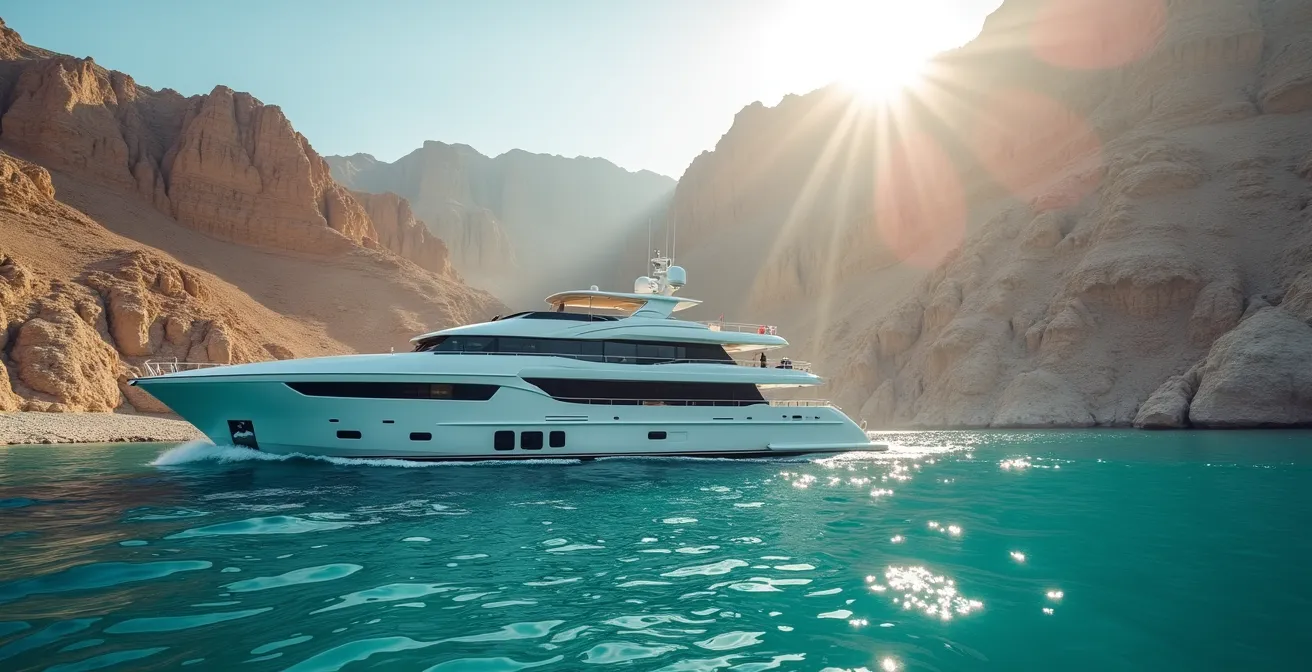
For a yacht owner based in the UAE, the call of Musandam’s dramatic fjords and pristine waters is irresistible. A weekend trip to Oman represents the pinnacle of the maritime lifestyle, a short but rewarding voyage beyond familiar coastlines. Yet, the stretch of water separating the two nations is more than just a geographical distance; it’s a firm maritime border governed by specific procedures, regulations, and potential pitfalls. Many owners are deterred by the perceived complexity of customs, immigration, and navigational rules.
Common advice often boils down to generic warnings about visas or a simplistic recommendation to “hire an agent,” which ignores the capabilities of a competent captain. This approach fails to address the core concerns of a yacht owner: operational efficiency, cost management, and regulatory compliance. The journey is not merely a pleasure cruise but a cross-border logistical operation that demands precision and foresight. True confidence comes not from delegating blindly, but from understanding the procedure itself.
This guide moves beyond the basics. We will break down the entire process from a captain’s perspective, treating your weekend voyage as a strategic mission. The key is not just knowing *what* to do, but understanding the operational logic behind each step. This framework will empower you to make informed decisions, manage the crossing with professional precision, and ensure your trip is memorable for the stunning scenery, not the bureaucratic hurdles.
From making the critical “captain vs. agent” decision to understanding the nuances of provisioning and anchoring in foreign waters, this guide provides the procedural knowledge required for a seamless and successful weekend expedition. We will cover the essential steps and strategic considerations to transform a potentially stressful crossing into a smooth and rewarding experience.
Summary: A Captain’s Procedural Guide to the UAE-Oman Crossing
- Captain vs Agency: Who Should You Hire to Manage Your Yacht Crew?
- The Stabilizer Tech That Eliminates Seasickness on Superyachts
- How to Provision a Yacht for a 3-Day Trip Without Food Spoilage?
- The Anchoring Mistake That Destroys Coral Reefs and Incurs Fines
- When is the Best Month to List Your Yacht for Sale in Dubai?
- The License You Need to Captain Your Own Boat in UAE Waters
- Fujairah vs Dubai: Where Are the Best Wrecks for Advanced Divers?
- How to Charter a Superyacht for the Formula 1 Weekend Without Overpaying?
Captain vs Agency: Who Should You Hire to Manage Your Yacht Crew?
The first strategic decision for your Musandam trip isn’t about your route, but about your clearance strategy. While the title mentions crew management, the immediate question is who will handle the crucial cross-border paperwork for everyone on board. You have two primary options: undertaking the process yourself (self-clearance) or delegating to a professional clearing agent. This choice hinges on a trade-off between time and money. A professional agent provides a turnkey solution, handling all documentation for both UAE exit and Omani entry, reducing clearance time to under two hours. However, this convenience comes at a significant cost.
According to an analysis of port formalities, using an agent is a substantial investment for a short trip. A detailed breakdown from Noonsite shows that professional services can be quite costly, noting that typical agent fees for entry of the vessel will cost around AED 12,000 (US$ 3,000). In contrast, self-clearance involves only the standard administrative fees but requires a personal investment of 4-6 hours navigating the bureaucratic processes on both sides of the border. For the hands-on captain, managing this process yourself is not only economical but also provides a deeper understanding of your vessel’s operational legalities. The following checklist outlines the core tasks you would need to execute.
Action Plan: UAE-Oman Maritime Border Crossing Checklist
- Visa and Tax Pre-Departure: Apply for the Oman eVisa online 24-48 hours in advance, which costs 5 OMR (approximately 50 AED), and prepare for the AED 30 exit tax per person for UAE departure, payable by card.
- Documentation Collation: Gather and print all required papers: valid passports for all on board, the vessel’s registration, a comprehensive crew list, and the yacht’s insurance certificate.
- Insurance Verification: Contact your insurance provider to confirm your policy covers Omani territorial waters. If not, arrange for additional coverage; a one-week extension typically costs around 200 AED.
- Agent Coordination (if applicable): If you opt for an agent, contact them at least 48 hours before your planned departure to allow sufficient time for them to prepare and file the necessary paperwork.
- Final Document Check: Before casting off, double-check that you have physical, printed copies of every required document. Digital copies may not be accepted by all authorities.
The Stabilizer Tech That Eliminates Seasickness on Superyachts
Operational readiness extends beyond paperwork to the physical comfort and safety of your vessel. The journey from the UAE to Musandam often involves crossing the Strait of Hormuz, an area known for potentially mixed sea conditions. Ensuring a comfortable ride is paramount, and modern stabilizer technology is the key to eliminating seasickness for your guests and crew. While many associate stabilizers with large superyachts, advanced systems are now viable for a wide range of vessel sizes, making them a crucial consideration for any owner who frequently travels in open waters.
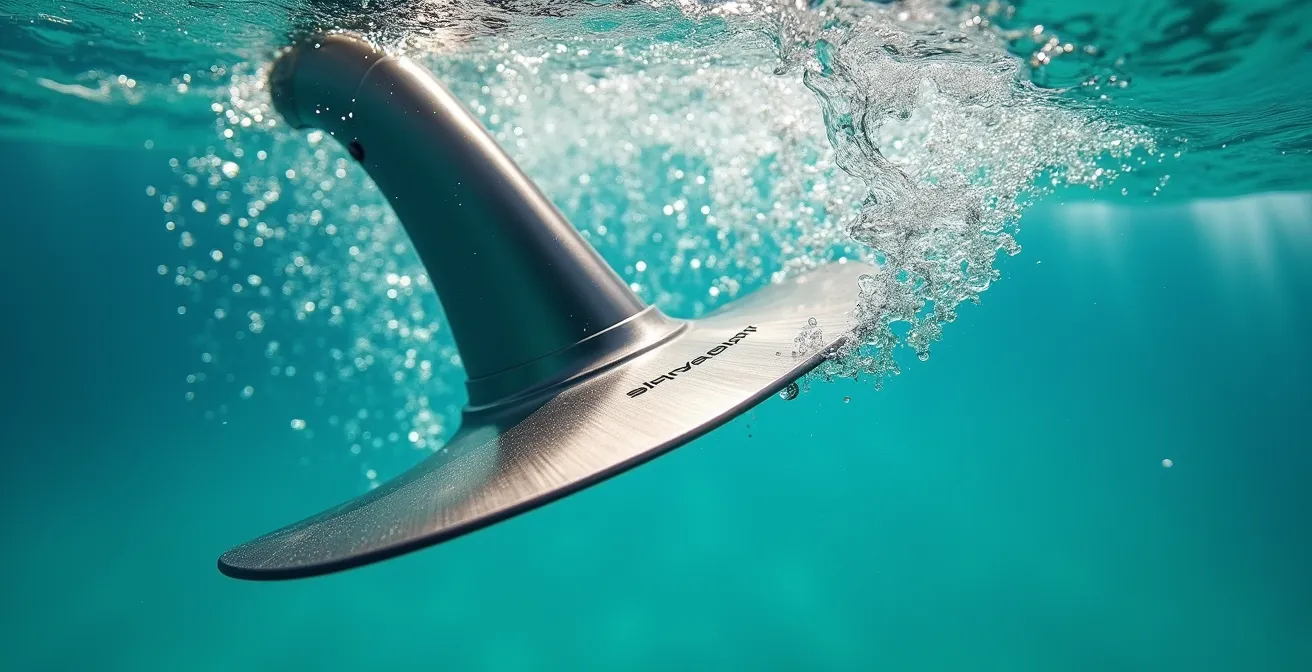
The two primary technologies are fin stabilizers and gyro stabilizers. Fins are highly effective while underway, actively counteracting roll in mixed seas. Gyros, on the other hand, excel at providing stability at anchor or at slow speeds, which is ideal for the calm, protected fjords of Musandam where you’ll likely spend considerable time. The most advanced “Zero Speed” systems combine both functionalities, offering unparalleled comfort across all operational modes. The choice depends on your yacht’s size, your primary usage patterns, and your budget.
This decision directly impacts the quality of your trip, as detailed in this comparative overview. As shown in this comprehensive look at stabilizer options, the right technology can transform the onboard experience.
| Technology | Best For | Strait of Hormuz Performance | Cost Range |
|---|---|---|---|
| Fin Stabilizers | Yachts 60ft+ | Excellent in mixed seas | $50K-200K |
| Gyro Stabilizers | At anchor/slow speed | Good for Musandam fjord anchoring | $30K-150K |
| Zero Speed Systems | Multi-speed operations | Ideal for varied conditions | $75K-250K |
How to Provision a Yacht for a 3-Day Trip Without Food Spoilage?
A successful weekend trip hinges on smart provisioning logistics. For a 3-day voyage from the UAE to Oman, the goal is to maximize culinary enjoyment while minimizing the risk of food spoilage. A purely UAE-based provisioning strategy can be risky, as fresh produce may not last the entire duration, especially in warmer months. The most effective approach is a hybrid model that combines the convenience and variety of UAE suppliers with the freshness of local Omani markets.
A strategic plan involves several key steps to ensure your galley is well-stocked and your meals are fresh throughout the journey. This includes careful planning of what to buy where, how to store it, and adhering to customs regulations. A well-thought-out provisioning list is essential:
- Bulk Stock in Dubai: Purchase all non-perishables, dry goods, and beverages in the UAE, where prices and selection are generally better.
- Alcohol Limits: Be mindful of Omani customs regulations regarding alcohol. Limit your stock to amounts clearly intended for personal consumption to avoid complications at the border.
- Fresh Local Purchases: Plan a stop at the Dibba Fish Market on your second day. This allows you to procure fresh seafood and local produce, enhancing the culinary experience.
- Meal Preparation: Pre-prepare and vacuum-seal several meals before departure. This significantly reduces cooking time onboard and is an excellent way to preserve food.
- High-Performance Cooling: Invest in a high-quality cooler with dry ice for items that need to remain frozen or deeply chilled for up to 72 hours.
This hybrid strategy is not just practical; it also enriches the cultural experience of the trip. Many seasoned cruisers have adopted this method, as it combines the best of both worlds.
The traditional Omani lunch served on board was delicious and added a nice cultural touch.
– Weekend Cruiser, TripAdvisor
The Anchoring Mistake That Destroys Coral Reefs and Incurs Fines
Once you’ve arrived in the stunning fjords of Musandam, your responsibility as a captain shifts to asset and environmental protection. The single most critical mistake a skipper can make in these pristine waters is improper anchoring. Dropping an anchor or chain on a coral reef not only causes irreversible damage to a fragile ecosystem but also carries the risk of substantial fines from Omani authorities. The seabed in many of Musandam’s most beautiful bays is a patchwork of sand and delicate coral, requiring careful selection of an anchoring spot.
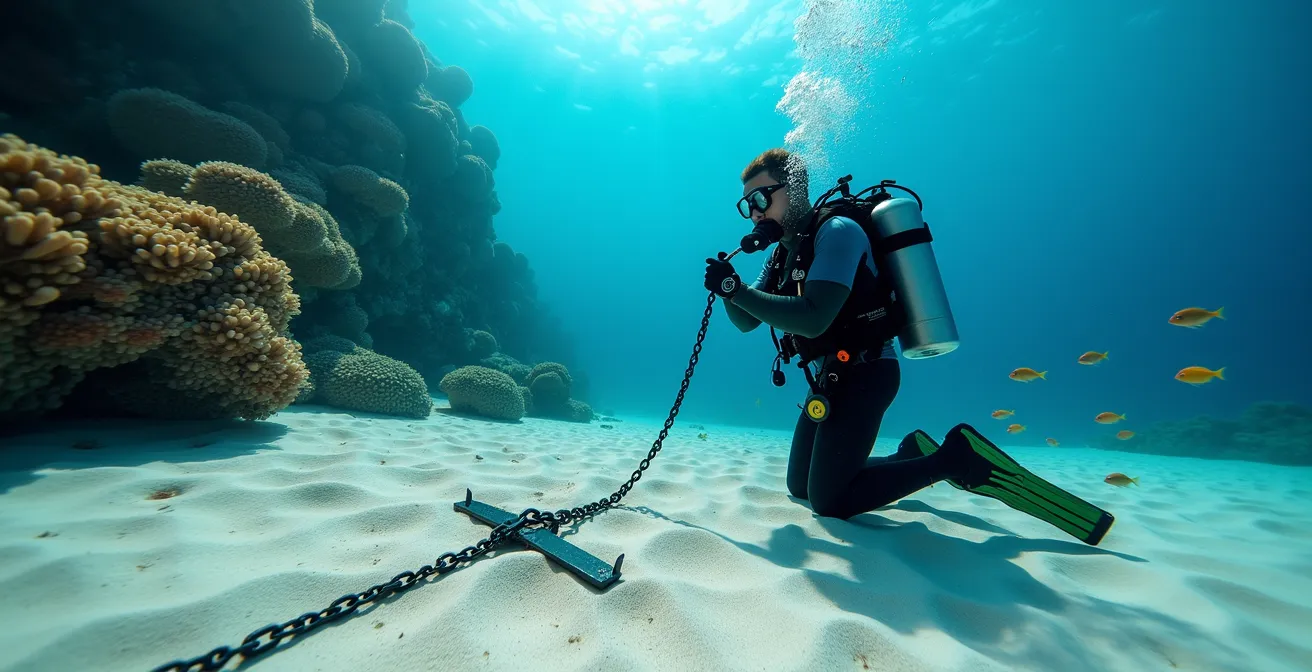
Navigational charts for the area designate specific anchorage areas and highlight marine protected areas (MPAs) where anchoring is strictly forbidden. The rule is simple: anchor only on sand. Before dropping anchor, it’s crucial to visually inspect the seabed if possible or rely on up-to-date charts and depth sounders to identify a sandy bottom. In many popular spots, mooring buoys have been installed specifically to prevent anchor damage. Using them is always the preferred and most responsible option when available.
Adherence to local anchoring regulations is non-negotiable for any visiting yacht. These rules are in place to preserve the very beauty that attracts boaters to the region. Key regulations to follow include:
- Use Designated Areas: Anchoring is only permitted in designated anchorage zones that are clearly marked on marine charts and located outside of MPAs.
- Utilize Mooring Buoys: Whenever mooring buoys are available in the Musandam fjords, they should be used to completely avoid any contact with the seabed.
- Maintain Safe Distance: Always maintain a minimum distance of 500 meters from visible coral reefs and the boundaries of marine protected areas.
- Report Position: When staying overnight in an anchorage, it is good practice to report your anchor position to the local coast guard.
When is the Best Month to List Your Yacht for Sale in Dubai?
While seemingly focused on yacht brokerage, this question holds a hidden strategic value for any yacht owner. The weekend trip to Musandam is more than just a pleasure cruise; it’s the ultimate “shakedown cruise.” It presents a perfect real-world opportunity to test every one of your vessel’s systems—from navigation and engine performance to plumbing and galley equipment—before you might ever consider listing it for sale. Identifying and resolving minor issues after a challenging, real-world trip is far more effective than relying on standard maintenance checks in the marina.
This perspective transforms the voyage into a valuable diagnostic tool. The passage through the Strait of Hormuz will test your stabilizers, the long-range navigation will test your electronics, and a weekend at anchor will test your power generation and domestic systems. A flawless trip to Oman and back is the best possible proof of your yacht’s reliability and seaworthiness. This proactive approach to vessel maintenance and testing is a core principle in professional yacht management.
Using the UAE-Oman trip as the ultimate pre-listing test to identify and resolve any latent mechanical or navigational issues
– Marine Survey Expert, Yacht Sales Strategy Guide
Therefore, the best time to think about a “listing” is right after you’ve validated your yacht’s capabilities on a demanding trip. A vessel that has just successfully completed a cross-border voyage is at its peak operational readiness and, consequently, its peak value. This mindset shifts the focus from reactive repair to proactive proving, a far more powerful position for any owner.
The License You Need to Captain Your Own Boat in UAE Waters
A common point of concern for yacht owners is the validity of their credentials in foreign waters. When planning a trip from the UAE to Oman, you must ensure both your personal and vessel documentation are in order. The primary question is whether a UAE-issued pleasure craft license is recognized for captaining your own boat in Omani territorial waters. While UAE residents can typically get a visa on arrival for a 14-day stay in Oman, the reciprocity for captain’s licenses is not always guaranteed and can change. It is imperative to contact the Omani maritime authorities or your clearing agent for the most current recognition status before your departure.
Beyond your personal license, the vessel’s paperwork is just as critical. You must have a complete portfolio of documents ready for inspection at any time. This includes the original vessel registration, an up-to-date crew list with passport details for everyone on board, and the outward clearance papers from the UAE authorities. All these documents should be printed and kept in a waterproof folder.
Finally, standard yacht insurance often does not automatically extend to neighboring countries. You must verify that your policy explicitly covers Omani territorial waters. If it doesn’t, you will need to purchase additional coverage. This can sometimes be done at the border, but it’s far safer to arrange it in advance with your provider. If purchased at the border, a policy costs approximately Dh106 for five days of basic coverage, but pre-arranging comprehensive coverage is the recommended procedure.
Fujairah vs Dubai: Where Are the Best Wrecks for Advanced Divers?
For the yacht owner who is also an advanced diver, the UAE-Oman trip offers an unparalleled opportunity to create a world-class diving itinerary. While Dubai is the starting point, the best diving is found on the East Coast and across the border in Musandam. Rather than a “Fujairah vs. Dubai” debate, the strategic captain sees it as a “Fujairah *and* Musandam” opportunity. A well-planned 3-day trip can combine the famous wrecks of Fujairah with the dramatic walls and marine life of the Omani fjords.
This approach allows you to experience two distinct underwater environments in a single voyage, maximizing the adventure for you and your guests. The itinerary becomes a key part of your passage plan, turning the journey itself into the destination.
The Ultimate UAE-Musandam Diving Itinerary
A highly effective 3-day diving itinerary begins by cruising to the UAE’s East Coast. Day 1 is dedicated to exploring Fujairah’s renowned Inchcape wrecks, offering a fantastic advanced diving experience. From there, you make the short cross-border journey into Oman. Days 2 and 3 are spent exploring Musandam’s spectacular and less-crowded dive sites, known for dramatic wall dives, underwater caves, and abundant sea life. The region is an amazing place to see, where dolphins often play and the water visibility is excellent, making it a truly memorable part of the trip.
Executing a cross-border diving trip requires specific logistical planning, particularly concerning your equipment. You must be prepared for inspections at both border crossings and ensure your gear is compliant with local regulations.
- Declare Equipment: All diving equipment, especially tanks and compressors, must be declared to customs authorities at both the UAE exit and Omani entry points.
- Safety Standards: Ensure your onboard dive compressor meets both UAE and Omani safety and certification standards.
- Carry Certifications: All divers on board must carry their certification cards and logbooks for potential inspection.
- Plan for Air Fills: If you anticipate needing air fills, pre-arrange them with a reputable dive center in Khasab to avoid delays.
- Pack Spares: Bring a kit with spare O-rings, regulators, and other essential parts to handle any minor equipment issues, as sourcing parts in remote areas can be difficult.
Key Takeaways
- Your first major decision is the clearance strategy: the high cost of a professional agent versus the significant time investment of self-clearance.
- Responsible anchoring in Musandam is not optional. Use mooring buoys or anchor exclusively on sand to avoid severe fines and protect the fragile coral reefs.
- Treat the voyage as a “shakedown cruise”—the most effective way to test your vessel’s systems in real-world conditions and confirm its operational readiness.
How to Charter a Superyacht for the Formula 1 Weekend Without Overpaying?
While you are captaining your own vessel, not chartering, the principles of avoiding peak-season pricing and congestion are directly applicable to your trip planning. High-demand periods, such as major holidays or events like the Formula 1 weekend in Abu Dhabi, create a surge in maritime traffic and can lead to crowded anchorages and strained port services, even on the East Coast and across the border in Oman. A strategic captain plans their Musandam voyage to avoid these peak times, ensuring a more serene and enjoyable experience.
Understanding the seasonal pricing and traffic patterns of the charter industry provides a valuable barometer for scheduling your private trip. The same periods that see a 100-150% surge in charter prices are the times you’ll face the most congestion at marinas, anchorages, and even with clearance authorities. Planning your trip during the shoulder seasons or regular weekends will not only be more peaceful but also more efficient from a logistical standpoint.
The following table, though designed for the charter market, offers clear guidance on the best and worst times for a private owner to undertake a UAE-Oman voyage. Choosing a “Standard” or “Discount” period is the most strategic approach.
| Period | Pricing Level | Availability | Alternative Strategy |
|---|---|---|---|
| Eid Holidays | +150% surge | Very Limited | Charter from Oman side |
| UAE National Day | +100% surge | Limited | Book 3 months ahead |
| Regular Weekends | Standard rates | Good | Last-minute deals possible |
| Summer (Jun-Aug) | -30% discount | Excellent | Best value period |
Ultimately, a successful and stress-free trip from the UAE to Musandam is the direct result of meticulous planning and a procedural mindset. By treating the voyage not as a simple getaway but as a well-managed logistical operation, you mitigate risks and enhance the experience for everyone on board. Your role as captain is to be the ultimate project manager, ensuring every detail, from paperwork and provisioning to anchoring and timing, is handled with precision. Begin by preparing your vessel and documentation using this guide to ensure your next trip to Musandam is as smooth as the waters you’ll be cruising.
Frequently Asked Questions About Navigating the Maritime Borders Between UAE and Oman for a Weekend Trip
Is a UAE Pleasure Craft License valid in Omani waters?
While UAE residents can get a visa on arrival stamped on their passport, which allows for a stay of 14 days in Oman, captain licensing reciprocity varies. It is crucial to contact Omani maritime authorities directly before your trip to confirm the current recognition status of your specific UAE license.
What vessel paperwork is required beyond the captain’s license?
You need a complete portfolio of printed documents, including the original vessel registration, a detailed crew list with passport information, proof of insurance that explicitly covers Omani waters, and the outward clearance documentation from UAE authorities before you depart.
Does standard yacht insurance cover Omani territorial waters?
Not always. You must check your policy details. If Oman is not included, you must purchase additional coverage. The minimum duration you can typically purchase is for five days, which costs approximately Dh106 for basic coverage if bought at the border, though arranging comprehensive cover in advance is recommended.